Help
Help 
Yen’s move below 155 could decide whether historic intervention succeeds
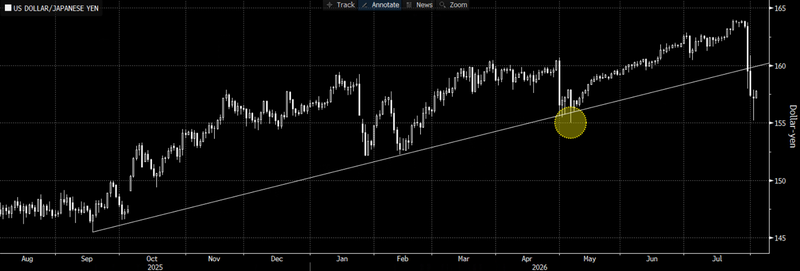
The first coordinated US-Japan yen-buying intervention since 1998 has pulled the currency sharply away from a four-decade low, but the rally now faces its most important test at 155 per dollar. A sustained break through that level could trigger a short squeeze and change trading behavior, while failure may reinforce expectations that the yen will eventually return toward 160.

Coordinated intervention lifted the yen by about 5% from a four-decade low near 164 per dollar.
The 155 level is viewed as the main test of whether the rally can become sustainable.
A clean break could accelerate the move toward 152 as bearish positions are unwound.
Wide US-Japan yield differentials could still send the dollar back toward 160–162.
The yen’s intervention rally approaches its decisive level
The historic joint intervention by Japan and the US has shifted the immediate direction of the yen, but it has yet to prove that it can change the currency’s longer-term trend.
The operation, the first coordinated yen-buying intervention by the two countries since 1998, triggered a rally of roughly 5% from a four-decade low near 164 per dollar.
Dollar-yen has since moved below its 200-day moving average near 158 for the first time since October and was trading around 157.70 during Tuesday’s Asian session.
The next major level is 155.
A sustained break below that threshold would distinguish the latest intervention from Japan’s previous operations, which temporarily pushed the exchange rate toward 155 before the dollar resumed its advance.
Failure to move beyond it could strengthen the market’s belief that official intervention can slow yen weakness without reversing the economic forces driving it.
Why 155 matters more than a technical level
The significance of 155 extends beyond chart analysis.
Previous interventions in April and May brought dollar-yen toward that area, but buyers returned before the currency could establish a durable recovery. Traders learned to treat intervention-driven declines as opportunities to buy the dollar at a cheaper level.
A clean break below 155 could disrupt that pattern.
Dollar demand may begin to weaken once investors who have been waiting to buy the pair are absorbed. Japanese exporters could also increase dollar sales if the exchange rate exits its recent range.
That would change market behavior from buying dips in dollar-yen to selling its rallies.
Such a transition would be important because sustainable currency moves usually require private flows to continue the direction initially created by official action.
Source: Bloomberg
Intervention has greater credibility with US support
Tokyo’s previous efforts faced questions over whether Japan could defend the yen alone against a strong dollar and wide interest-rate differentials.
Direct US participation has increased the credibility of the latest operation.
Both governments have signaled that they are prepared to intervene again if necessary. That raises the cost of rebuilding short-yen positions because traders now face the possibility of another coordinated operation rather than action from Japan alone.
The intervention also carries a stronger political message. Washington’s involvement suggests that excessive yen weakness has become a concern for both countries, potentially because of its effect on trade, inflation and financial stability.
But even coordinated intervention must eventually be supported by monetary and fiscal fundamentals if the yen is to sustain a larger recovery.
Crowded bearish positions create short-squeeze risk
Market positioning could magnify a move below 155.
Net short positions in the yen held by asset managers and leveraged funds have risen to their highest level since 2024.
These positions benefit when the yen weakens and dollar-yen rises. A stronger-than-expected yen can force traders to close them by buying the Japanese currency.
A break below 155 could therefore trigger a self-reinforcing short squeeze. As more investors reduce bearish positions, demand for the yen would rise, pushing dollar-yen lower and forcing additional traders to exit.
Even a partial unwinding could generate a significant move because positioning has become heavily concentrated.
Under that scenario, dollar-yen could extend its correction toward 152.
Exporter flows could reinforce the rally
Japanese corporations may also play a central role in determining whether the intervention succeeds.
Exporters typically receive revenue in foreign currencies and convert part of those earnings into yen. When dollar-yen remains within a familiar range, companies may delay conversions in the hope of securing a more favorable rate.
A decisive break below 155 could encourage them to accelerate dollar sales before the exchange rate falls further.
Institutional investors may react in a similar way by increasing currency hedges or reducing overseas exposure.
These flows could provide the organic demand needed to turn an intervention-led rally into a broader market move.
Without them, the impact of official buying may fade once central banks stop entering the market.
Wall Street remains skeptical
Many investors are still unconvinced that the yen can maintain its advance.
The main obstacle remains the interest-rate gap between the US and Japan.
If the Federal Reserve raises rates in the coming months while the Bank of Japan continues tightening only gradually, dollar-denominated assets will offer a larger yield advantage.
That encourages investors to borrow in low-yielding yen and purchase higher-yielding assets elsewhere, a strategy known as the yen carry trade.
Once the immediate threat of intervention fades, those flows could return.
Some forecasts see dollar-yen moving back toward 160–162 after official operations end, especially if the Federal Reserve adopts a more hawkish stance.
Early flows suggest momentum is already cooling
Recent market activity indicates that the initial intervention boost may be losing some strength.
Dollar-yen buying has started to recover, while leveraged funds that positioned for official intervention have taken profits and reduced tactical yen-long trades.
That does not mean the rally is over. It shows that fear of further intervention must compete with the underlying demand for dollars.
Traders may remain cautious about pushing the pair sharply higher while Tokyo and Washington are prepared to act again. But caution alone may only prevent further yen losses rather than produce a sustained recovery.
The difference between stabilization and a genuine trend reversal will become clearer around 155.
Monetary policy will determine the longer-term direction
Foreign-exchange intervention can influence prices quickly, but its effects often fade when it moves against monetary policy.
For the yen to recover significant ground, investors may need evidence that the Bank of Japan is prepared to raise interest rates at a faster pace.
Higher Japanese rates would narrow the yield gap with the US and reduce the attraction of using the yen as a funding currency.
The market will also watch the Federal Reserve closely. A US rate increase would widen the gap again and make the dollar more attractive.
This means the success of the intervention may ultimately depend less on the amount of currency bought and more on whether the two central banks’ policy paths begin to converge.
Fiscal credibility is also important
Japan’s fiscal policy could influence the yen alongside interest rates.
Investors will want reassurance that the government can support the currency without undermining confidence in public finances.
Large spending plans or weaker fiscal discipline could place upward pressure on Japanese government bond yields while raising questions over debt sustainability.
A credible fiscal framework would make it easier for the Bank of Japan to normalize policy and would strengthen confidence in the yen.
Without that support, intervention may remain a temporary defense against depreciation rather than the start of a durable recovery.
Three possible scenarios for dollar-yen
The first scenario is a sustained move below 155.
That could trigger exporter selling, reduce dollar demand and force leveraged traders to unwind short-yen positions. Dollar-yen could then move toward 152, with the intervention beginning to look like the start of a broader market shift.
The second scenario is consolidation between 155 and 160.
Fear of additional intervention could prevent the dollar from returning to its highs, while wide yield differentials limit the yen’s ability to strengthen. This would leave the currency trapped in a range while investors wait for central-bank decisions.
The third scenario is a renewed move toward 160–162.
That would become more likely if the Fed raises rates, the Bank of Japan remains cautious and official intervention stops. A failure to break 155 could also convince traders that the authorities have exhausted their most effective options.