Help
Help 
Yen bears are testing Tokyo again as policy and politics pull in opposite directions
Yen’s post-intervention rebound is fading, and investors are beginning to challenge Tokyo’s resolve once again. After the coordinated action by Japan and the United States in July, markets initially pulled back from aggressive short-yen positions. That caution is now disappearing. So far in August, the yen has been the only major G10 currency to weaken against the dollar, a sign that traders are rebuilding positions that had been reduced after the intervention.
If the United States decides that excessive yen weakness is becoming a broader financial problem.
The difficulty is that the Bank of Japan is unlikely to provide immediate support
BoJ is moving toward tighter monetary policy while influential political voices are arguing for continued fiscal support.
Why investors are rebuilding short-yen positions
Part of the confidence behind the renewed selling reflects a growing view that Japan may be approaching the practical limits of intervention under its IMF free-floating exchange-rate framework.
That assumption may be too strong
An IMF classification is not a hard barrier that prevents further intervention. Japan could choose to act again even if doing so raises questions about how its exchange-rate regime is described internationally.
Recent history suggests that U.S. preferences may matter more than IMF terminology. During periods of heightened economic tension, Washington’s policy priorities have often carried greater weight than formal classifications.
If the United States decides that excessive yen weakness is becoming a broader financial problem, markets may have to pay closer attention to that signal than to the label attached to Japan’s exchange-rate system.
Credibility is now part of the story
For Tokyo, the stakes have increased since the July intervention. Allowing the entire post-intervention rally to disappear would risk creating the impression that officials can slow the move but cannot change market behavior. That would make future interventions less effective and could encourage investors to push USD/JPY higher again.
The difficulty is that the Bank of Japan is unlikely to provide immediate support
The next policy meeting is still weeks away, and with U.S.-Japan yield differentials remaining exceptionally wide, a single rate increase would probably not be enough to alter the broader direction of the currency. Markets increasingly appear to be looking for a clearer path toward significantly higher Japanese interest rates rather than another small adjustment.
The BOJ is sounding more determined
At the same time, the tone from the Bank of Japan has become noticeably firmer. Investors are increasingly treating another rate hike as a serious possibility, with market pricing implying roughly a 78% probability of additional tightening. Japanese government bond yields have moved higher as traders reassess how far the BOJ may ultimately be willing to normalize policy.
This has turned the currency debate into a political one as well. A weaker yen helps some exporters, but higher interest rates raise borrowing costs and increase pressure on the government’s fiscal position.
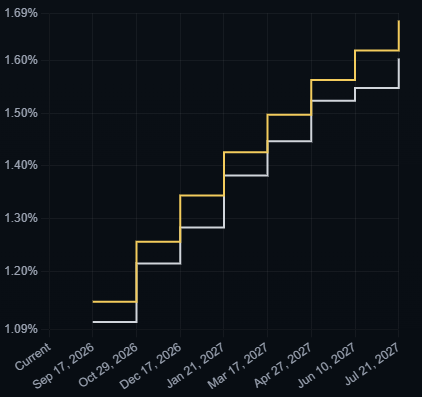
Source: Rate probability
Politics is pulling in the opposite direction
That tension is becoming more visible around Sanae Takaichi, whose camp has been emphasizing expansionary fiscal policy and consumption-tax relief to support domestic demand.
Her advisers have also warned against an overly aggressive reduction of the BOJ’s balance sheet, arguing that tightening financial conditions too quickly could undermine the recovery.
The result is an increasingly unusual policy mix: the central bank is moving toward tighter monetary policy while influential political voices are arguing for continued fiscal support.
What could bring Washington back in?
The next phase may depend less on Japan than on the United States. If Treasury yields continue to rise while the yen weakens further, Washington could become uncomfortable with the combination of tighter global financial conditions and renewed pressure on the Japanese currency.
A renewed intervention would matter more if it involved direct dollar selling rather than the type of broader currency operations seen previously. That would send a much stronger message to investors who remain heavily positioned against the yen.
For now, the market is testing whether Tokyo’s determination extends beyond one intervention. The answer will depend on three things: how quickly USD/JPY climbs, whether the BOJ follows through on the increasingly hawkish signals, and whether Washington decides that another bout of yen weakness has become a problem worth confronting again.