
 Help
AMD beats expectations as US job openings rise and RBA hikes rates
AMD exceeded expectations with robust third-quarter revenue and EPS growth, whilst US job openings rose unexpectedly and the Reserve Bank of Australia (RBA) raised interest rates to combat persistent inflationary pressures across Australia.

AMD reported third-quarter revenue of $13.38bn (+45% YoY) and non-GAAP EPS of $2.09 (+74% YoY), driving a 7% surge in after-hours trading.
AMD's Data Centre segment revenue surged 97% YoY, underpinning operating margin
US JOLTS job openings increased to 7.523 million in September, outperforming market expectations of 7.1 million.
The Reserve Bank of Australia raised its cash rate target by 25 basis points to 4.85% to curb persistent 4.3% headline inflation.
Date: 4 November 2026 (GMT+3)
AMD exceeds analysts' revenue and EPS estimates, driving shares higher after hours
Advanced Micro Devices (AMD) delivered solid financial results in its Q3 earnings release, surpassing market expectations for both total revenue and earnings per share (EPS).
The semiconductor giant reported revenue of $13.38 billion, exceeding the consensus estimate of $13.10 billion. Diluted non-GAAP earnings per share reached $2.09, outperforming the $1.95 anticipated by analysts. These results reflect a year-over-year (YoY) revenue growth rate of 45% alongside a 74% annual surge in EPS.
This performance was primarily propelled by substantial expansion in the Data Centre segment, which surged 97% YoY, accompanied by a 29% increase in the Embedded segment. Conversely, the Client & Gaming segment contracted slightly by 8%.
Additionally, operating income advanced by 75% YoY, expanding operating margins from 24% in Q3 2025 to 29% in Q3 2026. These metrics highlight strengthening operational performance, providing crucial support for equity valuations at a time when market participants are scrutinising capital expenditure sustainability and evaluating operational returns on technology investments.
In post-market trading, AMD shares appreciated by approximately 7%, buoyed by the company's strong top-line momentum and operational delivery.
US JOLTS job openings surge past market expectations
According to data published by the US Bureau of Labour Statistics (BLS), JOLTS job openings rose by 333,000 to 7.523 million in September, defying consensus forecasts that had anticipated a modest decline to 7.1 million. Notably, the latest reading reinforces a broader upward trend in job vacancies over the past twelve months.
The robust expansion in vacancies was driven primarily by gains in manufacturing (+54,000), state and local government (+108,000), and professional and business services (+106,000), as cited by CNBC.
Against this backdrop, the JOLTS report underscores underlying labour market resilience, indicating sustained momentum in employment demand. Investors and analysts are now turning their focus to the BLS non-farm payrolls and unemployment rate reports, scheduled for release this coming Friday.
US equity benchmarks delivered a mixed reaction following the data, reflecting broader market uncertainty amid advancing US mid-term elections and ongoing geopolitical tensions between Washington and Tehran. The S&P 500 index gained 0.36% to reach 7,568 points, while the Nasdaq 100 rose 0.68% to 28,180. Conversely, the Dow Jones Industrial Average slipped 0.38% to close at 51,792 points.
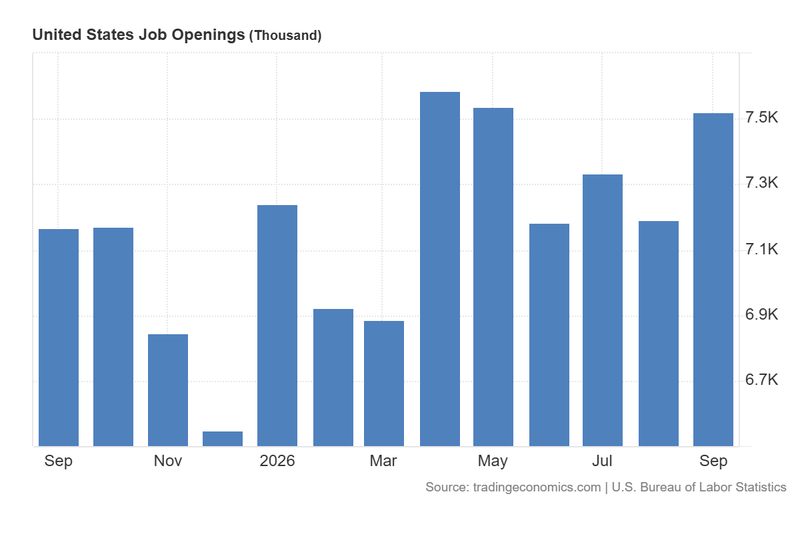
Figure 1. US Job Openings (2025–2026). Source: Data from the US Bureau of Labour Statistics; chart retrieved via Trading Economics.
RBA raises cash rate target by 25 basis points in line with consensus
The Reserve Bank of Australia (RBA) increased its cash rate target by 25 basis points to 4.85%, matching analyst expectations. The decision revealed a divided board, with six members voting in favour of a rate hike and three advocating to hold policy steady. Consequently, the cash rate has reached its highest level since November 2008, pointing to a significant tightening of financial conditions across Australia.
The RBA continues to navigate a challenging economic landscape, with inflationary pressures re-accelerating on the back of rising fuel costs. Australia's headline inflation rate stood at 4.3% in September, remaining well above the central bank's target band of 2.0%–3.0%. Furthermore, robust global demand for artificial intelligence infrastructure is driving up prices for critical technological products and services, which are assuming increasing strategic importance across global value chains.
However, despite the RBA's hawkish policy move, the Australian dollar depreciated by 0.48% against the greenback, with the AUD/USD currency pair settling at 0.6963.
