
 Help
CAC 40 falls amid French social instability; China’s economy gains momentum
Social unrest and fiscal fears pressured French assets, whilst Chinese economic growth beat forecasts following government stimulus. Meanwhile, investors braced for potential market volatility ahead of key quarterly earnings reports.

The French CAC 40 dropped 1.11% as civil unrest drove sovereign bond yields to a 24-year high.
China's Q3 GDP grew 1.2% quarter-on-quarter, exceeding market consensus forecasts.
Chinese retail sales and industrial output accelerated in September, surpassing expectations.
Volatility is expected as major US firms, including Netflix and Meta, report Q3 results.
Date: 19 October 2026
French CAC 40 index declines amid political and social instability
The CAC 40 Index fell by 1.11% to 7,868 points amid growing political and social instability in France. The decline followed a weekend of widespread protests over political deadlock, the rising cost of living, and concerns regarding public services—including education and healthcare—as cited by CNBC. Notably, the unrest escalated into riots, looting, and damage to public and private property, resulting in more than 2,000 arrests.
In response to the unrest, French authorities called for curfews in several local areas on Monday in an attempt to restore public order and contain the violence, as reported by Reuters. These measures further highlighted the severe challenges facing the French government in managing social tensions and maintaining political stability.
The unrest also intensified concerns in financial markets regarding France's fiscal outlook and broader political uncertainty. Investors expressed doubts over elevated public debt levels and the government's capacity to secure parliamentary support for its 2027 budget.
This instability compounded pressure on the French sovereign bond market. At market close, France's 10-year government bond yield advanced by 8.6 basis points to 4.94%—its highest level since July 2002.
China's GDP beats expectations as industrial production and retail sales accelerate
According to data released by the National Bureau of Statistics (NBS) of China, quarterly Gross Domestic Product (GDP) growth increased from 0.9% in Q2 2026 to 1.2% in Q3 2026, exceeding the market consensus forecast of 1.1%. Consequently, year-on-year (YoY) GDP growth accelerated from 4.3% to 4.5%, signalling underlying resilience within the Chinese economy.
An analysis by Trading Economics highlights that this implied growth was primarily driven by Chinese government stimulus measures, most notably including targeted interest rate cuts, mortgage subsidies, plans to accelerate major infrastructure projects, and local government capital allocations.
Concurrently, the NBS revealed that industrial production and retail sales accelerated firmly, with both exceeding market consensus forecasts. On the one hand, YoY industrial production advanced from 5.2% in August to 5.5% in September, buoyed by solid manufacturing activity across several industries. On the other hand, YoY retail sales accelerated from 0.4% to 1.1% over the same period, comfortably surpassing the forecast of 0.5%.
Notably, whilst domestic consumption remains a prominent economic area exhibiting weakness, the underlying acceleration in retail sales represents a key catalyst for Chinese demand, given that the current reading is the highest since March 2026. Additionally, headline inflation accelerated marginally in its latest reading, standing slightly above market consensus estimates and pointing to a potential increase in consumer spending.
Nevertheless, despite the underlying strength in macroeconomic factors, equity benchmarks such as the FTSE China A50 and the Hang Seng Index recorded marginal declines of 0.05% and 0.19%, respectively.
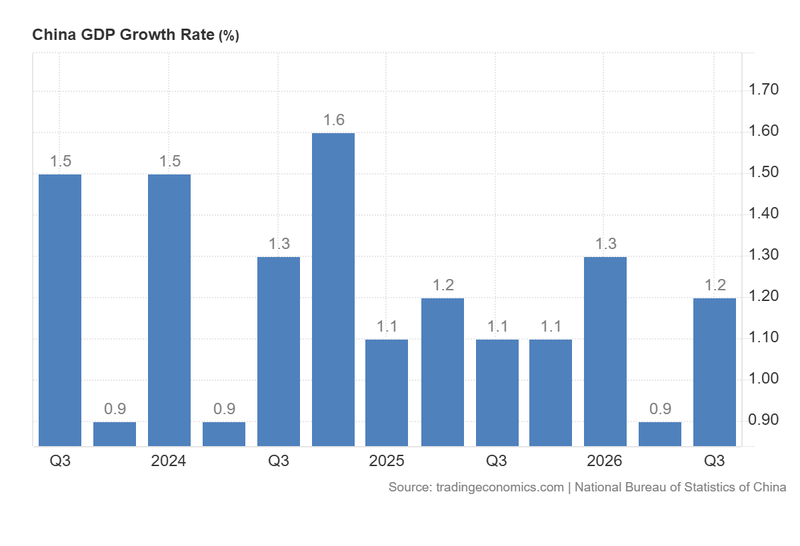
Figure 1. China GDP Growth Rate (2023–2026). Source: Data from the National Bureau of Statistics of China; figure retrieved from Trading Economics.
Quarterly US financial results
The third-quarter 2026 earnings season continues this week. The following major corporations are scheduled to report, which may contribute to heightened volatility across US equity markets:
Tuesday
- SpaceX (SPCX)
- GE Aerospace (GE)
- Netflix Inc. (NFLX)
- 3M Company (MMM)
- General Motors (GM)
- United Airlines (UAL)
Wednesday
- Meta Platforms (META)
- Tesla Inc. (TSLA)
- Philip Morris (PM)
- Texas Instruments (TXN)
- International Business Machines (IBM)
- Abbott Laboratories (ABT)
- CME Group (CME)
Thursday
- Procter & Gamble (PG)
- Blackstone Inc. (BX)
- Comcast Corp. (CMCSA)
Friday
- Exxon Mobil (XOM)
- American Express (AXP)
Key economic events this week
Several critical economic indicators are scheduled for release this week, with the following being of particular importance to market participants.
Monday
- China: GDP Growth Rate
- China: Industrial Production
- China: Retail sales
- Canada: Inflation Rate
Tuesday
- United Kingdom: Unemployment Rate
- Germany: ZEW Economic Sentiment Index
- US: Building Permits
- US: Housing Starts
- Japan: Balance of Trade
Wednesday
- United Kingdom: Inflation Rate
- US: EIA Crude Oil Stocks Change
Thursday
- Japan: Inflation Rate
Friday
- United Kingdom: Retail Sales
