
 Help
Help Daily discussion thread for August 11, 2026
The Reserve Bank of Australia maintained its benchmark interest rate at 4.35% amid persistent inflationary pressures and ongoing Middle East conflict. Concurrently, US existing home sales declined due to elevated long-term mortgage rates, while escalating fears of energy supply disruptions pushed global crude oil prices higher.

The RBA maintained its cash rate at 4.35%, noting that inflation remains elevated despite slowing consumer expenditure.
High 30-year fixed mortgage rates drove US existing home sales down to an annualised 4.06 million units in July.
The Australian dollar appreciated marginally to $0.7059 as market participants await key US inflation data.
Heightened Middle East tensions and threats to the Strait of Hormuz pushed Brent crude futures up to $88.92 per barrel.
The RBA decides to maintain its benchmark interest rate amid geopolitical uncertainty
The Reserve Bank of Australia (RBA) unanimously decided to keep its benchmark interest rate unchanged at 4.35% during its latest monetary policy meeting, in line with consensus forecasts. Board members signalled that inflationary pressures remain persistent, driven in part by the ongoing US-Iran conflict in the Middle East, even as the broader Australian economy continues to demonstrate resilience.
Australia's unemployment rate rose to 4.40% in June, continuing a gradual upward trend observed over the past three years, though it has remained relatively stable over the last twelve months. Meanwhile, annual inflation stood at 3.80% in June—down from its peak of 4.6% in March, but still above the RBA’s 2–3% target range. Conversely, a deceleration in consumer spending growth has helped ease demand-pull pressure on the central bank.
Following the policy announcement, the Australian dollar appreciated marginally by 0.08% against the US dollar to $0.7059. The modest move reflects market caution ahead of crucial US inflation data scheduled for release on Wednesday, 12 August.
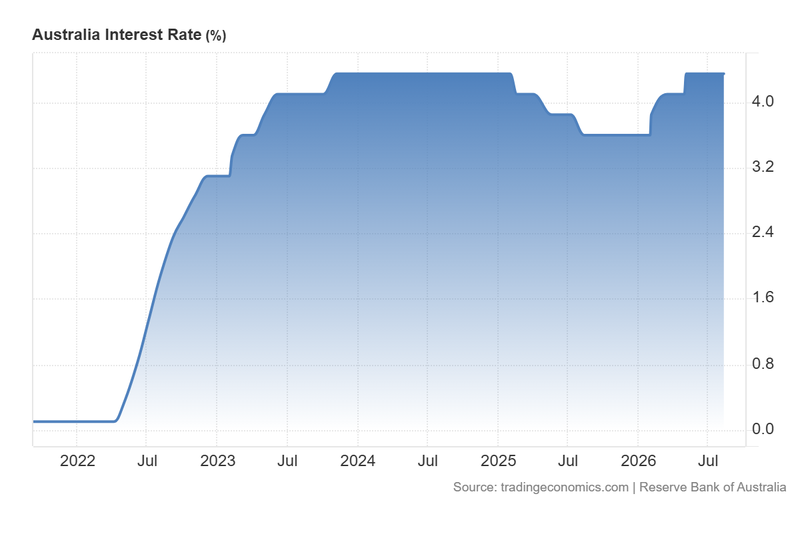
Figure 1. Australia Interest Rate (2021–2026). Source: Data from the Reserve Bank of Australia; Figure obtained from Trading Economics.
US existing home sales decrease amid higher mortgage rates
The US National Association of Realtors reported that existing home sales declined from an annualised rate of 4.13 million in June to 4.06 million in July. Although this marks a contraction in transaction volume, the figure printed slightly above the market consensus forecast of 4.05 million. This represents the second consecutive monthly decline in the indicator, driven by rising long-term borrowing costs.
According to data from the Federal Reserve Bank of St. Louis, the average 30-year fixed mortgage rate rose to 6.69% as of 6 August, reaching its highest level since July 2025. In this borrowing environment, home purchases financed through long-term debt have become significantly more expensive for American households. Nevertheless, the broader existing home sales metric has maintained a relatively range-bound pattern over the past three years.
Tehran warns the Strait of Hormuz will remain closed unless demands are met; Oil prices rise
Crude oil benchmarks advanced in tandem as geopolitical instability intensified across the Middle East. The Brent crude futures contract (BRNV6) rose 1.45% to $88.92 per barrel, while the West Texas Intermediate (WTI) futures contract (CLU6) gained 1.40% to trade at $83.23 per barrel.
As reported by Reuters, Tehran declared that the Strait of Hormuz would remain closed unless Washington complies with all of its demands. Tensions escalated further after a US Navy helicopter engaged a cargo vessel that failed to heed stop warnings, breaching an enforced naval blockade on Iranian ports. Concurrently, Reuters reported that Houthi forces targeted a Saudi vessel carrying military equipment in the Bab el-Mandeb Strait.
The current geopolitical landscape suggests a diplomatic resolution remains distant. So long as transit through both the Strait of Hormuz and the Bab el-Mandeb Strait remains blocked or hazardous, severe energy supply shocks could reignite global inflationary pressures, potentially forcing major central banks to adopt a more restrictive monetary policy stance.
