
 Help
Help Daily discussion thread for August 13, 2026
US PPI slowed to 4.7% in July, boosting equities and lowering interest rate hike expectations, while UK GDP growth decelerated to 0.4% and Japanese producer prices remained near multi-year highs.

US Producer Price Index eased to 4.7% in July, outperforming market expectations of a deceleration to 4.9%.
The S&P 500 reached a record high as market expectations shifted towards a Federal Reserve rate pause in September.
UK GDP growth slowed to 0.4% in the second quarter, matching analysts' consensus estimates.
Japan's PPI ticked down slightly to 7.2%, remaining near multi-year highs due to currency weakness and elevated oil prices.
US PPI decelerates beyond forecasts, although it remains on an upward trajectory
According to data from the US Bureau of Labor Statistics (BLS), the Producer Price Index (PPI) eased from 5.5% in June to 4.7% in July, exceeding the deceleration expected by analysts, who had projected 4.9%. The report signalled a monthly contraction in energy prices, as well as in transportation and warehousing services. Conversely, construction prices advanced, and portfolio management costs accelerated.
Although the PPI is not the primary gauge for inflation, it holds direct implications for the Consumer Price Index (CPI), as producer costs are often passed on to end consumers when companies can no longer absorb rising operational expenses. Following the release, the CME FedWatch Tool reflected a decrease in the market-implied probability of a 25 basis point interest rate hike at the Federal Reserve’s September meeting to 35%, while the probability of the US central bank keeping its benchmark rate unchanged rose to 65%.
Consequently, US equity benchmarks rose in tandem amid expectations of a neutral monetary policy stance. The S&P 500 Index advanced by 0.65% to 7,798, marking a new record high. Meanwhile, the Nasdaq 100 increased by 1.15% to 30,084, and the Dow Jones Industrial Average appreciated by 0.13% to 53,845 points.
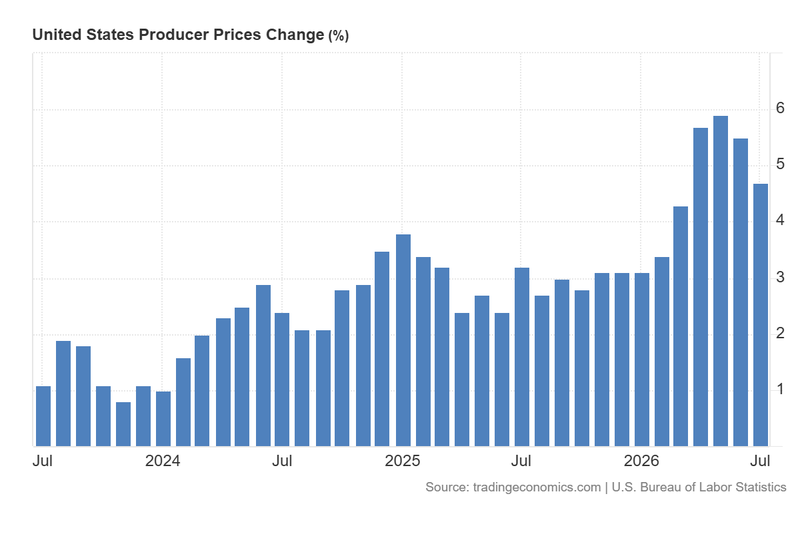
Figure 1. US Producer Price Index (2023–2026). Source: Data from the US Bureau of Labor Statistics; chart retrieved from Trading Economics.
UK GDP growth rate decelerates in line with analysts’ forecasts
The Office for National Statistics (ONS) reported that the UK Gross Domestic Product (GDP) growth rate decelerated from 0.6% in Q1 to 0.4% in Q2 2026, fully aligning with market expectations. An analysis by Trading Economics indicates that services output expanded by 0.5%, production exhibited no growth, construction output rose by 0.3%, gross fixed capital formation increased by 1.2%, and household consumption advanced by 0.3%. Conversely, government consumption contracted by 0.3%. On an annualised basis, GDP growth eased from 1.2% to 1.1%.
Following the GDP release, the British pound fell marginally by 0.05% to $1.3486 against the US dollar. Although the UK economy recorded a slight deceleration, it continues to exhibit underlying resilience through sustained economic growth, moderating inflation rates, and stable employment metrics.
Japanese PPI eases slightly, but remains within a multi-year high zone
According to data from the Bank of Japan (BoJ), the Producer Price Index eased slightly from 7.3% in June to 7.2% in July, missing analysts' forecasts of 7.4%. Despite the slight moderation, current PPI levels remain elevated near three-year highs. On a month-on-month basis, the PPI rose by 0.1%, coming in considerably below the market consensus estimate of 0.6%.
While producer price pressures moderated more than anticipated, they continue to reflect the ongoing friction of a weak Japanese yen. Given Japan’s heavy reliance on energy imports, rising input costs have directly fed into broader inflation levels, exacerbated by a depreciating currency as global crude oil remains denominated in US dollars. Consequently, Japanese firms continue to face persistent price pressures stemming from the ongoing Middle East conflict between the US and Iran, which has disrupted supply chains for roughly five months.
