
 Help
Help Daily discussion thread for August 5, 2026
US ADP private employment growth slowed to 44K in July, missing expectations and easing Federal Reserve rate-hike bets. Despite strong second-quarter revenue, SpaceX shares plunged due to high market participants scrutiny.

US private job additions eased to 44K in July, falling below the 70K forecast and signalling a cooling labour market.
The CME FedWatch Tool showed reduced odds (54.4%) for a 25-basis-point Fed rate hike following the weak ADP employment print.
The ISM Services PMI edged up to 54.1, but input price pressures spiked to 70.3 amidst ongoing Middle East tensions.
SpaceX shares plunged 13.6% as a 550% surge in AI-related capital expenditure overshadowed a Q2 revenue beat of $7.81 billion.
ADP employment change decelerates beyond market consensus forecasts
According to data released by Automatic Data Processing (ADP) Inc., private sector employment growth in the United States decelerated from a revised 95K in June to 44K in July, falling short of the consensus analyst forecast of 70K. This deceleration is significant because the ADP indicator frequently serves as an early harbinger of the official non-farm payrolls data, even if it is not strictly predictive. Furthermore, this marks two consecutive months of slowing employment growth, suggesting that a sustained downward trend in job creation may be re-emerging if subsequent figures continue to soften.
Sector-level data within the ADP report reveals that the most prominent gains occurred in Education and Health Services, which added 36K positions, and Financial Activities, which expanded by 10K. Conversely, the Leisure and Hospitality sector posted the sharpest contraction, shedding 11K jobs.
Following the release, the CME FedWatch Tool indicated that the implied probability of a 25-basis-point interest rate hike at the Federal Reserve’s September meeting dropped to 54.4%. This represents a slight decline from previous sessions, where the likelihood had hovered around the 58% mark. In contrast, the probability of the central bank holding rates unchanged rose to 45.6%.
Market participants are now turning their attention to the Bureau of Labor Statistics (BLS), which is scheduled to release the official non-farm payrolls and unemployment rate this coming Friday. A robust employment report would reinforce expectations that the US central bank will remain focused on containing inflationary pressures; conversely, a weak job print could prompt a pivot from the Fed’s restrictive monetary stance to support economic momentum.
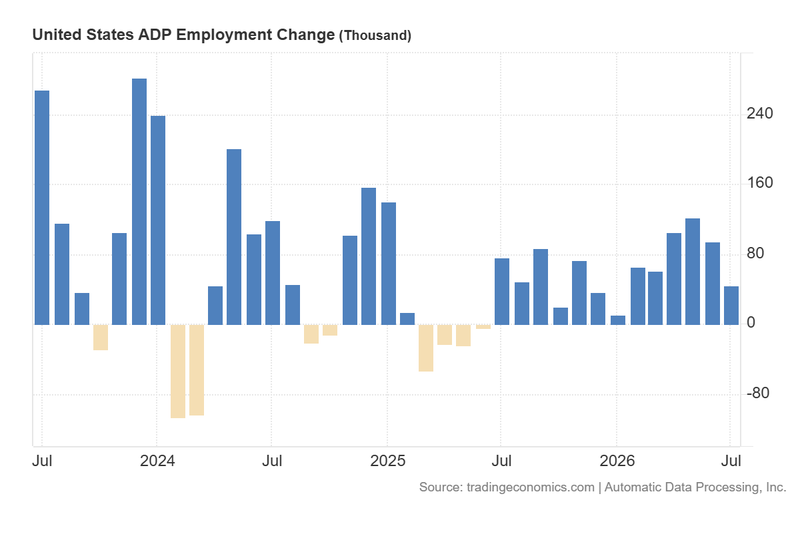
Figure 1. US ADP Employment Change (2023–2026). Source: Data from Automatic Data Processing Inc.; Figure obtained from Trading Economics.
US ISM services PMI advances, but remains below analysts’ estimates
The Institute for Supply Management (ISM) released its US Services PMI, which edged up from 54.0 points in June to 54.1 points in July, revealing a modest acceleration in expansion. However, the figure fell short of the consensus analyst forecast of 54.5 points. The reading reflects a broader regime of relative stagnation that has persisted since March, with the service sector index remaining anchored near the 54-point threshold, although it remains in expansion territory staying above the 50 threshold.
Sub-index analysis provided by Trading Economics highlights that the primary drivers of growth were Business Activity, which rose from 55.4 points in June to 59.1 in July, and New Orders, which advanced from 55.1 to 57.2. Inventories also recorded a subtle uptick, moving from 51.2 to 51.4. Conversely, the Prices Index surged from 67.7 to 70.3 points, driven by persistent energy supply disruptions in the Middle East.
In contrast to the expansion in output, operational backlogs and employment contracted. The Backlog of Orders index dropped from 54.9 to 50.9 points, while the Employment Index fell from 51.2 to 47.4 points, crossing into contractionary territory. This weakness in service-sector hiring aligns closely with the deceleration observed in the ADP employment figures, signalling potential downside risks for the upcoming BLS payroll report.
SpaceX shares fall sharply despite revenue exceeding market forecasts
Shares of Space Exploration Technologies (SpaceX) fell sharply by 13.61% to close at $108.27, despite the company delivering second-quarter top-line results that comfortably beat Wall Street estimates. SpaceX reported revenue of $7.81 billion, outperforming the market consensus forecast of $6.83 billion. Meanwhile, the firm posted a narrower-than-expected loss per share of $0.09, beating analyst projections of a $0.23 loss.
The earnings release confirmed that total revenue expanded by 92% year-on-year. However, market attention was dominated by the company's capital expenditure (CapEx), which surged to $18.37 billion for the quarter—primarily directed toward expanding artificial intelligence infrastructure. As highlighted by CNBC, this represents an aggressive 550% year-on-year increase in CapEx growth.
While investors recognize the commercial ambition driving the aerospace giant's long-term targets, the market reaction reflects intense scrutiny over elevated capital deployment relative to near-term benefit capabilities, particularly regarding large-scale AI investments.
