
 Help
Help Daily discussion thread for July 17, 2026
Escalating US-Iran tensions lifted oil prices and weighed on US equities amid compounding inflation concerns. Stronger-than-expected consumer sentiment provided some support to the broader market, while sharp declines in Netflix and SpaceX exerted pronounced downward pressure on the Nasdaq.

Brent crude rose 4.59% to $88.10 and WTI gained 3.25% as intensifying Middle East tensions heightened the risk of severe supply disruptions.
US stocks fell as ascending oil prices exacerbated domestic inflation concerns; the tech-heavy Nasdaq dropped 1.49%, leading the day's losses.
Netflix fell 7.26% following a mixed earnings release, while SpaceX dropped 5.43% after a postponed Starship launch.
The University of Michigan consumer sentiment index rose to 54.4, beating market forecasts, while one-year inflation expectations eased to 4.2%.
Risks of escalation in US-Iran conflict weigh on US equities and drive higher oil prices
Geopolitical tensions between the United States and Iran have intensified, raising the risk of a broader regional escalation. According to reports from Reuters, the US launched targeted strikes on Iranian bridges, whilst Iran struck a power and desalination plant in Kuwait. Concurrently, an oil shipment was intercepted along the Red Sea, triggering concerns that this critical maritime corridor could face disruptions, thereby exacerbating ongoing energy supply chain vulnerabilities.
At present, two critical risks confront the market: first, a severe energy supply disruption should Houthi forces successfully close the Bab al-Mandeb Strait on the Red Sea; second, a wider regional escalation if Washington targets additional Iranian infrastructure and if Iran retaliates against Gulf states that host US bases. The latter scenario presents a significant danger of drawing external nations into the conflict—most notably Saudi Arabia and Pakistan, which maintain a bilateral defence agreement.
At the market close, the primary oil benchmarks advanced in tandem. The Brent futures contract (BRNU6) increased by 4.59% to $88.10 per barrel, while the West Texas Intermediate (WTI) futures contract (CLU6) rose by 3.25% to settle at $81.78 per barrel. Crucially, global oil prices have now surged by approximately 20% over the last two weeks. Concurrently, these rising tensions weighed heavily on US equity benchmarks, which retreated in parallel amid mounting anxiety over inflationary pressures. The S&P 500 index decreased by 1.01% to 7,457 points, the Dow Jones Industrial Average fell by 0.77% to 52,151, and the Nasdaq 100 index depreciated by 1.49% to finish at 28,592.
According to the CME FedWatch Tool, the market-implied probability of a 25-basis-point interest rate hike by the Federal Reserve at its September meeting remained unchanged close to 51.2%. Meanwhile, 10-year US Treasury yields and the US Dollar Index (DXY) concluded the session with marginal net movement.
Nasdaq falls led by sharp depreciations of Netflix and SpaceX
As previously noted, the Nasdaq index suffered a sharp depreciation at the market close, retreating by 1.49%. While this market contraction can be broadly attributed to rising inflation concerns, the sell-off was heavily led by steep declines in two prominent firms: Netflix and SpaceX.
Netflix Inc. declined by 7.26% to close at $68.95 after publishing a mixed set of quarterly financial results. The streaming giant exceeded consensus expectations for earnings per share (EPS) but fell slightly short of top-line revenue forecasts. Netflix reported total revenue of $12.56 billion, marginally below the market consensus estimate of $12.58 billion. Conversely, EPS reached $0.80, slightly outperforming the $0.79 anticipated by analysts. Additionally, the company announced that it intends to reduce the publication frequency of its "What We Watched" data reports, suggesting a more conservative approach regarding future guidance and disclosures.
Concurrently, Space Exploration Technologies (SpaceX) fell by 5.43% to $123.99, accumulating a steep 27% depreciation over the course of July. The company aborted the launch of its Starship mega-rocket after several engines failed to ignite, according to comments made by Elon Musk—as quoted by CNBC.
US Michigan consumer sentiment index advances above market expectations
According to data released by the University of Michigan, the consumer sentiment index staged a notable recovery in its July evaluation, climbing from 49.5 to 54.4 points and comfortably beating analyst forecasts of 51 points. This current reading represents the highest consumer confidence level observed since February, indicating a resilient underlying recovery in household optimism.
The report highlights that all five core components of the index improved, led by significant gains in the buying conditions and business conditions metrics. However, the University of Michigan cautioned that the underlying consumer interviews were conducted prior to the recent escalation in the US-Iran conflict. Consequently, the adverse impact of these geopolitical frictions on consumer confidence will likely only manifest in the next monthly assessment, particularly if the ongoing hostilities persist or worsen.
Additionally, near-term inflation expectations for the year ahead moderated from 4.6% to 4.2%, while long-term 5-year inflation expectations remained unchanged at 3.3%.
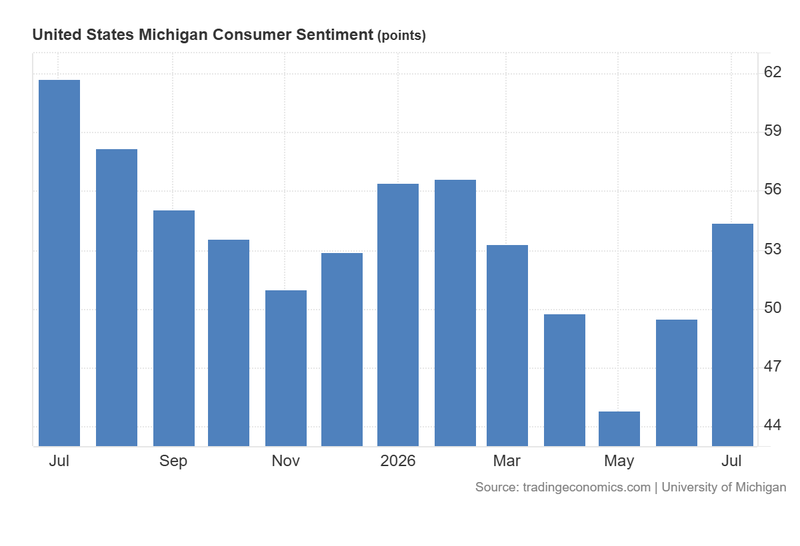
Figure 1. US Michigan Consumer Sentiment (2025-2026). Source: Data from the University of Michigan. Figure obtained from TradingView.
