
 Help
Help Daily discussion thread for July 24, 2026
Intel Corporation shares plunged despite beating quarterly estimates, as investors increasingly scrutinised heavy capital expenditures in artificial intelligence. Meanwhile, US equity markets closed mixed, UK retail sales surged past expectations, and Japanese inflation accelerated.

Intel fell 7.89% despite beating Q2 2026 top- and bottom-line estimates, reflecting heightened investor sensitivity towards artificial intelligence capital commitments and return timelines.
Wall Street indices closed diverged, with the tech-heavy Nasdaq falling 1.15% amidst chipmaker weakness, while the Dow Jones Industrial Average gained 0.45% to close at 51,952.
UK retail sales jumped 4.2% year-on-year in June, surpassing expectations and easing pressure on the Bank of England ahead of its upcoming rate decision.
Japan’s headline CPI inflation rose to 1.7% in June, driven primarily by reduced energy subsidies and higher import costs stemming from a weak yen.
Intel falls sharply despite beating analysts’ expectations; Equity indices close mixed
Intel Corporation shares dropped sharply by 7.89% to close at $92.32, despite the company surpassing Wall Street expectations on both total revenue and earnings per share (EPS).
The semiconductor giant reported second-quarter revenue of $16.13 billion, beating the consensus market estimate of $14.33 billion. Concurrently, non-GAAP EPS reached $0.42, well above the $0.21 forecast—representing a notable operational recovery from the -$0.10 EPS recorded in Q2 2025. Although Intel also provided Q3 2026 guidance that topped consensus expectations, the stock’s downward trajectory highlights growing investor scepticism surrounding substantial artificial intelligence investments whose cash flow returns are not yet materialising with equivalent momentum.
In the broader US equity markets, primary benchmarks delivered a mixed performance. The Nasdaq 100 Index dropped 1.15% to 28,128 points, dragged lower by Intel’s retreat and broader valuation concerns across the AI supply chain. Conversely, the Dow Jones Industrial Average rose 0.45% to reach 51,952 points, buoyed by solid gains in mega-cap constituents. The broader S&P 500 Index finished virtually flat, up 0.05% at 7,411 points.
UK retail sales exhibit solid increase, exceeding market expectations
Data released by the UK Office for National Statistics reveals that retail sales volumes accelerated notably from 3.5% year-on-year (YoY) in May to 4.2% in June, comfortably outpacing the consensus forecast of 2.3%. On a month-on-month basis, retail sales expanded by 1.0%, defying market expectations of a 0.3% contraction.
An analysis cited by Trading Economics indicates that consumer spending was supported by solid demand for athletic equipment, as well as increased purchases of cooling appliances such as fans and air-conditioning units. The reading points to underlying resilience in UK consumer demand, which has now accelerated for two consecutive months. This demand dynamics, alongside stable employment figures and moderating inflation, reduces immediate pressure on the Bank of England (BoE) to adopt a dovish or a hawkish stance amid global economic uncertainty.
Market focus remains fixed on the BoE’s upcoming monetary policy decision on July 30, where consensus anticipates benchmark interest rates will be held steady at 3.75%. The primary focal point for market participants will be the tone of the Monetary Policy Committee's statement regarding medium-term growth projections and inflation risks.
Following the economic data release, the British pound recorded a marginal gain of 0.04% to trade at $1.3319. Meanwhile, the UK’s benchmark FTSE 100 Index advanced 0.91% to close at 10,736 points, reflecting optimism surrounding a stable economic outlook and a neutral policy stance from the central bank.
Japanese inflation rate accelerates across both headline and core metrics
According to official figures from Japan’s Ministry of Internal Affairs and Communications, headline inflation accelerated from 1.5% YoY in May to 1.7% in June, marking its highest level since December 2025. This uptick was primarily driven by a step-down in state energy subsidies, which reintroduced upward cost pressures on domestic fuel and transportation. Furthermore, elevated energy import bills—amplified by lingering geopolitical friction in the Middle East and a structurally weak yen—further contributed to the inflationary push.
In parallel, core inflation—which strips out volatile energy and fresh food prices—rose from 1.4% to 1.6% over the same period.
While accelerating price pressures typically increase the probability of monetary tightening by the Bank of Japan (BoJ), inflation metrics remain beneath the central bank’s target of 2.0%. However, persistent yen weakness and the upward drift in 10-year Japanese Government Bond (JGB) yields continue to serve as the main catalysts that pressure the BoJ.
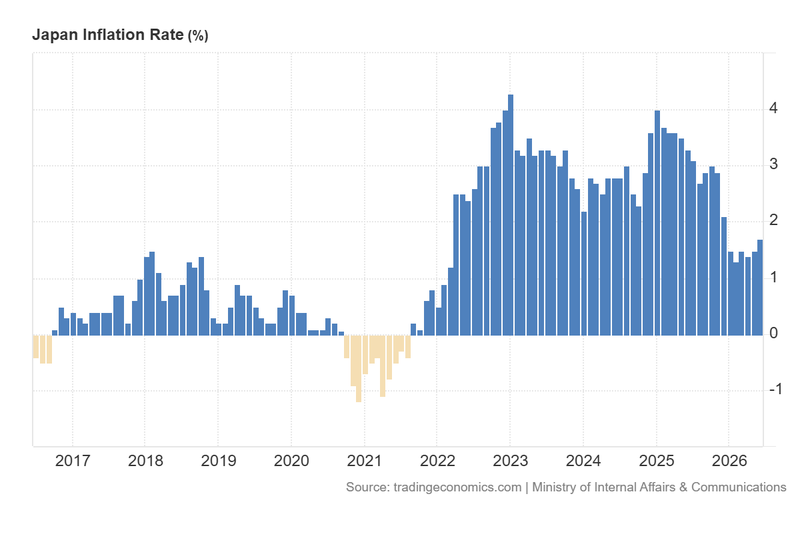
Figure 1. Japan Inflation Rate (2016–2026). Source: Data from the Ministry of Internal Affairs and Communications; Figure obtained from Trading Economics.

