
 Help
Help Daily discussion thread for July 29, 2026
US equities dropped sharply as the Federal Reserve held interest rates steady without providing clear future guidance, while escalating Middle East tensions, falling EIA crude inventories, and mixed Big Tech earnings heightened market uncertainty.

The Fed held interest rates steady at 3.75% with a hawkish undertone, offering no explicit path for future rate movements.
Escalating Middle East missile strikes pushed Brent crude up by 7.32% and WTI crude up by 6.56%.
US EIA crude oil inventories plunged by 7.167 million barrels, far exceeding the expected drawdown.
Big Tech results were mixed: Microsoft shares rose by 8% in post-market trading following a strong earnings report, whereas Meta Platforms fell by 8.5% on mixed results.
US equity indices fall amid uncertainty over Fed comments and geopolitical instability in the Middle East
US equity benchmarks fell significantly amid rising expectations of a more hawkish monetary stance from the Federal Reserve, alongside escalating tensions in the Middle East that continue to drive energy prices higher.
Fed keeps interest rates steady but offers no clues for upcoming decisions
The Federal Reserve elected to maintain its benchmark interest rate at 3.75%, aligning with market expectations. However, Chairman Kevin Warsh refrained from providing forward guidance regarding future monetary policy adjustments. The decision passed with a 9-vote majority to keep rates unchanged, contrasted against three dissenting votes in favour of an immediate interest rate cut of 25-basis points. This marked the first instance since 2016 in which all dissenting voters converged in the same direction regarding a policy change.
While Chairman Kevin Warsh noted that Federal Open Market Committee (FOMC) members view the US economy as solid and resilient, policymakers expressed concern over current inflation rates, which remain considerably above the central bank’s 2% target. Additionally, heavy capital expenditure on artificial intelligence (AI) infrastructure was highlighted as an emerging factor exerting upward pressure on prices.
Geopolitical tensions in the Middle East escalate
Geopolitical instability in the Middle East has intensified, raising concerns of a broader regional conflict. According to a report by Reuters, Iran launched missile strikes targeting host countries with US bases across the region, while Saudi Arabia conducted strikes against Iran-backed armed groups in Iraq. Furthermore, friction between Saudi Arabia and the Houthi movement persists in the Bab-el-Mandeb Strait off the coast of Yemen. Should Saudi Arabia become directly involved in the hostility, analysts warn the conflict could escalate into a wider regional dispute.
Consequently, major crude oil benchmarks advanced in tandem. The Brent crude futures contract (BRNV6) surged by 7.32% to $88.09 per barrel, while the West Texas Intermediate (WTI) futures contract (CLU6) gained 6.56% to reach $84.46 per barrel. This rally was further compounded by a sharp reduction in US crude oil inventories, signalling potentially stronger demand alongside tightening supply.
Against this backdrop, major US stock benchmarks experienced synchronized losses. The S&P 500 index dropped 1.52% to close at 7,316 points, the Nasdaq 100 declined by 2.06% to 27,192, and the Dow Jones Industrial Average fell by 2.19% to 51,599 points. Conversely, the volatility index (VIX) jumped by 13.46% to 20.65 points.
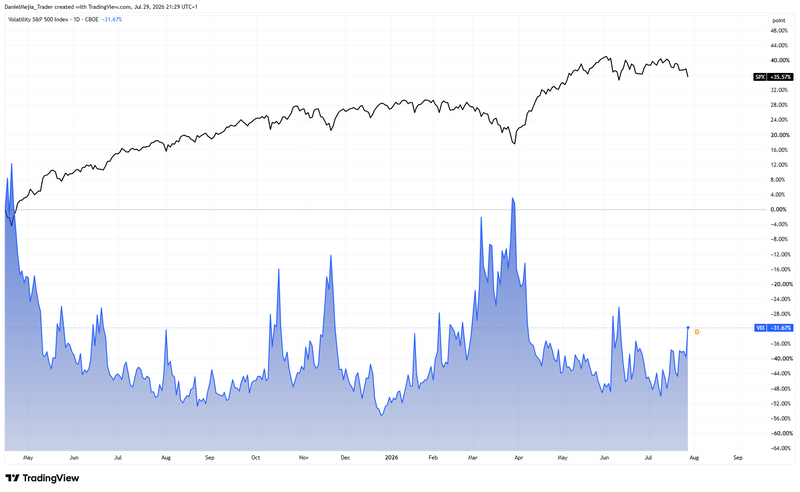
Figure 1. S&P 500 & VIX Indices (2025–2026). Source: Data from the CBOE Exchange; Figure obtained from TradingView.
EIA crude inventories fall sharply beyond market expectations
According to data released by the US Energy Information Administration (EIA), commercial crude oil inventories plunged by 7.167 million barrels in its latest weekly assessment. This contraction significantly exceeded analyst forecasts of a 1.3 million-barrel drawdown, as well as the previous week’s reported build of 2.011 million barrels. The report highlighted that the sharp decline in crude stocks was not accompanied by a reduction in distillate or gasoline inventories, suggesting that the drawdown was driven primarily by strong US export demand amid severe global supply chain disruptions.
While a single weekly inventory report is not typically the sole determinant of energy benchmark trends, this substantial contraction played a central role in driving WTI crude’s daily appreciation of 6.56%.
Corporate earnings results: Microsoft Corporation & Meta Platforms
Mega-cap technology companies Microsoft Corporation and Meta Platforms delivered diverging quarterly results: Microsoft exceeded Wall Street expectations across both revenue and earnings per share (EPS), whereas Meta Platforms beat top-line revenue estimates but missed on EPS.
Microsoft Corporation reported total revenue of $90.01 billion, comfortably surpassing market estimates of $87.61 billion. The technology giant achieved an EPS of $4.74, beating the consensus estimate of $4.24. These figures reflect a year-on-year (YoY) revenue expansion of 17.75% and an EPS growth rate of 29.9% YoY. Spurred by these robust fundamentals, Microsoft shares climbed by 8.00% in post-market trading.
In contrast, Meta Platforms posted total revenue of $60.80 billion, slightly ahead of the $60.19 billion expected by analysts. However, the social media giant reported an EPS of $6.18, missing market consensus estimates of $7.17. This performance represents a YoY revenue increase of 27.9%, alongside an annual EPS decline of 13.0%. Amid heightened investor scrutiny regarding capital allocation and profitability within Big Tech, Meta shares fell by 8.50% in extended trading.

