
 Help
Help Daily discussion thread for October 1, 2026
Brent crude prices surged above $100 as geopolitical tensions between the United States and Iran threatened to escalate. Meanwhile, Australia’s trade balance narrowed, and the US manufacturing Purchasing Managers' Index (PMI) dipped slightly to 54.5, missing market expectations.

Brent crude jumped 4.37% to $102.31 per barrel as US military deployments heightened tensions in the Middle East.
Australia’s trade surplus decreased to AUD 0.495 billion in August, prompting a decline in the Australian dollar.
The US ISM Manufacturing PMI slipped to 54.5 in September, even as underlying price pressures accelerated further.
Oil prices advance amid renewed tensions between the US and Iran in the Middle East
Crude oil prices advanced amid renewed geopolitical friction between the United States and Iran. At market close, the Brent futures contract (BRN) rose by 4.37% to $102.31 per barrel, once again surpassing the $100 threshold. Simultaneously, the West Texas Intermediate (WTI) futures contract (CL) gained 2.83% to trade at $92.98 per barrel.
Against this backdrop, reports indicate that the US is deploying a third aircraft carrier strike group to the Middle East, suggesting preparations for a renewed phase of hostilities. Furthermore, as reported by CNBC citing the Wall Street Journal, US officials indicated that Marine Corps vessels and approximately 10,000 troops are being deployed to the region, potentially intensifying the conflict in the months ahead. These military movements follow declarations by US President Donald Trump indicating that he expects to resume strikes against Iran following the mid-term elections in November.
Conversely, Iranian officials stated that Tehran is preparing a broader and more forceful response should the United States resume military strikes, according to statements reported by Reuters. Nevertheless, despite this rhetoric, Iran remains open to diplomatic negotiations, maintaining that diplomacy represents the sole viable avenue for resolving the ongoing conflict.
In this context, Tehran has sought a return to diplomatic dialogue, primarily on the calculation that the US administration faces mounting political pressure as President Trump’s approval ratings drop to record lows. This public discontent is disadvantageous for Republicans seeking to secure seats in Congress to advance the White House’s legislative agenda. Nonetheless, the US President appears indifferent to these domestic pressures, threatening to prolong the conflict. This assertive political stance comes despite energy supply disruptions generating severe macroeconomic concerns in the United States through heightened inflation and elevated interest rates—factors fuelling substantial criticism of the administration's management.
Australia’s trade balance declines, extending a multi-year downtrend
According to data released by the Australian Bureau of Statistics, the trade balance narrowed from AUD 1.351 billion in July to AUD 0.495 billion in August, missing analyst expectations of an expansion to AUD 2.0 billion. This contraction was primarily driven by a 5.8% month-on-month surge in imports, which outpaced a 3.7% increase in exports. Consequently, Australia’s trade surplus reinforced a broader downward trajectory in its five-year performance (see Figure 1).
The Australian Bureau of Statistics highlighted that the sharp rise in imports was predominantly driven by strong demand for capital goods alongside a notable increase in non-monetary gold purchases. Conversely, export growth was principally supported by robust international sales of non-monetary gold, coal, coke, and briquettes.
Governments globally generally seek to avoid deteriorating trade balances, as a narrowing surplus can signal an increasing structural reliance on foreign goods and services. In an environment marked by heightened geopolitical instability, such dependence presents potential risks to long-term economic resilience. Nevertheless, it is noteworthy that Australia’s trade balance remains in positive territory, confirming that total exports continue to exceed aggregate imports.
Following the release of the economic data, the Australian dollar depreciated by 0.30% against the US dollar, with the AUD/USD currency pair trading at approximately 0.6924.
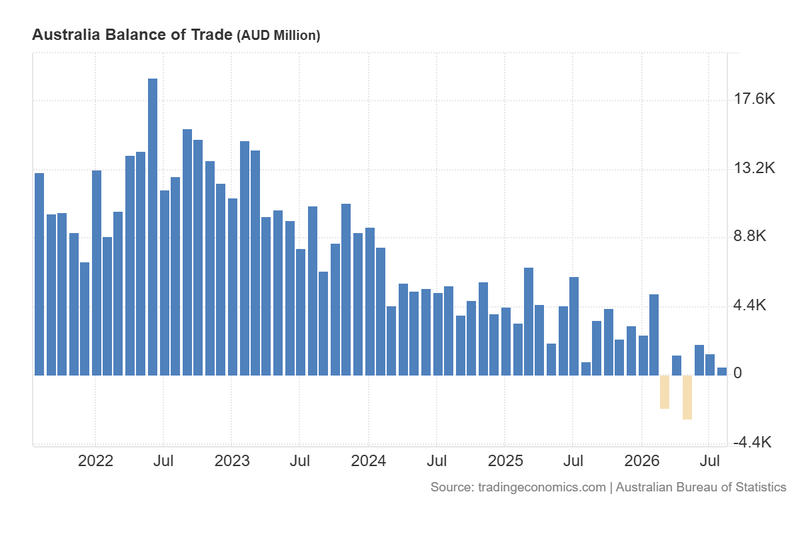
Figure 1. Australia Balance of Trade (2021–2026). Source: Data from the Australian Bureau of Statistics; chart retrieved via Trading Economics.
US manufacturing PMI falls slightly, missing analysts' expectations
Data published by the Institute for Supply Management (ISM) showed that the US Manufacturing PMI dipped slightly from 54.6 in August to 54.5 in September, falling short of the market consensus forecast of 55.0. Despite this minor easing, the index remained comfortably above the 50.0 threshold separating expansion from contraction. Furthermore, secondary analysis from Trading Economics highlighted that the most significant gains occurred within the price pressures sub-index—which climbed from 71.1 to 77.9—and order backlogs, which expanded from 51.8 to 56.4. Conversely, supplier deliveries and production volumes registered a slight deceleration.
