
 Help
Help Daily discussion thread for October 9, 2026
US President Donald Trump has announced an agreement to expand Russian diesel exports in an effort to curb soaring domestic inflation ahead of the upcoming mid-term elections, even as US consumer sentiment plunges towards historic lows.

A potential agreement between the US and Russia promises up to 4 million tonnes of diesel to alleviate severe global energy supply chain disruptions.
Ongoing geopolitical conflicts has driven diesel prices up by over 60%, fuelling inflation and weighing heavily on President Trump's approval ratings.
The University of Michigan Consumer Sentiment Index dropped to 46.3, while one-year inflation expectations rose to 4.7%.
Trump announces agreement with Putin to expand Russian diesel exports
US President Donald Trump announced that Russia will supply more than 4 million tonnes of diesel to the global market following a telephone call with Russian President Vladimir Putin during which the agreement was reached, as reported by CNBC. According to Reuters, the deal encompasses an initial delivery of 300,000 tonnes, followed by 500,000 tonnes in November and a further 1 million tonnes shortly thereafter. In addition, Russia could deliver another 3 million tonnes subject to the operational capacity of its oil refineries, several of which have sustained damage from ongoing military strikes in the conflict with Ukraine.
Since the onset of the conflict involving the US, Israel, and Iran on 28 February, diesel prices have surged by more than 60% amidst a severe deterioration in global energy supply chains. This disruption has been further compounded by the persistent conflict between Russia and Ukraine, where targeted military attacks on oil refineries have contracted global fuel supplies.
Consequently, rising diesel prices have intensified US inflationary pressures, as elevated freight and logistical transportation costs are passed on through higher retail food prices. Against this backdrop, President Trump's approval ratings have fallen to near-historic lows, driven by rising living costs and escalating borrowing rates as the Federal Reserve maintains a restrictive monetary stance to contain inflation. Accordingly, Trump's announcement appears aimed at reining in inflation ahead of the upcoming mid-term elections in early November, although any tangible impact on retail fuel prices is likely to materialise with a time lag.
Following these geopolitical developments, West Texas Intermediate (WTI) crude futures (CL) appreciated marginally by 0.39% to $91.85 per barrel, whereas gasoline futures (RB) depreciated by 0.63% to $3.29 per gallon.
University of Michigan Consumer Sentiment Index approaches historical lows amid rising inflation expectations
Preliminary data released by the University of Michigan revealed that its Consumer Sentiment Index fell from 48.1 in September to 46.3 in October, contracting further than the consensus forecast of 47.6. Consequently, the index approached its record low of 44.8, reflecting a sharp erosion in consumer confidence driven by the ongoing US–Iran conflict and the accompanying spike in energy prices. Within the report, the Current Economic Conditions Index dropped from 50.9 to 44.7, whereas the Index of Consumer Expectations edged up slightly from 46.3 to 47.3.
According to the survey details, buying conditions for durable goods plummeted under the dual pressures of high retail prices and elevated borrowing costs. Furthermore, sentiment deteriorated sharply among lower-income households and consumers with smaller equity portfolios, who are disproportionately affected by the rising cost of living. In this environment, inflation expectations worsened slightly: one-year-ahead inflation expectations advanced from 4.6% to 4.7% month-on-month, while five-year-ahead inflation expectations increased from 3.4% to 3.5%.
Nevertheless, despite consumer sentiment pointing to a challenging economic outlook for the United States, major equity benchmarks advanced in tandem. The S&P 500 index gained 0.59% to reach 7,811 points—nearing its all-time high—while the Dow Jones Industrial Average rose by 0.83% to 51,660, and the Nasdaq 100 appreciated by 0.51% to close at 30,883 points.
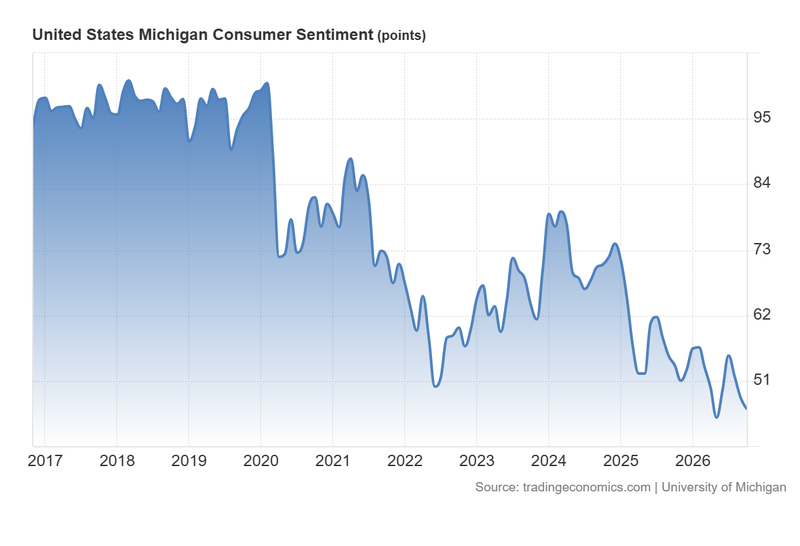
Figure 1. US Michigan Consumer Sentiment (2016–2026). Source: Data from the University of Michigan; chart retrieved via Trading Economics.
