
 Help
Help Daily discussion thread for September 10, 2026
The ongoing US–Iran conflict and Houthi military actions near Red Sea have driven crude oil prices above $100 per barrel. Concurrently, higher-than-expected US Producer Price Index (PPI) inflation data has weighed on equity markets and pushed Treasury yields higher.

Brent and WTI crude surged by over 6%, surpassing $100 per barrel amid rising risks of Middle Eastern supply disruptions.
The US Producer Price Index rose to 5.4% YoY in August, beating forecasts and fuelling inflation concerns.
The S&P 500, Dow, and Nasdaq fell as 10-year Treasury yields surged to 4.96% on heightened interest rate expectations.
US existing home sales dropped to 3.98 million in August as average 30-year fixed mortgage rates reached 6.76%.
Ongoing US–Iran conflict pushes oil prices higher as stock markets fall on inflation concerns
Oil prices advanced and US stock markets fell amid ongoing military engagements between the United States and Iran in the Middle East. Concurrently, tensions in the Bab-el-Mandeb Strait continue to escalate.
According to reports from Reuters, the Houthi group has advanced to control further territory along the Red Sea coast, reinforcing its influence over the Bab-el-Mandeb Strait—a key maritime logistical corridor through which global energy flows transit. If this corridor were closed to commercial oil tankers, pressure on the US would intensify, as reduced energy supplies would heighten the probability of sustained higher crude prices.
Conversely, Saudi Arabia has deployed additional military support within Yemen to reinforce government-aligned forces, signalling that geopolitical tensions in the region are likely to remain elevated.
A scenario in which both the Bab-el-Mandeb Strait and the Strait of Hormuz remain closed—or experience severely reduced traffic—could intensify ongoing energy supply chain disruptions, given that both maritime passages are critical to global supply. Furthermore, such a development would complicate a potential conflict exit for the US, as Iranian and Houthi forces would control both vital bottlenecks, thereby exerting greater leverage over the trajectory of the conflict.
Against this backdrop, the two main oil benchmarks rose in tandem amid mounting concerns regarding further energy supply disruptions. The Brent futures contract (BRNX6) jumped by 6.34% to $107.63 per barrel, while the West Texas Intermediate (WTI) futures contract (CLV6) appreciated by 6.83% to $102.55 per barrel—exceeding the $100 threshold for the first time in approximately four months.
In parallel, US equity benchmarks fell amid rising inflationary pressures and market apprehension that the Federal Reserve could adopt a more restrictive monetary stance to contain prices. The S&P 500 index declined by 0.58% to 7,591 points, the Dow Jones Industrial Average fell by 0.61% to 52,069 points, and the Nasdaq 100 index dropped by 1.08% to 29,103 points.
US PPI accelerates, generating concerns over rising inflationary pressures
According to data released by the US Bureau of Labour Statistics (BLS), the Producer Price Index (PPI) accelerated from 4.8% year-on-year (YoY) in July to 5.4% in August, exceeding the market consensus forecast of 5.3%. Additionally, Core PPI—which excludes the volatile energy and unprocessed food components—accelerated from 4.3% to 4.6%.
This is a significant factor due to its strong correlation with the Consumer Price Index (CPI), as producers may pass higher input costs on to consumers if they are unable to absorb them. The CPI dataset is scheduled for publication tomorrow by the BLS.
Following the release, long-term US Treasury yields rose sharply to multi-year highs. The 10-year government bond yield advanced by 11.6 basis points to 4.96%—a level not recorded since October 2023. Similarly, the 30-year Treasury bond yield increased by 7.3 basis points to 5.37%—its highest level since June 2007. This upward pressure can be attributed to several factors, most notably the acceleration in PPI and elevated crude oil prices, which continue to rise amid escalating tensions in the Middle East.
US existing home sales decline, in line with analysts' expectations
The US National Association of Realtors reported that existing home sales declined from 4.06 million in July to 3.98 million in August, in line with analysts' estimates. This represents a monthly contraction of 2.0%, marking three consecutive months of decline. The real estate sector remains under significant pressure from elevated long-term mortgage rates, which have risen alongside persistent inflationary pressures.
According to data from the Federal Reserve Bank of St. Louis (FRED), the average 30-year fixed-rate mortgage reached 6.76% on 10 September—its highest level since June 2025. An environment of elevated interest rates adversely affects prospective homebuyers, as long-term borrowing becomes increasingly expensive, constraining access to property acquisition.
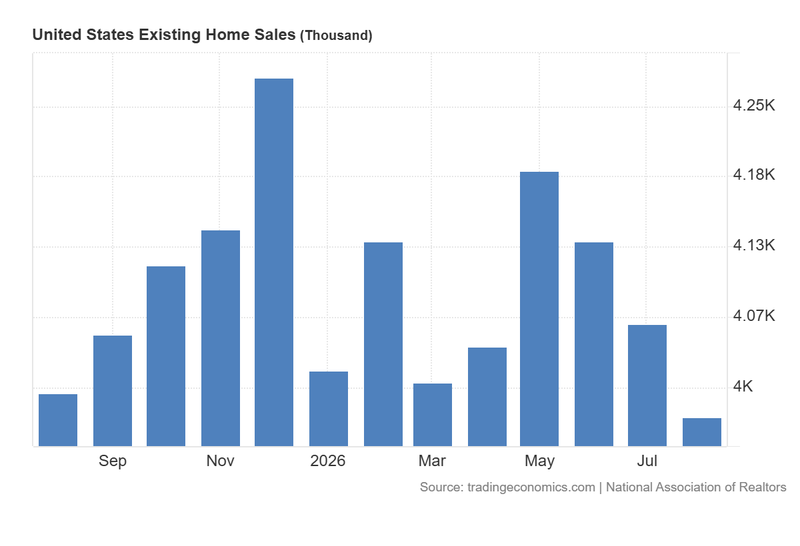
Figure 1. US Existing Home Sales (2025–2026). Source: Data from the National Association of Realtors; chart obtained via Trading Economics.

