
 Help
Help Daily discussion thread for September 17, 2026
The US Securities and Exchange Commission (SEC) has announced a five-year "Innovation Exemption" framework for tokenised US equities, providing a boost to global equity markets. Meanwhile, the Bank of England maintained its benchmark interest rate at 3.75%, whilst elevated mortgage yields continued to weigh on US housing metrics.

The SEC introduced a five-year regulatory framework for tokenised US stock trading, sparking a rally across major equity indices.
The Bank of England kept its benchmark interest rate unchanged at 3.75%, prompting a decline in sterling against the US dollar.
US building permits contracted by 2.7% in August as 30-year fixed mortgage rates surged towards a multi-year high of 6.95%.
SEC supports regulatory framework for tokenised stock trading as equities advance
The US Securities and Exchange Commission (SEC) has issued an order establishing a regulatory pathway for the issuance of tokenised US equities, as quoted by CNBC. Designated as the "Innovation Exemption", this temporary five-year framework aims to evaluate how market participants integrate this technology into their investment strategies. SEC Chair Paul Atkins noted that the exemption is structured to uphold investor protections and market integrity standards as technological innovation in US capital markets advances.
Under this framework, stock tokenisation allows international investors to hold US financial assets on decentralised digital ledgers, enabling continuous trading beyond traditional market hours. While this model could attract global market participants and inject greater liquidity into US capital markets, it may also introduce heightened volatility. Consequently, the SEC has incorporated volume caps to mitigate systemic market risks, alongside stringent regulatory requirements for institutions seeking to issue tokenised equity instruments.
Crucially, this initiative does not constitute permanent legislation, but rather a flexible regulatory sandbox enabling the commission to identify regulatory gaps and structural refinements over time. Nevertheless, market critics have raised significant governance concerns regarding shareholder rights, particularly voting entitlements and dividend distributions for tokenised equity holders. A further unresolved issue concerns the legal mechanisms available to corporations wishing to prevent third parties from tokenising their shares without explicit authorization.
Following the SEC's announcement, major US equity benchmarks rallied in tandem: the S&P 500 index rose by 1.14% to close at 7,637, the Dow Jones Industrial Average advanced by 0.61% to 51,783, and the Nasdaq 100 index gained 1.73% to reach 29,446 points.
Bank of England holds benchmark interest rate steady in line with expectations
The Bank of England (BoE) voted to maintain its benchmark interest rate at 3.75%, aligning with consensus forecasts. The Monetary Policy Committee (MPC) split 6–3, with the majority favouring a pause whilst three members advocated for a 25-basis-point rate hike. This policy decision occurs against a backdrop of headline inflation running at 3.1%, modest quarterly GDP growth of 0.4%, and the UK unemployment rate standing at 4.9% in the latest readings.
Although headline consumer price inflation remains above the BoE's 2.0% target, it has followed a downward trajectory over the past year, having peaked at 3.8% in September 2025. This moderating trend has afforded the central bank leeway to adopt a neutral policy stance as it balances price stability against economic growth and labour market conditions. Nonetheless, persistent upward pressure on energy prices could compel the MPC to resume monetary tightening if the broader inflation outlook deteriorates.
In the wake of the announcement, sterling extended its four-day decline, slipping by 0.18%. At the market close, the GBP/USD currency pair traded at $1.3352, marking a cumulative four-day depreciation of 1.25%, driven by the contrast between the BoE's neutral stance and the Federal Reserve's hawkish monetary posture.
US building permits and housing starts decline amid rising mortgage rates
The contraction in US residential construction activity deepened as long-term borrowing costs continued to climb. According to data published by the US Census Bureau, building permits dropped from an annualised rate of 1.43 million in July to 1.39 million in August, underperforming consensus projections of 1.41 million and representing a monthly decline of 2.7%.
This downturn in forward-looking construction permits reflects weakening housing demand caused by elevated borrowing costs. Data from the Federal Reserve Bank of St. Louis (FRED) shows that the average 30-year fixed mortgage rate reached 6.95% on 17 September, its highest level since January 2025.
Concurrently, the Census Bureau reported that US housing starts (on a seasonally adjusted annualised basis) fell from 1.309 million units in July to 1.27 million units in August, missing analyst expectations of a modest rise to 1.31 million units. A granular breakdown cited by Trading Economics reveals a sharp 22.5% slump in multi-family unit starts, offsetting a 7.6% gain in single-family home construction. Given the strong historical correlation between building permits and housing starts, persistent rate pressures are likely to continue dampening residential investment, as development projects remain highly sensitive to long-term financing conditions.
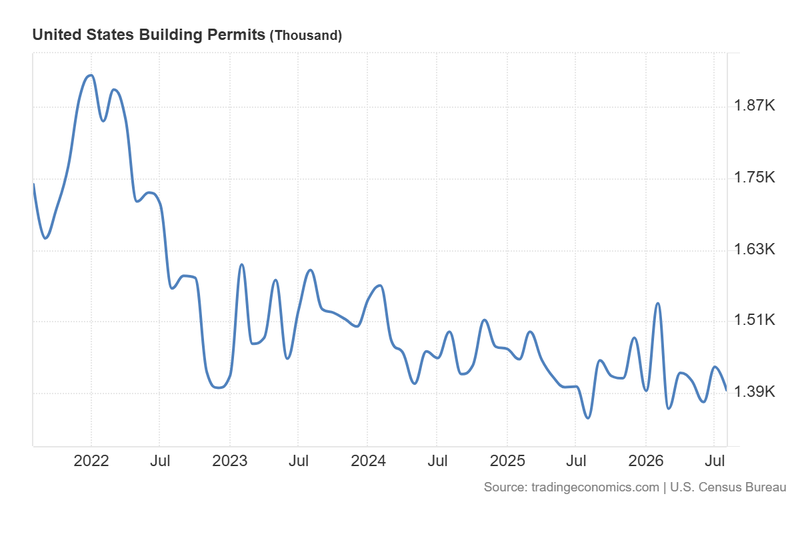
Figure 1. US Building Permits (2021–2026). Source: Data from the US Census Bureau; chart obtained via Trading Economics.

