
 Help
Help Daily discussion thread for September 25, 2026
Potential diplomatic talks between the United States and Iran regarding the reopening of the Strait of Hormuz have lowered crude oil benchmarks, whilst deteriorating German consumer confidence and persistently weak US consumer sentiment reflect ongoing global macroeconomic uncertainty.

Crude oil prices dropped by over 2% following prospects of US–Iran diplomatic talks aimed at reopening the Strait of Hormuz.
Unconfirmed diplomatic negotiations leave energy markets exposed to tail risks of escalation in the Middle East.
German GfK consumer confidence fell to -30.6 points, contrasting sharply with the Ifo business climate index that has reached a three-year high.
US consumer sentiment dropped to 48.1 points in September as persistent inflation and tariffs continue to weigh on household expectations.
Oil prices decline amid renewed prospects of US–Iran diplomatic talks to reopen the Strait of Hormuz
Crude oil prices declined amidst renewed optimism surrounding potential diplomatic negotiations between the United States and Iran that could lead to the reopening of the Strait of Hormuz. Iranian Foreign Minister Abbas Araghchi proposed reopening the vital waterway and resuming nuclear talks with Washington within a seven-day window, provided the US administration accepts Tehran's conditions—as quoted by CNBC. Notably, it is possible that implied conditions could align with the frameworks established in the Islamabad Memorandum of Understanding.
Furthermore, according to a Reuters report, US and Iranian negotiators are exploring a phased roadmap towards de-escalation, aiming to secure the reopening of the Strait of Hormuz alongside the termination of the blockade against Iran. These developments emerge just weeks ahead of the US midterm elections scheduled for November. This timeframe represents a crucial window for diplomacy, as sustained inflationary pressures remain a dominant driver of declining approval ratings for US President Donald Trump—a vulnerability Tehran may leverage to incentivize a return to formal negotiations.
Against this backdrop, key international crude benchmarks fell in tandem: the Brent crude futures contract declined by 2.77% to settle at $97.44 per barrel, whilst West Texas Intermediate (WTI) futures fell 2.33% to finish at $92.44 per barrel.
Nevertheless, official diplomatic talks remain unconfirmed, leaving energy markets vulnerable to further volatility amidst ongoing geopolitical friction across the Middle East. Tensions remain particularly acute between Houthi forces and Saudi Arabian troops near the Bab el-Mandeb Strait—a vital maritime bottleneck serving as a critical corridor for global energy transit.
German consumer confidence declines, contrasting an improvement in business climate
According to data published by GfK, Germany's Consumer Climate Indicator deteriorated from a revised reading of -26.8 points in September to -30.6 points heading into October, exceeding the consensus forecast of -27.4 points. This marks the lowest level recorded since May 2026. An analysis by Trading Economics indicates that the downturn in consumer sentiment was primarily driven by a sharp deterioration in income expectations, severely eroded by fears of elevated energy costs. Concurrently, the propensity to save surged, whereas the willingness to buy registered a slight contraction.
This widespread pessimism among consumers stands in sharp contrast to the improvement in the business climate index, which reached its highest level in approximately three years, as reported earlier this week by Germany's Ifo Institute. The Ifo report highlighted notable gains in both current business conditions and forward-looking expectations, underscoring an unusual divergence between corporate outlooks and household sentiment.
Following the GfK release, Germany's benchmark DAX 40 index advanced modestly by 0.56% to 25,408 points, whilst the EUR/USD currency pair appreciated marginally by 0.11% to $1.1388. These muted market reactions suggest that investors attached limited weight to the softer consumer confidence print.
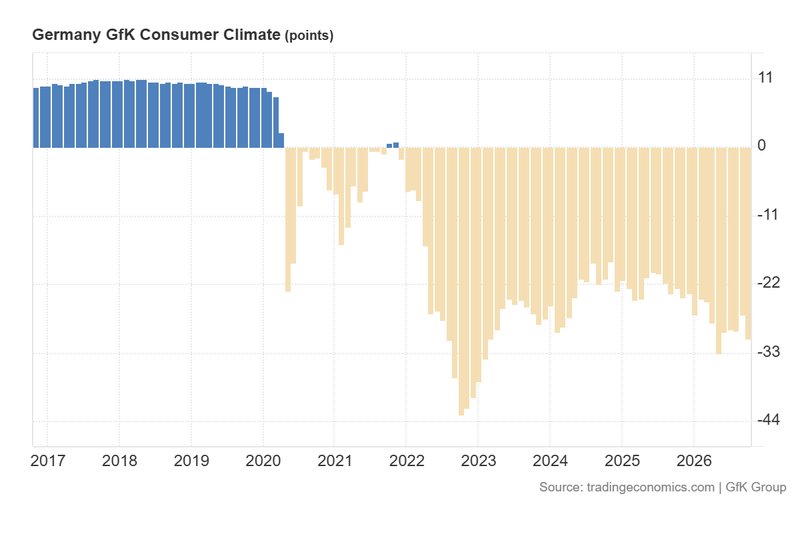
Figure 1. German GfK Consumer Confidence (2016–2026). Source: Data from the GfK Group; chart obtained via Trading Economics.
University of Michigan slightly upgrades consumer sentiment in final September revision
The University of Michigan reported a minor upward revision to its Index of Consumer Sentiment in the final reading for September. Nevertheless, overall indicators continue to reflect a distinct contraction in household sentiment.
Specifically, the headline Consumer Sentiment Index fell from 51.7 in August to 48.1 points in September, the Current Economic Conditions index slipped from 51.9 to 50.9 points, and the Index of Consumer Expectations dropped sharply from 51.5 to 46.3 points. The survey indicates that primary consumer anxieties stem from persistent inflationary pressures and the implementation of tariffs, both of which threaten real purchasing power and household expenditure.
Furthermore, the University of Michigan release indicated that inflation expectations remained elevated, with consumers anticipating one-year-ahead inflation at 4.6% and five-year-ahead inflation holding at 3.4%.
