
 Help
Help Daily discussion thread for September 28, 2026
US stock benchmarks fell as US–Iran diplomatic talks stalled, heightening Middle East geopolitical risks. Meanwhile, Indian industrial production growth exceeded forecasts.

US indices fell after President Trump rejected Iran's proposal to reopen the Strait of Hormuz as part of a conflict resolution agreement.
A prolonged conflict elevates the likelihood of global inflation and sustained interest rate risks.
India's industrial output beat forecasts by expanding 8.0% year-on-year in August, driven by manufacturing alongside electricity and gas supply.
The Nifty 50 index dropped 1.56%, demonstrating that geopolitical tensions outweighed robust Indian growth figures.
US stock indices decline as US and Iran fail to yield conflict resolution
US stock benchmarks dropped in tandem after the United States and Iran failed to achieve a resolution regarding their conflict in the Middle East. According to a Reuters report, US President Donald Trump rejected an Iranian proposal to reopen the Strait of Hormuz and cease military attacks. This rejection followed statements from Iranian officials emphasizing that only diplomacy could resolve ongoing tensions.
Against this backdrop, the US–Iran conflict may extend beyond the US mid-term elections. In recent weeks, Tehran had sought to resume diplomatic discussions, potentially in response to polling that signals a sharp drop in President Trump's popularity. However, the US President suggested that Iran is desperate to secure a deal—a stance that could prolong the conflict, as it overlooks underlying political pressures.
Concurrently, direct tensions between Saudi Arabia and Houthi forces—the latter supported by Iran—have persisted, disrupting energy supply chains through the Bab el-Mandeb Strait as Houthi control over this key maritime corridor expands.
Consequently, geopolitical pressures continue to push global inflation higher, compelling central banks to maintain restrictive monetary policy stances. This environment remains unfavourable for equities, as higher borrowing costs complicate growth projects while domestic consumption contracts.
As a result, major US stock benchmarks fell in tandem. The S&P 500 index declined by 0.77% to 7,683 points, the Dow Jones Industrial Average dropped by 0.67% to 51,487, and the Nasdaq 100 index fell by 1.08% to 30,276 points. In turn, European markets also moved lower, with the DAX 40, the UK FTSE 100, and the IBEX 35 indices dropping in parallel, while in Asia, the Nikkei 225 and FTSE China A50 indices also recorded losses.
India's industrial production accelerates above market expectations
According to data released by India's Ministry of Statistics and Programme Implementation (MOSPI), year-on-year industrial production accelerated from 7.4% in July to 8.0% in August, comfortably surpassing the market consensus forecast of 6.5%. Analysis by Trading Economics indicates that this expansion was driven by accelerating electricity and gas output, which surged 12.3% (up from +8.7% in July), alongside manufacturing output, which expanded by 9.0% (up from +8.2%). Notably, Indian industrial production has maintained an upward trajectory over the past year (see Figure 1).
Furthermore, MOSPI confirmed a notable acceleration in manufacturing output over the same period, with year-on-year growth rising to 9.0% from 8.2% in the previous month.
However, despite the underlying strength in Indian economic performance, the benchmark Nifty 50 index dropped by 1.56% to 22,780 points. This highlights that market participants are assigning greater weight to escalating geopolitical tensions and global inflationary risks than to resilient domestic growth fundamentals. In the second quarter of 2026, India's gross domestic product (GDP) growth rate advanced by 1.8%, signalling economic resilience.
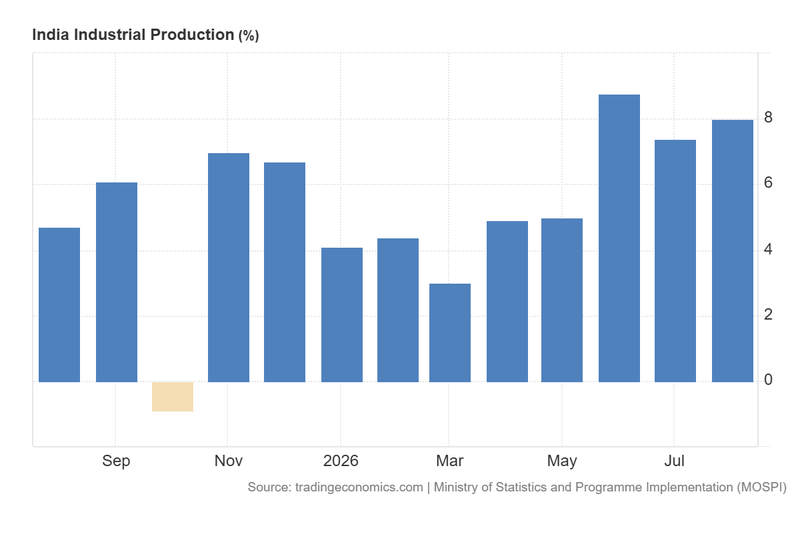
Figure 1. India Industrial Production (2025-2026). Source: Data from the Ministry of Statistics and Programme Implementation (MOSPI); chart obtained via Trading Economics.
Key economic events this week
Several critical economic indicators and policy announcements are scheduled for release this week, with the following of particular importance to market participants:
Tuesday
- Australia: RBA Interest Rate Decision
- US: JOLTs Job Openings
Wednesday
- China: NBS Manufacturing PMI
- Germany: Inflation Rate
- US: ADP Employment Change
- US: PCE Price Index
- US: EIA Crude Oil Stocks Change
Thursday
- Australia: Balance of Trade
- US: ISM Manufacturing PMI
Friday
- European Union: Inflation Rate
- US: Non Farm Payrolls
- US: Unemployment Rate
