
 Help
Help Daily discussion thread for September 29, 2026
US 30-year Treasury yields reached levels not seen since 2002 amidst heightened Federal Reserve rate hike expectations, elevated oil prices, and weakening consumer confidence. Meanwhile, the Reserve Bank of Australia (RBA) raised its cash rate by 25 basis points to 4.6%.

Yields on 30-year US Treasury bonds reached 5.57%, their highest level since 2002, driven by hawkish Federal Reserve expectations.
Brent crude trades to $96.16 per barrel amidst persistent geopolitical tensions and supply risks in the Middle East.
US consumer confidence fell to 81.9 in September, reaching its lowest level since 2014.
The Reserve Bank of Australia raised its cash rate by 25 basis points as headline inflation remains above target at 3.5%.
US 30-year government bond yields reach highest level since 2002
Yields on 30-year US Treasury bonds rose to 5.57%, reaching a level not observed since 2002. This selling pressure in the sovereign bond market stems from growing expectations that the Federal Reserve will adopt a more restrictive monetary policy stance at upcoming meetings. According to the CME FedWatch Tool, market-implied probabilities signal an increased likelihood that the central bank could deliver one or two additional benchmark interest rate hikes before the end of 2026.
Additionally, expectations of tighter monetary policy have been further fuelled by sustained high oil prices. At market close, the Brent crude futures contract (BRN) settled at $96.16 per barrel, whilst the West Texas Intermediate (WTI) futures contract (CL) finished at $89.40 per barrel. Although crude prices remain below the $100 milestone, ongoing Middle East hostilities maintain significant uncertainty regarding potential energy supply disruptions should the US-Iran conflict persist over time.
In this context, market participants are focussing on two critical economic indicators scheduled for release this week: the Personal Consumption Expenditures (PCE) Price Index—the Federal Reserve's preferred inflation gauge—and the Bureau of Labor Statistics (BLS) employment report. Should inflation remain elevated while labour market data signals resilience, the US central bank may be further inclined to reinforce its hawkish posture.
Meanwhile, US equity benchmarks closed mixed amidst broader macroeconomic and geopolitical uncertainty. The S&P 500 index declined by 0.17% to 7,670 points, whilst the Dow Jones Industrial Average dropped by 0.26% to 51,355 points. Conversely, the Nasdaq 100 index gained 0.21% to close at 30,339 points.
RBA increases benchmark interest rate in line with analysts' expectations
The Reserve Bank of Australia (RBA) raised its benchmark cash rate by 25 basis points to 4.6%, in line with consensus forecasts. This decision marks the highest policy rate since October 2011, underscoring the Australian central bank's commitment to maintaining a restrictive monetary stance amidst persistent inflation.
Headline inflation currently stands at 3.5%, remaining above the RBA's target range of 2.0% to 3.0%. Against this backdrop, the Monetary Policy Board voted unanimously for the hike amidst elevated global energy prices linked to the Middle East conflict. The Board emphasised that whilst inflationary pressures persist, the central bank remains committed to taking necessary policy actions to guide inflation back to its target band. Notably, Australian policy rates now mark an inflection point, departing from the long-term downward trend observed over recent years (see Figure 1).
Following the announcement, the Australian dollar depreciated by 0.48% against the US dollar, with the AUD/USD currency pair settling at 0.6984 at market close.
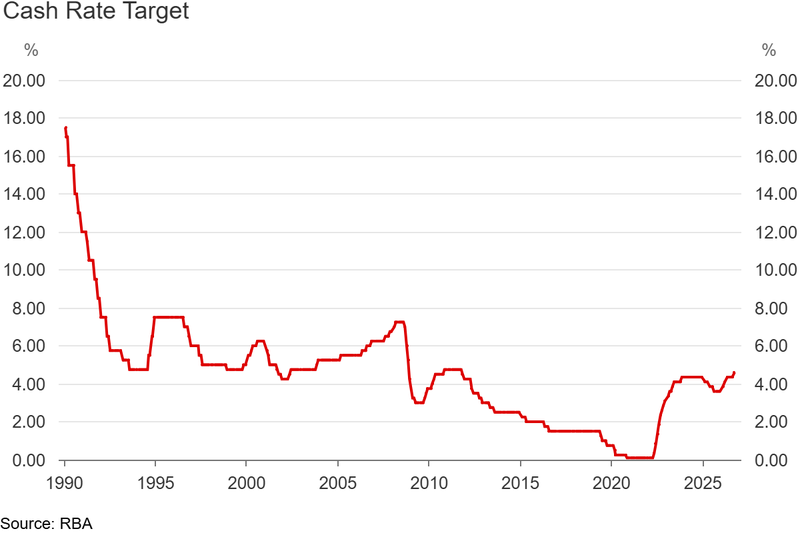
Figure 1. Australia Interest Rate (1990–2026). Source: Data from the Reserve Bank of Australia.
US consumer confidence drops to lowest level since 2014
Data released by The Conference Board in the United States showed the Consumer Confidence Index falling from 88.6 in August to 81.9 in September, trailing the market consensus forecast of 89.2. This reading marks the lowest level recorded since 2014. Concurrently, the Present Situation Index fell by 7.9 points to 109.3, whilst the Expectations Index dropped 5.9 points to 63.6.
The primary headwinds suppressing domestic confidence include high costs for goods and services—particularly fuel—alongside heightened geopolitical and trade anxieties impacting the US economy. Additionally, growing labour market concerns were cited alongside a pessimistic outlook regarding personal finances. Consumers' 12-month average inflation expectations stood at 6.1%, reflecting widespread anticipation that energy price pressures will persist while Middle East tensions remain unresolved in the short term.
