
 Help
Help Daily discussion thread for September 4, 2026
US non-farm payrolls for August surged by 162,000, significantly exceeding expectations and boosting odds of a Federal Reserve interest rate hike. Meanwhile, political pressure on the Fed, weak Canadian employment figures, and mixed stock market performances introduced further uncertainty for market participants.

US non-farm payrolls (NFP) jumped by 162,000 in August, surpassing market estimates while the unemployment rate held steady at 4.1%.
The CME FedWatch tool indicated that the probability of a rate hike rose to 58.6% ahead of the upcoming inflation report.
Donald Trump exerted pressure on the Federal Reserve to cut rates, exacerbating concerns regarding central bank independence.
Canadian employment contracted by 41,700 jobs, strengthening the US dollar against the Canadian dollar.
US Non-Farm payrolls accelerate considerably beyond analysts' expectations
The US Bureau of Labor Statistics (BLS) published a strong employment report for August. According to the BLS, non-farm payrolls (NFP) jumped by 162,000—a solid increase compared to the previous reading of 21,000. This macroeconomic update comfortably surpassed market expectations of 56,000, demonstrating underlying strength in the labour sector. Notably, the August print represents the highest level in five months, pointing to economic resilience in the job market despite the ongoing US–Iran conflict in the Middle East weighing on business confidence.
Additionally, the BLS reported that the unemployment rate remained unchanged at 4.1%, in line with analysts' expectations. This unemployment figure indicates underlying stability in the labour market, as current levels remain the lowest recorded since June 2025. Furthermore, although the broader NFP trend reflects a gradual deceleration over a five-year horizon, net job creation over the past three years demonstrates a period of consolidation, pointing towards market stabilisation.
In this context, a Reuters report suggests that the implied deceleration in non-farm payroll growth has been driven by the US administration, led by Donald Trump, through its crackdown on immigration via deportations and revocations of Temporary Protected Status (TPS). Additionally, several information-related sectors have experienced periods of job contraction—an outcome economists largely attribute to the widespread adoption of artificial intelligence. Consequently, despite the strong employment release, underlying risks persist in the US labour sector, which investors will likely monitor closely in the coming months.
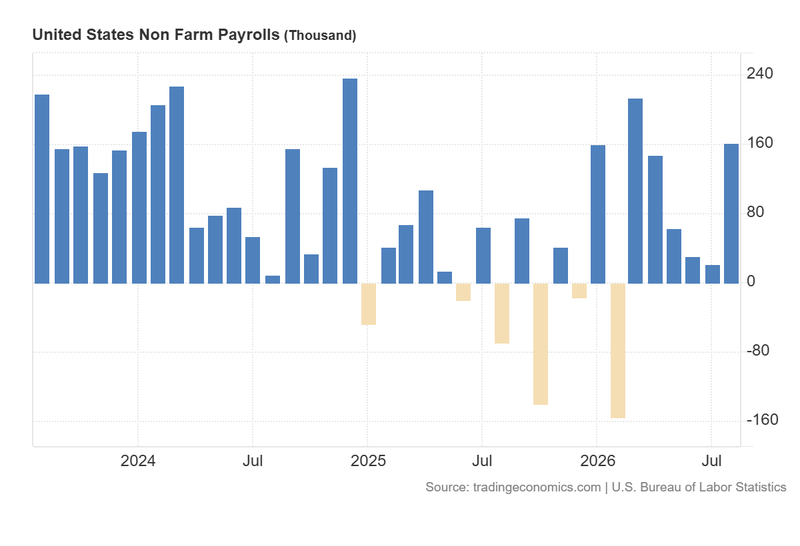
Figure 1. US Non-Farm Payrolls (2023–2026). Source: Data from the US Bureau of Labor Statistics; chart obtained from Trading Economics.
Are market participants anticipating an interest rate hike?
In response to the BLS report, market expectations for a Federal Reserve rate hike surged. According to the CME FedWatch Tool, the market-implied probability of a rate increase at the Fed's September meeting rose from 49.5% to 58.6% following the employment release. This shift reflects expectations that the US central bank may pivot its focus towards inflationary pressures, given the apparent stability of the labour market. Conversely, the probability of interest rates remaining unchanged declined from 50.5% prior to the release to 41.4%.
Market participants are now turning their attention to the upcoming BLS inflation report due next week. Prices performance is expected to serve as the key determinant for the Federal Reserve's monetary policy decision on 16 September.
Meanwhile, US equity markets demonstrated heightened uncertainty, with major benchmarks closing mixed. The S&P 500 fell by 0.38% to 7,718 points, while the Dow Jones Industrial Average declined by 0.51% to 53,419 points. Conversely, the Nasdaq 100 rose by 0.21% to 29,544 points, buoyed by solid quarterly earnings results from semiconductor firms.
Trump exerts pressure on the Federal Reserve to cut rates
US President Donald Trump issued statements exerting renewed pressure on the Federal Reserve to adopt a more dovish monetary stance. As quoted by Reuters, the President stated: "Unless the Federal Reserve cut interest rates, he would stop trading with countries which the US had a deficit." Furthermore, Trump asserted that high interest rates place the country at a disadvantage—something he claimed he would not permit.
Concurrently, CNBC noted that Donald Trump hailed the August employment report as a "great jobs number", maintaining that the US central bank ought to lower interest rates rather than raise them.
These comments highlight a potential risk to Federal Reserve independence—a factor that market participants have weighed in prior periods. Central banks internationally rely on operational independence from the sitting government, given that political administrations and monetary authorities often pursue conflicting objectives, with central banks primarily tasked with inflation containment. While the US administration continues to apply persistent pressure for lower interest rates, the upcoming BLS inflation report remains the primary factor shaping Federal Reserve policy. Should monetary policy decisions diverge from economic data, financial markets could react negatively to a perceived compromise in central bank independence.
Canadian labour market exhibits weakness in latest update
According to data released by Statistics Canada, Canadian employment contracted by 41,700 jobs in August, missing analysts' expectations of a 15,000 gain. This marks the sharpest monthly contraction since February 2026, indicating that the labour market faces headwinds from a challenging domestic economic climate. Days prior to the release, the US administration announced new tariffs on Canadian goods, threatening to erode Canada's recent economic resilience.
Nevertheless, Statistics Canada reported that the unemployment rate held steady at 6.4% in August, matching consensus forecasts. While this reading suggests headline stability, underlying vulnerabilities persist, while the rate stands at its lowest level since July 2024.
Following the Canadian employment release, the USD/CAD currency pair rose by 0.33% to 1.3837, driven by a strengthening US dollar and elevated expectations that the Federal Reserve may adopt a more restrictive monetary stance at its upcoming meeting.
