
 Help
Help Daily discussion thread for September 8, 2026
China's trade surplus grew to $119.1 billion driven by strong technology exports, while Australian business and consumer sentiment deteriorated amid inflation and interest rate concerns. Meanwhile, escalating tensions in the Middle East pushed crude oil prices higher on renewed supply disruption fears.

China's trade balance reached $119.1 billion in August, propelled by a 25% year-on-year surge in technology exports.
Australian consumer and business confidence dropped significantly, weighed down by persistent cost pressures and fears of further interest rate hikes.
Houthi attacks on Saudi oil facilities pushed Brent crude to $97.92 per barrel amid heightened Middle Eastern supply concerns.
Investors look ahead to US inflation metrics, corporate earnings from Oracle and Adobe, and the European Central Bank's rate decision.
Chinese trade balance expands, signalling economic resilience
According to data from China's General Administration of Customs, the nation's trade balance rose from $112.5 billion in July to $119.1 billion in August, aligning with market consensus forecasts. This outcome reinforces a sustained upward trajectory observed over the past decade (see Figure 1).
The expansion in China's trade surplus was primarily driven by artificial intelligence (AI) related products, which continue to underpin export performance. Exports advanced by 25% year-on-year. An analysis by Trading Economics indicates that high-tech products accounted for more than half of overall export growth, led by integrated circuit exports—which climbed by 130%—and high-tech sales, which grew by 57%. Conversely, Chinese imports were heavily weighted towards commodities, dominated by crude oil, natural gas, coal, and iron ore.
In this context, export strength continues to support the Chinese economy. On one hand, China's advancing high-tech capabilities are establishing the country as a key global player that is increasingly less dependent on foreign innovation. Furthermore, China maintains a leadership position in critical sectors such as renewable energy, battery technology, electric vehicles, and rare earth minerals. On the other hand, sluggish domestic consumption remains a primary structural weakness, constraining broader economic expansion across the nation.
Regarding downside risks to Chinese export flows, the substantial trade surpluses maintained with the United States and the European Union could face restrictions should both regions implement tariffs to curb their commercial deficits. Both jurisdictions have urged Beijing to address these imbalances. Market participants are now focused on the upcoming diplomatic summit between Chinese President Xi Jinping and US President Donald Trump, where potential trade agreements may be reached.
Following the release of the economic data, the FTSE China A50 index declined by 0.74% to 14,563 points, while the Hang Seng Index depreciated by 0.44% to close at 25,222 points.
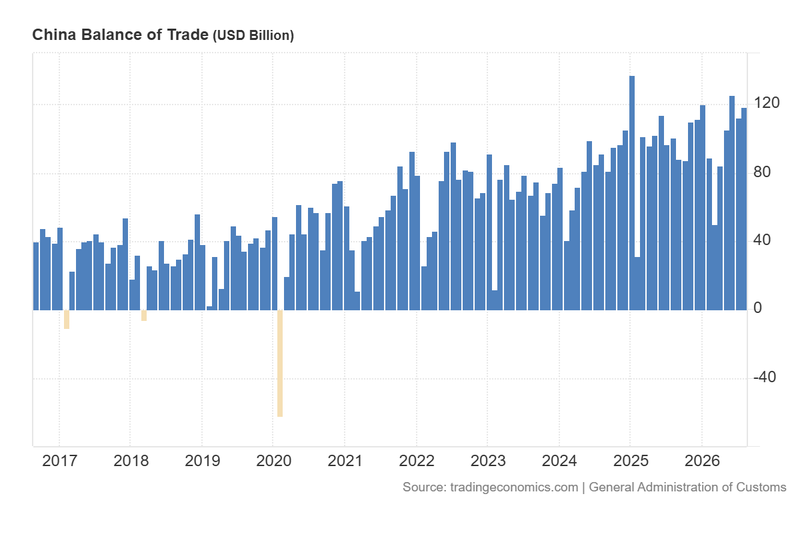
Figure 1. China Balance of Trade (2016–2026). Source: General Administration of Customs of China; chart via Trading Economics.
Australian confidence falls amid growing economic uncertainty
Data released by Westpac Banking Corporation reveals that Australian consumer confidence contracted in September, falling to 84.4 points from 88.9 in August—a monthly drop of 5.2%. This decline in sentiment was predominantly driven by rising fuel prices and heightened concerns over potential monetary tightening by the Reserve Bank of Australia (RBA). The RBA faces a delicate balancing act, with the unemployment rate lingering near its highest level in three years alongside an inflation rate of 3.5%, which remains above the central bank's target range.
Concurrently, National Australia Bank (NAB) reported that business confidence fell by 8 points in August, deepening the 6-point decline recorded in the previous reading. This represents the lowest level for business confidence since May 2026, reflecting widespread corporate apprehension regarding the current economic landscape. The NAB report highlighted that this deterioration stemmed primarily from underlying weakness in business activity, capital investment, and employment. Additionally, persistent cost pressures continue to complicate the operational environment for Australian firms.
Following these reports, the AUD/USD currency pair traded flat, reflecting broader foreign exchange market uncertainty as the US dollar faced concurrent pressure from mounting concerns over US sovereign debt levels.
Houthi attacks on Saudi infrastructure escalate Middle East tensions as oil prices advance
Crude oil benchmarks advanced in tandem amid heightened Middle Eastern tensions, generating concerns about ongoing energy supply disruptions. The Brent crude futures contract (BRNX6) advanced by 0.95% to $97.92 per barrel, while West Texas Intermediate (WTI) crude futures contract (CLV6) rose by 1.71% to $93.04 per barrel.
According to reports from Reuters, Houthi forces launched strikes targeting four cities in southern Saudi Arabia, causing fires and inflicting damage on energy facilities. Against this backdrop, market participants are concerned that global energy supply bottlenecks could worsen if maritime flow through the Bab el-Mandeb Strait contracts while traffic through the Strait of Hormuz remains limited. Such conditions risk further constricting crude supply and driving energy prices higher.
Quarterly US financial results
The second-quarter 2026 earnings season continues this week. The following key corporate earnings are scheduled for release, which may contribute to further volatility across US equity markets:
Thursday
- Oracle Corporation (ORCL)
- Adobe Systems (ADBE)
Key economic events this week
Several critical economic indicators are scheduled for release this week, with the following of particular importance to market participants:
Tuesday
- Australia: Westpac consumer confidence change
- Australia: NAB business confidence
- China: Balance of trade
- Germany: Balance of trade
Wednesday
- China: Inflation rate
Thursday
- European Union: ECB interest rate decision
- US: Existing home sales
- US: EIA Crude Oil Stocks Change
Friday
- US: Inflation rate
- US: Michigan consumer sentiment

