
 Help
Help Fed hike risks grow; India inflation accelerates; investors focus on US bank reports
Cleveland Federal Reserve President Beth Hammack has signalled potential US interest rate hikes amidst persistent inflation, while India's headline inflation accelerated to a near two-year high. Meanwhile, market participants brace for major corporate earnings reports and key economic releases later this week.

Beth Hammack warns that additional rate hikes may be required as US inflation remains well above the 2% target.
US 10-year Treasury yields linger near multi-year highs of 5.24% on hawkish Federal Reserve expectations.
India's annual inflation rate reached 5.54% in September, driven by rising food costs, elevated crude oil prices, and currency weakness.
Major US financial institutions prepare to report quarterly financial results alongside key consumer price index (CPI) releases.
Beth Hammack signals rate hikes may be needed to prevent inflation expectations from becoming entrenched
Cleveland Federal Reserve President Beth Hammack stated that tighter monetary policy could be necessary to contain inflation and prevent an inflationary mindset from becoming entrenched in the economy, as cited by CNBC.
However, following her remarks, market-implied probabilities for upcoming Federal Reserve meetings remained largely steady. According to the CME FedWatch Tool, pricing reflects a 79% likelihood that the Federal Reserve will hold its benchmark interest rate unchanged at 4.0% at its October meeting. Conversely, the metric indicates a 70% probability of a 25-basis-point rate hike at the December meeting.
Currently, the US Personal Consumption Expenditures (PCE) Price Index—the Fed’s preferred inflation metric—stands at 3.4%, whilst the Core PCE rate sits at 3.0%. Although both figures held steady in their latest readings, they remain considerably above the central bank’s 2% target. This persistent inflationary environment has endured for over five years, raising concerns that elevated price pressures may prove sticky and difficult to reverse.
Consequently, bondholders have exerted selling pressure on long-dated Treasury securities amidst growing expectations that the central bank will need to adopt a more restrictive policy stance, thereby driving Treasury yields to multi-year historical highs. At market close, the 10-year Treasury yield settled near 5.24%, remaining close to its multi-year peak of 5.3%—a level last witnessed in 2002.
India's inflation rate accelerates to a near two-year high
According to data released by the Ministry of Statistics and Programme Implementation (MOSPI) of India, headline inflation accelerated from 4.83% in August to 5.54% in September (year-on-year), exceeding consensus estimates of 5.4%. Consequently, this represents the highest reading recorded since October 2024. Analysis from Trading Economics highlights that substantial price pressure stemmed from food costs, which surged by 7.74% year-on-year, whilst elevated oil prices and a sharp depreciation of the Indian Rupee accelerated transportation inflation (+5.01%).
Year-to-date, the Indian Rupee has depreciated by approximately 6.5% against the US dollar. This has mounted pressure on the Reserve Bank of India (RBI) to raise its benchmark policy rate. Facing the dual challenges of surging inflation and currency weakness, the central bank implemented a 25-basis-point rate hike in its latest policy decision, bringing the repo rate to 5.5%.
Against this backdrop, India remains heavily exposed to rising energy costs as the US–Iran conflict in the Middle East persists, given the country's substantial reliance on crude imports from the region. Consequently, this creates a dual inflationary shock: India must import crude oil at elevated dollar prices whilst its domestic currency depreciates against the greenback.
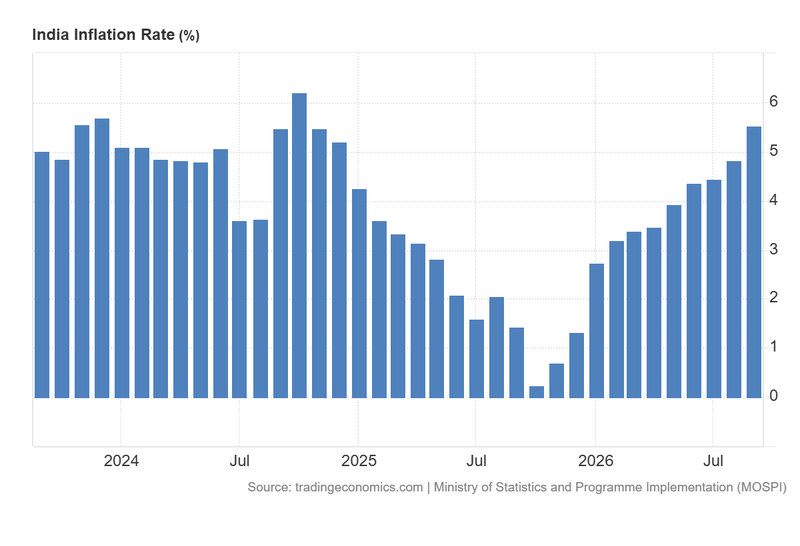
Figure 1. India Inflation Rate (2023–2026). Source: Data from the Ministry of Statistics and Programme Implementation (MOSPI); figure retrieved from Trading Economics.
Quarterly US financial results
The second-quarter 2026 earnings season starts this week. The following major financial institutions and corporations are scheduled to report, which may contribute to further volatility across US equity markets:
Tuesday
- JPMorgan Chase (JPM)
- Goldman Sachs (GS)
- Wells Fargo (WFC)
- Citigroup (C)
- Johnson & Johnson (JNJ)
- UnitedHealth (UNH)
Wednesday
- Bank of America (BAC)
- Morgan Stanley (MS)
- BlackRock (BLK)
Thursday
- The Charles Schwab (SCHW)
Key economic events this week
Several critical economic indicators are scheduled for release this week, with the following being of particular importance to market participants.
Tuesday
- Australia: NAB Business Confidence
- US: Existing Home Sales
Wednesday
- China: Inflation Rate
- China: Balance of Trade
- US: Inflation Rate
Thursday
- United Kingdom: Gross Domestic Product
- United Kingdom: Industrial Production
- US: Producer Price Index
- US: Retail Sales
- US: EIA Crude Oil Stocks Change
