
 Help
Fed tightening expectations rise; Mexico output falls
Distressing US inflation figures have fuelled Federal Reserve interest rate hike expectations and strengthened the US dollar. Meanwhile, Mexico’s industrial output fell sharply in September (monthly change).

Comments by the Chicago Federal Reserve Bank President raised market expectations of a US interest rate hike in December.
The US Dollar Index climbed to 102.84 points, reaching its highest level since April 2025.
Mexican industrial production fell by 1.4% in September (monthly change).
Persistent Middle Eastern maritime incidents drove Brent and WTI crude futures higher.
Date: 12 November 2026 (GMT+3)
Expectations of further interest rate hikes by the Fed strengthen as FOMC member describes US inflation as "disturbing"
Expectations of a more restrictive monetary policy stance by the Federal Reserve mounted after Chicago Federal Reserve Bank President Austan Goolsbee described the latest inflation reading as "another distressing report, borderline disturbing", as quoted by CNBC. The Federal Open Market Committee (FOMC) member noted that the US central bank faces a developing inflation issue, signalling that further interest rate hikes may be implemented to contain prices.
Consequently, the CME FedWatch Tool indicated heightened expectations of an interest rate increase at the Fed's December meeting, with market-implied probabilities pointing to an 87% likelihood of a 25-basis-point hike, alongside a 13% probability of a 50-basis-point increase. These odds have risen steadily in recent days after the Bureau of Labour Statistics (BLS) reported on Tuesday that US inflation exceeded analysts' forecasts.
Following the Chicago Fed President's comments, the US Dollar Index (DXY)—which tracks the greenback's performance against a basket of major currencies including the euro, British pound, and Japanese yen—rose firmly by 0.61% to 102.84, reaching its highest level since April 2025.
Mexico's industrial production experiences its sharpest monthly contraction since October 2024
According to data published by Mexico's Instituto Nacional de Estadística y Geografía (INEGI), industrial production dropped by 1.4% month-on-month (MoM) in September, missing the 0.2% contraction forecast by analysts. This marks the sharpest monthly decline since October 2024. Consequently, year-on-year (YoY) industrial production growth decelerated sharply from 3.5% in August to 1.3% in September.
INEGI's report indicated that the underlying deceleration was primarily driven by manufacturing activity, which eased from 3.2% to 0.6%, as well as petroleum and coal product output, which slowed sharply from 21.4% to 0.4%, as cited by Trading Economics. Additionally, construction sector growth moderated from 7.5% to 4.9%.
While the Mexican economy has remained resilient—with gross domestic product (GDP) growing at 3.2% in Q3 2026—industrial output and retail sales have experienced slowdowns in recent months. This trend has been driven by ongoing trade uncertainty with the United States and heightened concerns over elevated energy prices, both of which have weighed on domestic consumption and private investment.
Notably, the Banco de México decided to cut its benchmark interest rate by 25 basis points last week to 6.25%, seeking to support the economy by prioritising growth.
Following the INEGI release, the Mexican peso depreciated by 0.20% against the US dollar, with the USD/MXN exchange rate closing at 18.58.
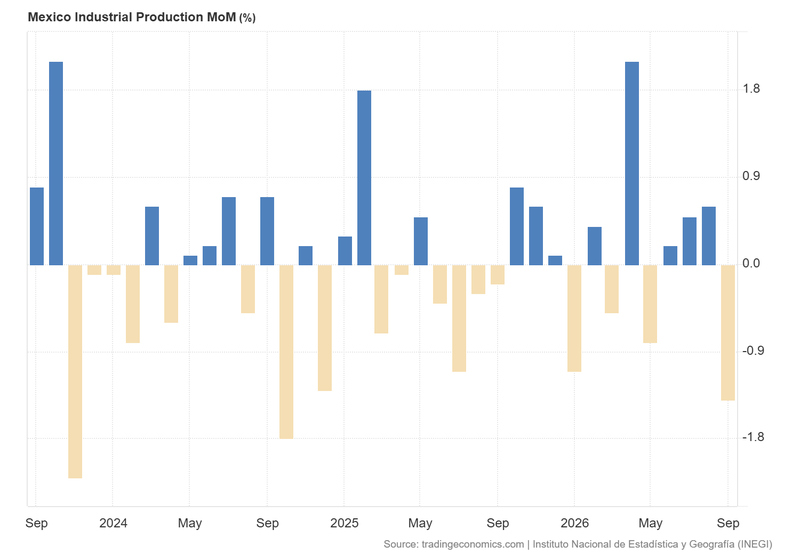
Figure 1. Mexico Industrial Production MoM (2023–2026). Source: Data from the Instituto Nacional de Estadística y Geografía (INEGI); chart retrieved via Trading Economics.
Oil prices advance amid persistent geopolitical tensions in the Middle East
Oil prices advanced marginally amid persistent tensions in the Middle East, despite rising hopes of potential conflict resolution between the US and Iran. Brent crude futures (BRN) rose by 1.39% to $92.76 per barrel, whilst West Texas Intermediate (WTI) futures (CL) advanced by 0.57% to $86.53 per barrel.
According to a Reuters report, the United Kingdom Maritime Trade Operations (UKMTO) agency reported an incident involving a tanker in the Strait of Hormuz. Meanwhile, Iranian authorities stated that an oil tanker caught fire following an impact with a naval mine. Against this backdrop, the Washington Institute for Near East Policy recorded at least 10 maritime attacks on vessels in November, following 37 reported attacks in October, as cited by the news agency.
The monthly average for maritime incidents stands at 15 since March 2026. This highlights that shipping route uncertainty has persisted since the outbreak of the conflict, despite a relative pause in broader geopolitical friction between Washington and Tehran.
Additionally, ongoing tensions between the Houthi movement and Saudi Arabia continue to persist, reinforcing regional uncertainty across the Middle East.
