
 Help
Help Geopolitical tensions escalate, raising risk of US response; China, US exports grow
Middle East tensions intensified as continued Israeli-Iranian attacks and a US threat of retaliation raised fears of a wider conflict, although oil prices fell. Meanwhile, US exports reached a record level on strong demand for petroleum products and capital goods, while Chinese exports and imports exceeded expectations, supporting local equities.

Israeli-Iranian strikes continued, while Trump’s warning raised the risk of direct US military involvement in the conflict.
Oil prices fell despite tensions: Brent declined by 2.97% to $91.45 and WTI by 3.43% to $88.19, as markets weighed hopes of de-escalation.
US exports reached a record $327.1 billion in April, led by petroleum products and capital goods; the trade deficit was slightly narrower than expected.
China’s exports rose by 19.4% and imports by 27.4% in May, lifting the trade surplus to $105.43 billion and supporting equities.
Renewed geopolitical tensions raise the prospect of a US response; oil prices decrease
Geopolitical tensions continue to intensify in the Middle East. Although Israel and Iran have discussed the possibility of a ceasefire, bilateral attacks have persisted, raising concerns that the conflict could escalate into a broader regional dispute. In addition, US President Donald Trump wrote in a social media post that Iran had attacked the US Apache helicopter that was patrolling the Strait of Hormuz and threatened to respond, increasing doubts that US forces may return to direct hostilities. Iranian officials have stated that Tehran remains open to continuing negotiations with the White House in order to reach a ceasefire agreement, but warned that it would retaliate if Israel advanced its offensive in Lebanon.
Concurrently, the US Energy Information Administration (EIA) projected that global petroleum production and oil demand would decline in 2026 as a consequence of the US–Israel–Iran conflict in the Middle East, according to Reuters. The EIA also stated that inventories in Organisation for Economic Co-operation and Development (OECD) countries could fall to their lowest levels since 2003 owing to the increasing use of oil reserves in response to the energy supply shock.
At market close, the Brent futures contract (BRNQ6) fell by 2.97% to $91.45 per barrel, while the West Texas Intermediate (WTI) futures contract (CLN6) declined by 3.43% to $88.19 per barrel.
US exports rise amid solid international energy sales
According to data from the US Census Bureau, exports increased from $318.78 billion in March to $327.10 billion in April, marking a new historical high over the past ten years. Furthermore, US imports rose from $375.4 billion to $383 billion. Consequently, the US trade balance recorded a deficit of $55.9 billion, a figure slightly narrower than the $56.1 billion deficit expected by analysts.
A Reuters report indicates that this strong performance in US exports was primarily driven by petroleum products and capital goods, both of which rose to record levels. These results are correlated with rising international demand for US crude-related products as a consequence of severe disruptions to energy supply chains in the Middle East. In addition, the increase in capital goods reflects growing demand for products linked to the expansion of artificial intelligence.
Although the US trade figures point to solid economic conditions, the main US equity benchmarks closed mixed in a highly volatile trading session amid renewed geopolitical uncertainty, which is increasing expectations that the Federal Reserve could adopt a more hawkish stance in upcoming meetings. The S&P 500 index fell by 0.26% to 7,386 points, while the Nasdaq 100 declined by 1.12% to 29,084 points. By contrast, the Dow Jones Industrial Average rose by 0.17% to 50,877 points.
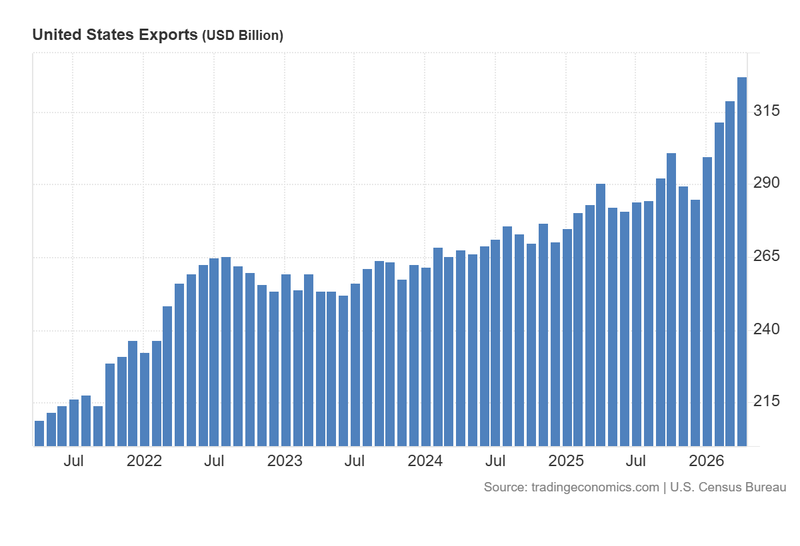
Figure 1. US Exports (2021–2026). Source: Data from the US Census Bureau; figure obtained from Trading Economics.
Chinese exports advance and the trade balance increases
According to data from the General Administration of Customs of China, exports increased by 19.4% in May on a year-on-year basis, exceeding analysts’ expectations of a 15% rise and the previous reading of 14.1%. In turn, Chinese imports rose by 27.4%, surpassing the market consensus forecast of 15% and the prior reading of 25.3%. Consequently, the trade balance increased from $84.8 billion in April to $105.43 billion in May, marking its strongest performance since January 2026.
Although these levels do not represent record highs, they do reflect an improvement in Chinese production, as stronger international demand supports Chinese goods and services, as well as an improvement in domestic consumption, which is driving demand for foreign products.
In terms of market reaction, the FTSE China A50 index rose by 1.04% to 15,349, while the Hang Seng index recorded a marginal gain of 0.23% to 24,629 points.

