
 Help
High US PCE, Trump tariffs and hawkish Fed outlook weigh on stocks
Accelerating US inflation, upward Q3 GDP revision, Donald Trump's newly proposed tariffs on major trading partners, and heightened scrutiny of AI stock valuations pressured US equity markets amid hawkish Federal Reserve interest rate expectations.

Q3 US GDP growth reached 4.3% while Core PCE rose to 3.3%, fuelling expectations of potential Fed rate hikes.
US President Trump proposed tariffs of 20% to 40% on 14 major trading partners, adding trade and inflation uncertainty.
Heavy scrutiny of AI valuations dragged down major technology stocks such as Nvidia, Amazon, and Micron.
The S&P 500 and Nasdaq fell slightly amid heightened volatility, while the Dow Jones recovered to close 0.33% higher.
Date: 26 November 2026 (GMT+3)
US GDP growth rate is revised firmly upwards while the PCE price index accelerates
According to data released by the US Bureau of Economic Analysis (BEA), the gross domestic product (GDP) growth rate was revised upwards in its second estimate. Consequently, GDP growth accelerated significantly from 2.2% in Q2 to an annualised rate of 4.3% in Q3 2026. Notably, this upward revision exceeded analysts' expectations of a 3.5% reading. This represents the strongest quarterly economic expansion since Q3 2023, suggesting that the US economy remains robust and resilient.
Furthermore, the BEA reported that the headline Personal Consumption Expenditures (PCE) Price Index—the primary inflation gauge considered by the Federal Reserve for monetary policy decisions—accelerated from 3.7% to 3.8% year-on-year (YoY). Additionally, the BEA revealed that the Core PCE Price Index—which excludes the volatile energy and unprocessed food components—advanced from 3.1% to 3.3% YoY. This marks the highest reading since November 2023, signalling the risk that core inflation may be experiencing second-round effects from elevated energy prices and tariffs.
The combination of solid economic growth and elevated inflation is reinforcing expectations that the Federal Reserve will adopt a more restrictive monetary policy stance at its upcoming meetings, as the central bank could prioritise price containment. According to the CME FedWatch Tool, market-implied probabilities signal a 98% likelihood of a 25-basis-point interest rate hike at the Fed's December meeting. Furthermore, pricing for the January 2027 meeting indicates a 60% probability of a subsequent 25-basis-point rate increase.
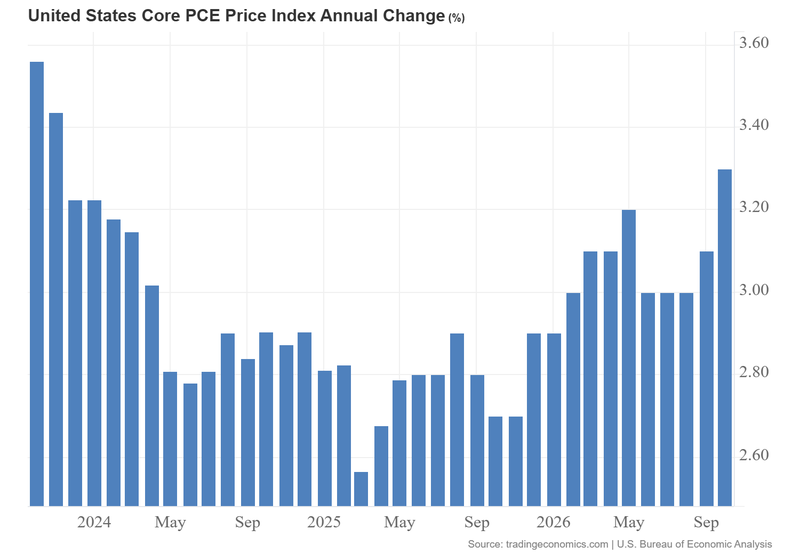
Figure 1. US Core PCE Price Index YoY (2023–2026). Source: Data from the US Bureau of Economic Analysis; chart retrieved via Trading Economics.
US President Donald Trump proposes new tariffs on 14 major trading partners
US President Donald Trump proposed a new wave of tariffs on 14 major trading partners, including China, Japan, and the European Union—as cited by Reuters. The proposed headline tariff rates range from 20% to 40%. However, the US administration indicated that proposed duties would be capped at lower levels consistent with trade agreements already concluded or currently under negotiation.
Crucially, although the implementation of the proposed tariffs remains subject to further regulatory procedures under US trade legislation, the announcement added pressure to equity markets as investors weighed renewed trade uncertainty, alongside concerns over the Federal Reserve's monetary policy outlook and the sustainability of AI-related valuations.
US stock markets fall amid rising hawkish Fed expectations, renewed concerns over technology firms, and Trump's tariff proposals
US equity markets experienced a markedly volatile session amid investor concerns surrounding hawkish Fed expectations, AI-related valuations, and the potential implementation of US tariffs.
The S&P 500 index declined by 0.25% to 7,182 points (following a 3% intraday drop), while the Nasdaq 100 index fell by 0.64% to 26,046 points (after a 4% intraday decline). Conversely, although the Dow Jones Industrial Average touched an intraday low of -2%, the index recovered during the session to close 0.33% higher at 50,188 points.
A more restrictive monetary stance from the Federal Reserve weighs on equities by increasing the cost of debt and disincentivising growth projects, while a higher cost of capital embedded in discounted cash flow models reduces the present value of projected cash flows and compresses equity valuations. Meanwhile, should another wave of tariffs be implemented, upward price pressures could intensify as imports become costlier for US importers, further fuelling inflation.
Additionally, pronounced selling pressure on AI-related firms—driven by heightened investor scrutiny—weighed on US stock markets. Notably, market capitalisation within the S&P 500 index is heavily concentrated in technology firms, meaning that a targeted sell-off in AI-related or semiconductor companies can drag down the broader market. Notable decliners included Nvidia, which fell by 3.91%, Amazon, which dropped by 3.12%, and Micron, which declined by 4.53%.
