
 Help
Help Japan inflation rises modestly as yen breaks ¥161 threshold; UK retail sales surge
Japan’s headline inflation ticked up to 1.5% in May, while the yen weakened past the critical ¥161 mark against the US dollar, intensifying market fears of an official intervention. Concurrently, UK retail sales surged by a robust 3.2% on an annual basis, significantly bolstered by an expansion in non-store sales.

Japan's headline inflation reached 1.5% in May, while the core inflation remained steady at the 1.4% level.
The Japanese yen weakened past the critical ¥161 threshold per US dollar, striking a multi-decade low and fuelling intense market intervention fears.
Driven by warmer weather and online promotional campaigns, UK retail sales surged by a stellar 3.2% annually, pushing the British pound higher.
Brent crude climbed past $80 amid a Lebanon ceasefire, as ongoing transit friction in the Strait of Hormuz keeps energy markets highly anxious.
Japan inflation rises modestly, while yen slides past ¥161 level
According to data released by the Ministry of Internal Affairs and Communications of Japan, the country's headline inflation rate accelerated slightly from 1.4% in April to 1.5% in May. The inflation report indicates that price gains occurred across several categories, including transport, housing, clothing, household goods, recreation, and miscellaneous items, though these accelerations remained contained. In turn, the core inflation rate—which excludes the volatile components of energy and unprocessed food—remained unchanged at 1.4%, aligning precisely with market consensus forecasts.
The consumer inflation metrics stood in stark contrast to the producer price index (PPI) reading for May, which surged to 6.3%, marking its highest level since March 2023. This divergence suggests that Japanese firms are largely absorbing escalating wholesale energy costs rather than passing them onto consumers, in an effort to avoid dampening domestic demand. Another significant mitigating factor is the Japanese government’s implementation of electricity and gas subsidies, which have cushioned the impact of energy price increases on households.
Concurrently, the Japanese yen weakened past the ¥161 threshold against the US dollar. This exchange rate level has not been observed since July 2024 and represents a prominent psychological price zone touched in only three distinct periods over the last forty years. Reports from Reuters indicate that market participants remain highly alert to potential direct liquidity interventions by Japanese authorities, mirroring the actions taken in late April and early May. By the market close, the USD/JPY pair retraced marginally by 0.04% to settle at ¥160.28.
UK retail sales exhibit a solid acceleration, surpassing analysts’ forecasts
Data from the UK Office for National Statistics (ONS) reveals that annual retail sales accelerated sharply from 0.1% in April to 3.2% in May, comfortably outperforming market consensus expectations of a 1.9% increase. On a month-on-month basis, retail sales expanded by 1.2%, significantly eclipsing the forecast of 0.5% and reversing the 1% contraction recorded in the previous month. An analysis by Trading Economics indicates that this solid recovery was primarily driven by a 6.1% surge in non-store retail sales. This digital expansion was supported by major online promotional campaigns and warm weather, which catalysed consumer demand for seasonal goods such as outdoor furniture and cooling fans.
Following the economic release, the British pound advanced by 0.20% against the US dollar to trade at $1.3232. In contrast, the equity markets reacted negatively, with the benchmark FTSE 100 index declining by 0.35% to close at 10,363 points.
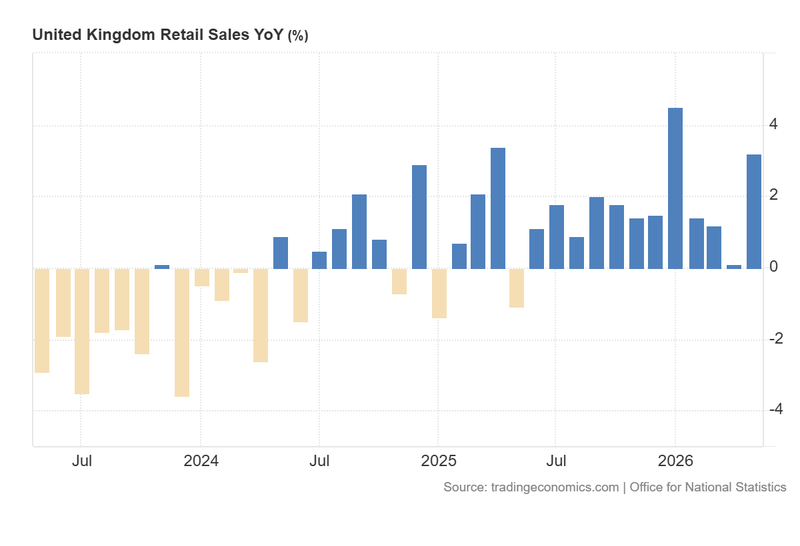
Figure 1. United Kingdom Retail Sales (2023–2026). Source: Data from the Office for National Statistics; Figure obtained from Trading Economics.
Brent edges closer to $80 as Strait of Hormuz reopening gains traction
As reported by Reuters, Israel and Hezbollah reached a ceasefire agreement in Lebanon on Friday, sparking renewed optimism that a broader diplomatic resolution could be achieved in the Middle East. However, a scheduled meeting between Iranian and US officials in Switzerland was postponed, introducing element of doubt regarding the long-term sustainability of a Washington-Tehran diplomatic breakthrough. Simultaneously, while a limited number of commercial oil tankers managed to navigate the Strait of Hormuz during the session, Iranian officials stated that all maritime vessels must coordinate their routes with the Revolutionary Guards navy. This requirement suggests that a total normalization of shipping traffic remains complicated for the foreseeable future.
Energy analysts estimate that a significant portion of global crude supply could return to the market following the formal reopening of the Strait of Hormuz. Nonetheless, substantial market doubts persist, as intricate logistics and regulatory hurdles complicate a stable normalization of supply lines. Currently, market participants remain intensely focused on the finalization of an official accord in the Middle East that would guarantee a comprehensive ceasefire between the US, Iran, Israel, and Hezbollah, alongside secure passage through the Strait. Notably, contradictory official public statements from the involved parties continue to fuel anxieties that a comprehensive deal may not be imminent.
At the market close, the Brent crude futures contract (BRNQ6) appreciated by 0.90% to trade at $80.57 per barrel—a level not witnessed since early March 2026. Meanwhile, the West Texas Intermediate (WTI) futures contract (CLQ6) advanced by 0.91% to settle at $76.54 per barrel.
