
 Help
Meta and Tesla deliver mixed Q3 results; UK inflation surprises higher
Meta and Tesla posted mixed Q3 2026 earnings results, sparking divergent share price reactions, while UK inflation unexpectedly accelerated to 3.5% in September, bolstering the British pound against the US dollar.

Meta revenue rose 26% year-on-year (YoY) to $64.6 billion, but the company missed earnings per share (EPS) expectations; nevertheless, shares advanced around 2% in post-market trading.
Tesla slightly missed revenue forecasts at $28.05 billion, sending its stock down 3% approximately in after-hours trading.
UK headline inflation unexpectedly accelerated to 3.5% YoY in September, largely driven by surging fuel costs.
Core UK inflation reached 2.8% YoY, lifting GBP/USD to $1.3388 on heightened Bank of England rate-hike expectations.
Date: 21 October 2026
Meta and Tesla deliver mixed third-quarter results, causing divergent post-market reactions
The mega-capitalisation companies Meta Platforms and Tesla Inc. released their Q3 2026 financial results, presenting a mixed picture relative to market expectations across total revenue and earnings per share (EPS).
On the one hand, social media giant Meta Platforms reported revenue of $64.6 billion, surpassing analysts' estimates of $63.34 billion. However, the company reported diluted earnings per share of $3.83, missing the market consensus forecast of $6.54. Against this backdrop, the quarterly figures represent a year-on-year (YoY) revenue growth rate of 26%, alongside an annual increase of 265% in EPS.
Among the most notable figures in the financial overview, the company posted operating income of $12.99 billion, resulting in an operating margin of 20%—a significant drop from the 40% margin recorded in the prior-year period, as costs and expenses expanded considerably during the third quarter. Additionally, the firm maintained its commitment to long-term growth through capital expenditure (CAPEX) of $34.91 billion, a figure well above its historical quarterly average.
Following Meta's announcement, its shares advanced around 2% in post-market trading.
On the other hand, Tesla Inc. reported total revenue of $28.05 billion, slightly missing analysts' forecasts of $28.06 billion. Conversely, the company reported non-GAAP diluted earnings per share of $0.48, beating the consensus estimate of $0.45. These results represent a marginal YoY decrease compared to the Q3 2025 revenue figure of $28.09 billion, whilst EPS declined by 4% YoY.
Furthermore, according to Tesla's quarterly report, operating income stood at $718 million, representing an operating margin of 2.6%—below the 5.8% registered in Q3 2025. Nevertheless, although revenue growth and operating income remained subdued, the firm maintained its commitment to expansion, as capital expenditure reached $4.73 billion—a 110% YoY increase compared to Q3 2025.
In this context, Tesla's shares fell around 3% in the post-market session, as revenue and operational growth remained constrained.
UK inflation accelerates beyond market expectations; GBP/USD advances
According to data released by the UK Office for National Statistics (ONS), headline inflation accelerated sharply from 3.1% in August to 3.5% in September (YoY), exceeding the market consensus forecast of 3.4%. This acceleration was primarily driven by transport costs, which rose from 4.6% to 6.6%, as motor fuel inflation surged from 23.0% to 29.8%, as cited by Trading Economics.
Concurrently, the ONS report highlighted that the core inflation rate—which excludes volatile energy and unprocessed food components—accelerated from 2.6% to 2.8% YoY, topping the consensus estimate of 2.7%. This indicates that elevated energy prices may be feeding into core inflation as higher fuel costs pass through to producers and consumers.
Following the ONS release, the British pound appreciated by 0.10% against the US dollar, with the GBP/USD currency pair closing near $1.3388. This market reaction reflects rising expectations that the Bank of England will adopt a more restrictive monetary policy stance to counter persistent inflationary pressures, particularly as the UK labour market and productivity indicators continue to demonstrate underlying resilience.
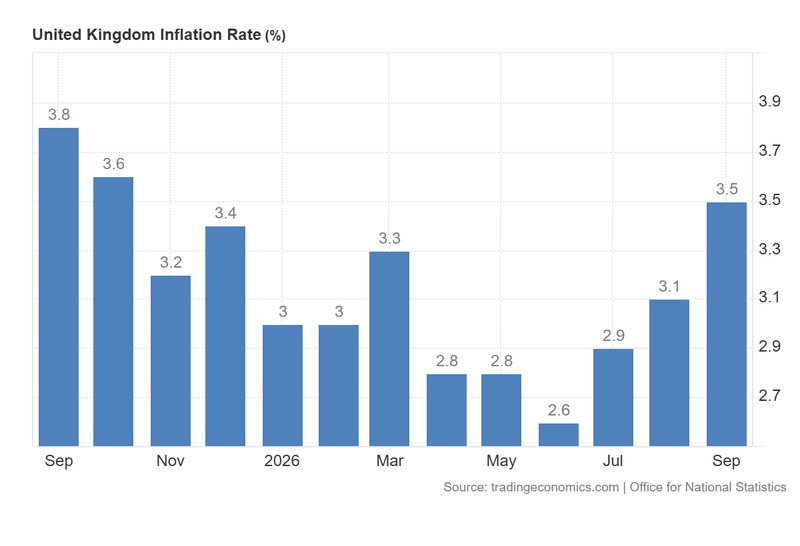
Figure 1. United Kingdom Inflation Rate (2025–2026). Source: Data from the Office for National Statistics; figure retrieved from Trading Economics.
