
 Help
Nvidia faces credit rating risks; German confidence and Mexico jobless rise
Nvidia faces a potential S&P credit downgrade over governance concerns following Jensen Huang's reinstatement. Meanwhile, German consumer sentiment recovered slightly, supporting the DAX index, whilst Mexico's unemployment rate rose to 3%, weighing on the peso.

S&P Global Ratings placed Nvidia on downgrade watch over board oversight and CEO succession.
The GfK Consumer Climate Index edged up to –30.2, though elevated energy costs and inflation continue to weigh on German consumers.
Mexico's unemployment rate reached 3% in October, exceeding estimates and pushing USD/MXN up to 19.7240.
Date: 27 November 2026 (GMT+3)
S&P Global warns Nvidia's board issues may threaten its credit rating
S&P Global Ratings placed Nvidia's credit rating under review, signalling a possible downgrade as the CEO's reinstatement could expose management weaknesses—as cited by Reuters.
The rating agency highlighted that the prolonged tenure of certain board members may have compromised their independence, potentially weighing on Nvidia's management and governance framework. It also emphasised the need to assess the effectiveness of the company's corporate governance practices—particularly regarding executive oversight, board independence, and leadership succession—in order to identify potential risks to future management continuity.
Following Jensen Huang's resignation on 12 November, amid revelations of extramarital affairs and concerns surrounding potential national security implications, Nvidia's board of directors subsequently voted unanimously to reinstate him as CEO on 23 November.
The decision followed a period of heightened volatility in the company's shares, as investors assessed the potential implications of his departure for Nvidia's leadership and business outlook. Notably, US President Donald Trump expressed support for Huang's reinstatement and confirmed that he had held discussions with members of Nvidia's board regarding the executive's return.
Crucially, S&P Global Ratings stated that it could downgrade Nvidia within the next 90 days, signalling that any potential reduction would likely be limited to one notch—unless investigations or disclosures reveal evidence of reputational harm to Nvidia's management. Currently, Nvidia holds an "AA" rating, a grade that indicates a strong capacity to meet financial commitments, compared with the highest possible rating of "AAA".
German consumer confidence exhibits a slight recovery; DAX index rises
German consumer confidence showed signs of modest improvement in December, although the broader outlook remains relatively subdued. According to the GfK Group, the Consumer Climate Index rose to –30.2 points from –30.9 in November. Despite this uptick, consumer sentiment remained below expectations, as the latest reading fell short of the –29.9 points anticipated by analysts.
Examining the individual components of the survey, income expectations improved to –13.9 points from –15.7, whilst willingness to buy edged up from –11.9 to –11.5, as cited by Trading Economics. However, these gains were partly offset by a decline in economic expectations, which moved into negative territory at –1.6 points from 2.1 previously. Meanwhile, the propensity to save decreased from 17.2 to 15.6 points, indicating a slight moderation in households' preference for saving.
Overall, the survey suggests that consumer sentiment is recovering gradually, yet underlying confidence remains fragile. Persistent concerns over elevated energy costs and their implications for household purchasing power continue to weigh on sentiment, particularly as inflation remains above the European Central Bank's 2% target. In Germany, annual inflation reached 2.8% in October.
Following the release of the GfK report, the benchmark German DAX rose by 2.08% to 25,215 points. By contrast, the EUR/USD pair edged down 0.03% to $1.0970. This divergence suggests that equity investors interpreted the modest improvement in consumer confidence as a constructive signal for the German economy, whilst the currency market showed little reaction to the data.
Mexico's unemployment rate advances beyond analysts' estimates
According to data published by the Instituto Nacional de Estadística y Geografía (INEGI), Mexico's unemployment rate rose from 2.8% in September to 3% in October, exceeding analysts' estimates of 2.7%.
Although the unemployment rate has not reached multi-year highs, it remains at the upper end of its three-year range, hovering near 3%. Nevertheless, Mexico's unemployment rate remains considerably below the global average of 4.9%—an average level reported by the International Labour Organization (ILO).
Notably, the INEGI report indicated that total employment was concentrated in the services sector at 44.6%, followed by commerce at 19.3%, manufacturing at 15.9%, agriculture at 10.3%, and construction at 8.5%—as cited by Trading Economics.
Following the INEGI employment release, the USD/MXN currency pair rose markedly by 0.75% to 19.7240. The Mexican peso has accumulated significant depreciation against the US dollar as hawkish expectations surrounding the Federal Reserve's upcoming monetary policy decisions have underpinned the greenback. The USD/MXN pair has gained approximately 6% over the past month, bringing its cumulative advance to nearly 16% since reaching its lowest level in early September.
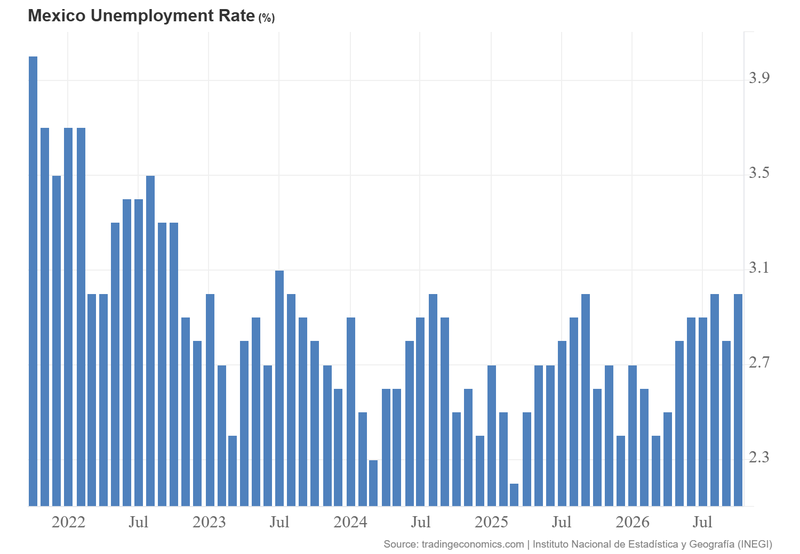
Figure 1. Mexico Unemployment Rate (2021–2026). Source: Data from the Instituto Nacional de Estadística y Geografía (INEGI); chart retrieved via Trading Economics.
