
 Help
Help Oil falls on oversupply after Hormuz reopening; Michigan sentiment improves
Oil prices fell as the Strait of Hormuz reopened, with Brent and WTI posting sharp weekly losses. Meanwhile, Michigan consumer sentiment improved as conflict-related fears eased, although inflation expectations remained elevated. The Nikkei declined amid concerns over AI valuations and yen weakness.

Brent fell by 3.84% to $72.60, down around 9% on the week, as the reopening of the Strait of Hormuz raised concerns over oversupply.
WTI dropped by 3.74%, extending its weekly loss to around 7% amid resumed oil flows and delayed supply releases.
Michigan consumer sentiment rose to 49.5 in June, supported by lower conflict-related concerns, although inflation expectations remained elevated.
The Nikkei 225 fell by 4.15% as doubts over AI valuations and yen weakness near ¥161.73 weighed on Japanese equities.
Oil prices decline on oversupply following Strait of Hormuz reopening
Oil prices fell due to an outflow of supply from delayed inventories following the reopening of the Strait of Hormuz. In addition, according to information shared with Reuters, oil giant Saudi Aramco resumed oil loading at its Ras Tanura terminal after an interruption of almost four months. With oil flows resuming and supply that had been stalled during the conflict between the United States, Israel, and Iran returning to the market, a period of oversupply is likely to weigh on crude market prices.
As a result, the Brent futures contract (BRNU6) depreciated by 3.84% to $72.60 per barrel, accumulating a decline of approximately 9% over the last trading week. Meanwhile, the West Texas Intermediate (CLQ6) futures contract fell by 3.74% at the market close, extending its weekly decline to approximately 7%.
Michigan consumer sentiment improves and inflation expectations ease
According to data from the University of Michigan, US consumer sentiment increased from 44.8 points in May to 49.5 points in June, recovering from the record low at which the index had remained. The University’s report indicated that confidence improved in relation to income, wealth, and business conditions amid reduced concerns over the US–Iran conflict in the Middle East. However, inflation expectations remain elevated.
The University of Michigan reported that one-year-ahead inflation expectations declined from 4.8% to 4.6%, a level still clearly above the Federal Reserve’s 2% target. Meanwhile, long-term inflation expectations over a five-year horizon fell from 3.9% to 3.3%. Therefore, Michigan’s surveys continue to reflect concerns about the impact of inflation on domestic consumption, which could affect the US economic outlook over the coming quarters.
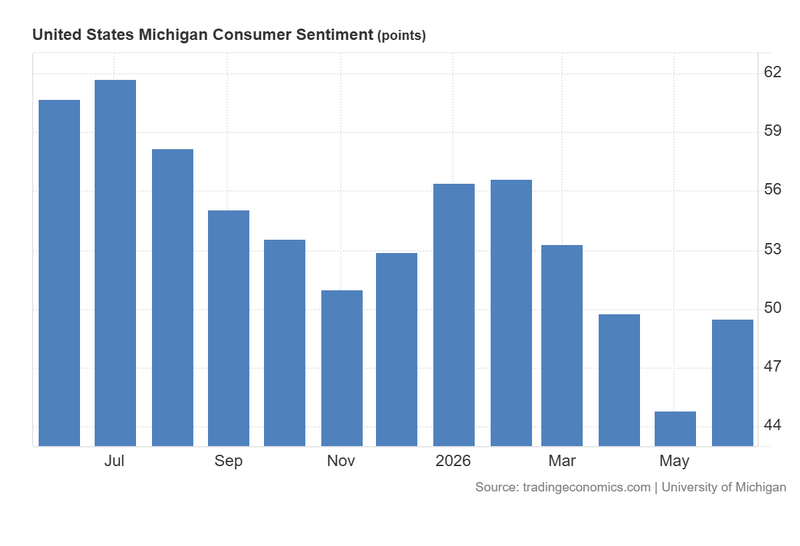
Figure 1. US Michigan Consumer Sentiment (2025–2026). Source: Data from the University of Michigan; figure obtained from Trading Economics.
Nikkei falls as uncertainty over AI investments intensifies
The Japanese stock index, the Nikkei 225, fell sharply at the market close, declining by 4.15% to 69,360 points. This market retracement could be explained by rising doubts over artificial intelligence (AI) companies, which may be considered overvalued by market participants globally. In addition, investors may be concerned about potential Japanese government intervention in the yen, as the currency trades near a forty-year low.
At market close, the Japanese yen traded at the ¥161.73 level, a historical low over the past four decades. A weak domestic currency could affect domestic companies if the depreciation leads to higher inflation through import prices or creates economic instability if the weakness persists.
