
 Help
Help Oil jumps as US–Iran tensions re-escalate; Indian inflation accelerates
Oil prices surged after renewed US–Iran tensions and the closure of the Strait of Hormuz heightened supply risks. Rising energy costs intensified inflation concerns, while India’s inflation rate exceeded forecasts.

Brent rose by 9.59% to $83.30 and WTI gained 9.42% as US–Iran tensions disrupted energy markets.
Iran closed the Strait of Hormuz, while the US reinstated restrictions on Iranian shipping, raising supply concerns.
Higher oil prices lifted Federal Reserve rate-hike expectations, boosting Treasury yields and the dollar while pressuring equities.
India’s inflation rate accelerated to 4.38%, above forecasts, driven by higher food and transport costs.
Oil prices surge amid renewed US–Iran tensions
Oil benchmarks surged sharply amid a significant re-escalation of the conflict between the United States and Iran. Before the market close, the Brent futures contract (BRNU6) had advanced by 9.59% to $83.30 per barrel, while the West Texas Intermediate (WTI) futures contract (CLQ6) was up by 9.42% to $78.14 per barrel. In both cases, prices reached their highest levels in four weeks.
Following a weekend marked by several military actions between the two countries, Iranian officials declared the Strait of Hormuz closed—a key maritime route through which a significant proportion of the global energy supply passes. At the same time, the US announced that the bilateral ceasefire agreement between the two nations had ended.
In addition, according to Reuters, US President Donald Trump stated on Monday that the United States was reinstating its blockade of Iranian shipping in the Gulf. The US President declared in a post on Truth Social that “The Hormuz Strait is open and will remain open with or without Iran”. Concurrently, Iranian Foreign Minister Abbas Araqchi said that “Tehran was the guardian of the Strait and would remain so forever”, as quoted by Reuters.
Which markets have been impacted by the ongoing geopolitical instability?
Several markets have been impacted by the renewed geopolitical instability in the Middle East.
The yield on the 10-year US Treasury note rose by 6.3 basis points to 4.62%, its highest level since 19 May 2026. This increase indicates that market participants are pricing in potential interest rate hikes by the Federal Reserve amid mounting energy-driven inflationary pressures. Consistent with this view, the CME FedWatch Tool indicated a 43.3% probability of a 25-basis-point rate increase at the Federal Reserve’s July meeting, compared with a 56.0% probability that rates would remain unchanged. Looking further ahead, market participants continued to assign the highest probability to a rate increase at the September meeting, with the implied likelihood standing at 51.1%.
Meanwhile, the US Dollar Index (DXY) rose by 0.31% to 101.28 points, supported by increased demand for safe-haven assets. During periods of heightened geopolitical uncertainty, investors typically seek refuge in highly liquid assets such as the US dollar and US Treasury securities. The stronger dollar also reflects expectations that elevated energy prices could reinforce inflationary pressures and support relatively higher US interest rates.
Conversely, US equity benchmarks fell in tandem: the Dow Jones Industrial Average declined by 0.26% to 52,504 points, the S&P 500 fell by 0.79% to 7,515, while the Nasdaq 100 depreciated by 1.88% to 29,264 points, with the technology and semiconductor sectors recording the most significant losses. Stock markets tend to be negatively affected during periods of geopolitical instability, as investors move away from high-risk assets and towards safe-haven or defensive investments.
India’s inflation rate accelerates slightly above analysts’ expectations
According to data released by India’s Ministry of Statistics and Programme Implementation (MOSPI), the annual headline inflation rate accelerated from 3.93% in May to 4.38% in June, slightly exceeding the market consensus forecast of 4.3%. The latest reading marks the highest inflation rate since December 2024, highlighting the price pressures that have emerged across several Asian economies amid a more challenging energy environment linked to tensions in the Middle East and the ongoing US–Iran conflict.
Analysis from Trading Economics suggests that the acceleration was driven primarily by rising transport costs, which increased by 4.31% during the period. In addition, food inflation rose from 4.78% in May to 5.32% in June, adding further upward pressure to consumer prices. Food markets have remained particularly sensitive to geopolitical developments in the Middle East, as disruptions and uncertainty surrounding key maritime routes have increased concerns over the supply of essential commodities and fertilisers within global supply chains. These factors have contributed to higher production and distribution costs, ultimately feeding through to consumer prices.
Despite the stronger-than-expected inflation reading, financial markets displayed a relatively muted reaction. The Nifty 50 Index edged up by 0.02% to 24,211 points, suggesting that investors remain broadly confident in the resilience of the Indian economy. Meanwhile, the USD/INR exchange rate rose by 0.26% to 95.62 rupees per US dollar, reflecting modest pressure on the Indian currency as market participants reassessed the inflation outlook and its potential implications for future monetary policy decisions by the Reserve Bank of India.
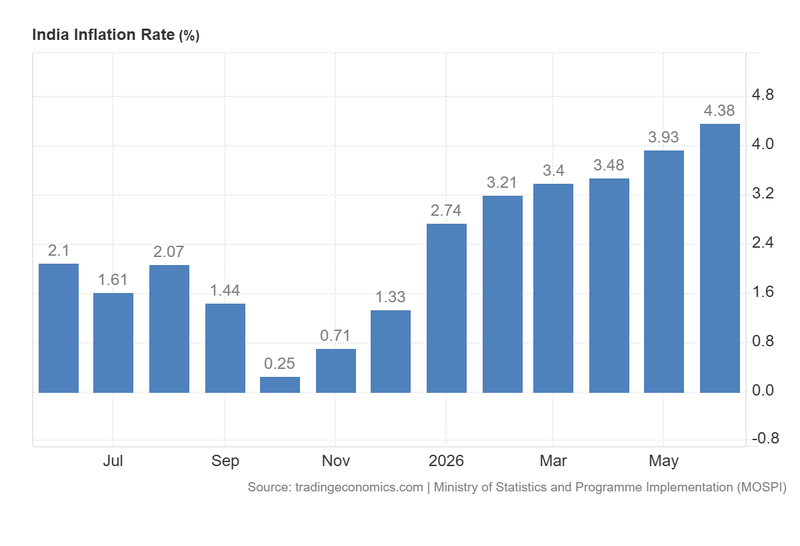
Figure 1. India Inflation Rate (2025-2026). Source: Data from the Ministry of Statistics and Programme Implementation. Figure obtained from Trading Economics.
Quarterly US financial results
The second-quarter 2026 earnings season begins this week. The following key institutions are scheduled to report, which may contribute to further volatility in US equity markets:
Tuesday
- JPMorgan Chase & Co. (JPM)
- Bank of America (BAC)
- Goldman Sachs Group (GS)
- Wells Fargo & Company (WFC)
- Citigroup (C)
Wednesday
- Johnson & Johnson (JNJ)
- Morgan Stanley (MS)
- BlackRock Inc. (BLK)
Thursday
- UnitedHealth Group (UNH)
- GE Aerospace (GE)
- Netflix Inc. (NFLX)
- Abbott Laboratories (ABT)
Key economic events this week
Several critical economic indicators are scheduled for release this week, with the following being of particular importance to market participants:
Tuesday
- Australia: Westpac Consumer Confidence
- China: Balance of Trade
- US: Inflation Rate
Wednesday
- China: Industrial Production
- China: Retail Sales
- Canada: BoC Interest Rate Decision
- US: EIA Crude Oil Stocks Change
Thursday
- United Kingdom: GDP Growth Rate (MoM)
- US: Retail Sales
Friday
- US: Building Permits
- US: Michigan Consumer Sentiment
