
 Help
Help PCE Price Index accelerates in line with forecasts; Geopolitical uncertainty persists
The US headline Personal Consumption Expenditures (PCE) inflation rate accelerated to 3.8% in April, matching market forecasts, while durable goods orders surged by 7.9%. Despite persistent inflationary pressures, financial markets found temporary relief in a potential 60-day US-Iran ceasefire agreement.

Headline PCE inflation reached a multi-year high of 3.8% in April, while the core PCE metric ticked up to 3.3%, with both indicators aligning precisely with Wall Street expectations.
US manufacturing demonstrated robust performance as durable goods orders surged by 7.9% in April, driven by substantial gains in the transport and capital equipment sectors.
Geopolitical risk remains elevated following the imposition of new US sanctions targeting the Iranian oil trade, despite a potential 60-day maritime traffic agreement.
PCE Price Index accelerates in line with analysts' expectations; Equity benchmarks rise
According to data released by the US Bureau of Economic Analysis (BEA), the year-on-year headline PCE Price Index accelerated from 3.5% in March to 3.8% in April, matching the consensus analyst forecast. This current level marks the highest rate of inflation recorded since May 2023. Concurrently, the Core PCE Price Index—which excludes volatile food and energy costs—rose marginally from 3.2% to 3.3% over the same period, also aligning with market expectations. Although these figures present clear complications for the Federal Reserve's monetary policy trajectory, the fact that the indices met expectations offered temporary respite to the markets, particularly as a tentative US-Iran agreement could downwardly pressure global energy prices and mitigate broader inflationary forces.
In tandem, the US Census Bureau reported that new orders for manufactured durable goods increased by 7.9% in April, marking the strongest monthly performance since May 2025. An analysis by Trading Economics reveals that the primary drivers of this expansion were transportation equipment, which jumped 21.5%, and capital goods, which advanced by 21% during the period.
In summary, several macroeconomic releases indicate that US domestic production and consumption remain stable and resilient. Nevertheless, inflation continues to be the primary economic variable clouded by high uncertainty, though its trajectory remains deeply intertwined with geopolitical tensions in the Middle East and their potential resolution.
Reflecting this sentiment, major US equity benchmarks advanced in parallel, bolstered by hopes of a diplomatic breakthrough that could normalise maritime traffic through the critical Strait of Hormuz. The S&P 500 index rose by 0.58% to close at 7,563, the Nasdaq 100 advanced 0.84% to 30,223, and the Dow Jones Industrial Average appreciated by 0.05% to settle at 50,674. Notably, all three indices established new record highs during the session.
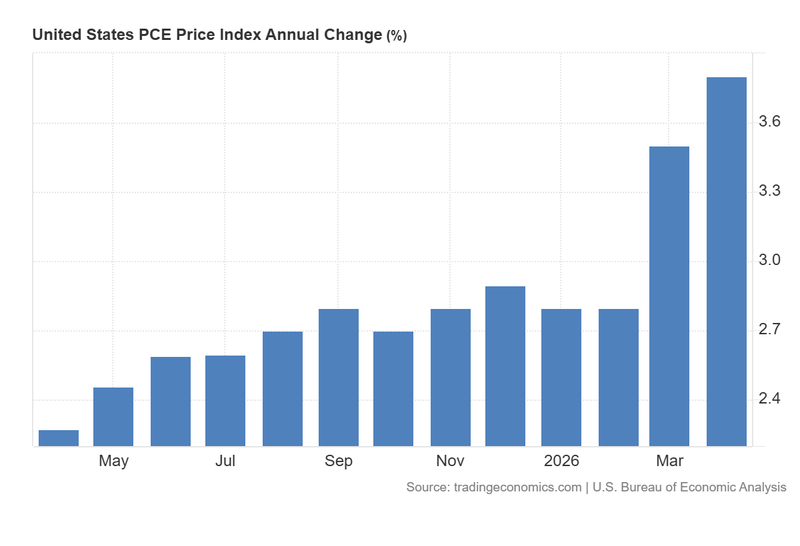
Figure 1. US PCE Price Index YoY (2025-2026). Source: Data from the US Bureau of Economic Analysis; Figure obtained from Trading Economics.
Geopolitical uncertainty lingers following conflicting US-Iran declarations
As reported by Reuters, negotiators from the United States and Iran have reached a memorandum of understanding regarding a potential 60-day ceasefire extension. However, the implementation of this preliminary agreement remains subject to the formal approval of US President Donald Trump, keeping market participants in a state of uncertainty pending the White House's ultimate decision. Sources indicate that the proposed framework would restore unhindered commercial shipping through the Strait of Hormuz, with broader bilateral negotiations scheduled to take place during the course of the 60-day truce.
Conversely, during the same trading session, Washington announced fresh sanctions targeting Iran's military oil trade, underscoring the fragility of the tentative diplomatic progress between Washington and Tehran. The Treasury Secretary Scott Bessent declared: "The US will not allow the Iranian government to increase its oil revenue to improve its military capabilities.". Concurrently, ongoing bilateral military engagements between Israel and Hezbollah in Lebanon continue to intensify, serving as a stark reminder that any regional security agreement remains highly unstable.
