
 Help
SpaceX, Netflix and GE beat estimates; US housing market softens
SpaceX, Netflix, and GE Aerospace surpassed quarterly estimates, although mixed stock movements followed. Concurrently, demand in the US housing market softened significantly, whilst German economic sentiment weakened alongside surging producer prices.

SpaceX, GE Aerospace, and Netflix surpassed earnings estimates, though only SpaceX shares registered gains post-market.
US housing indicators fell as 30-year fixed mortgage rates surged to a multi-year peak of 7.40%.
Pending home sales plunged 7.3% month-on-month, recording the largest annual contraction since August 2023.
German economic sentiment dropped to 28.1 points, affected by inflationary pressures and weak economic growth.
Date: 20 October 2026
SpaceX, Netflix and GE Aerospace exceed analysts' expectations on both revenue and EPS
Mega-cap firms in the United States delivered solid quarterly earnings reports during today's trading session, surpassing analysts' estimates for both total revenue and earnings per share (EPS). Among the most prominent companies were SpaceX, Netflix, and GE Aerospace.
SpaceX reported revenue of $14.58 billion, comfortably exceeding the market consensus forecast of $12.87 billion. The company also posted EPS of $0.35, well above the $0.13 estimate. Consequently, SpaceX shares advanced by approximately 7% in post-market trading.
Meanwhile, GE Aerospace reported revenue of $13.29 billion, above the market forecast of $12.85 billion. Furthermore, the firm revealed EPS of $2.25, surpassing analysts' expectations of $2.00. However, despite robust quarterly fundamentals, shares fell by 3.67% at market close following the pre-market earnings release.
Similarly, Netflix Inc. reported total revenue of $13.44 billion, exceeding market forecasts of $12.87 billion. The streaming giant also released earnings per share of $0.87, ahead of the $0.82 estimate. Nevertheless, in post-market trading, Netflix shares declined by approximately 5% amid a weaker-than-expected forecast for the upcoming quarter.
US building permits and housing starts decline slightly, while pending home sales plunge
According to data released by the US National Association of Realtors (NAR), building permits registered a slight decline in September, falling by 0.2%. Consequently, this construction indicator decreased from 1.403 million in August to 1.400 million in September. Meanwhile, the NAR revealed that pending home sales plunged by 7.3% over the same period (month-on-month), driving a year-on-year contraction that represents the sharpest decline since August 2023.
This deterioration across housing indicators is primarily attributable to rising mortgage rates, which have reached multi-year highs. According to data published by the Federal Reserve Bank of St Louis (FRED), the average 30-year fixed-rate mortgage reached 7.40% on 15 October, attaining its highest level since November 2023. As mortgage rates increase, property acquisitions become increasingly constrained as long-term borrowing becomes more expensive, thereby weighing on housing demand.
Additionally, the US Census Bureau reported that housing starts fell by 5.2% month-on-month, bringing the indicator down from 1.288 million in August to 1.221 million in September.
In summary, housing indicators are signalling significant underlying weakness as inflationary pressures persist and the Federal Reserve adopts a more restrictive monetary policy stance to contain prices. Because mortgage rates are closely linked to long-term Treasury yields, this environment could deteriorate further if energy prices continue their upward trajectory, exerting pressure via higher fuel costs.
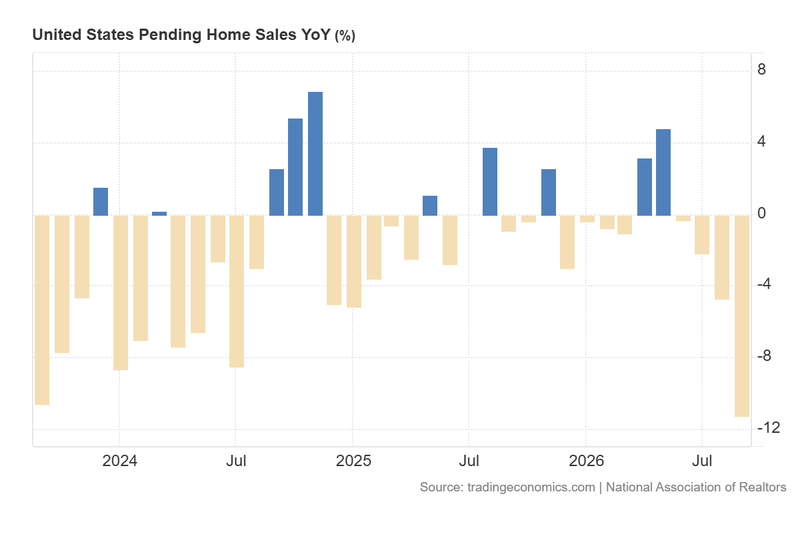
Figure 1. US Pending Home Sales (2023–2026). Source: Data from the US National Association of Realtors; chart obtained from Trading Economics.
German economic sentiment declines as producer prices accelerate sharply
The Centre for European Economic Research (ZEW) reported that the German Economic Sentiment Index declined from 34.7 points in September to 28.1 points in October, missing analysts' estimates of 30.0 points. The ZEW report revealed that sentiment deteriorated across several sectors, including banking, insurance, services, and telecommunications—as cited by Trading Economics.
Meanwhile, business concerns remain pronounced amid rising inflationary pressures, which have weighed on the German economy as weak domestic consumption and escalating producer costs impact negatively on economic growth.
Against this backdrop, Germany's Federal Statistical Office reported that year-on-year producer prices accelerated sharply from 4.6% in August to 6.7% in September, pointing to an ascending trendline in the producer inflation indicator over the past three years.
However, despite underlying data revealing economic weakness in Germany—the largest economy in the European Union—the euro appreciated against the US dollar, with the EUR/USD currency pair rising by 0.21% to $1.1237 at market close.
