
 Help
Help US ADP employment and ISM manufacturing PMI decline; Japan confidence improves
US equities declined after weaker ADP hiring and a softer ISM manufacturing PMI signalled easing economic momentum, despite manufacturing remaining in expansionary territory. Japan’s consumer confidence improved slightly but missed forecasts, reflecting better expectations for livelihoods and employment.

ADP private hiring slowed to 98,000 in June, below the 113,000 forecast, signalling possible labour-market easing.
ISM manufacturing PMI fell to 53.3 from 54.0, showing softer momentum while still remaining above the 50-point expansion threshold.
US stocks slipped after the data, led by the Nasdaq 100, which fell by 1.54%, while markets priced a 49.8% probability of a September Fed rate hike.
Japan’s consumer confidence rose to 33.8, below the 34.0 forecast, with sentiment still below February’s reading of 39.7.
ADP employment change decelerates below forecasts, while ISM manufacturing PMI decreases
US stock benchmarks declined in tandem amid an easing in private employment and manufacturing indicators. According to data from Automatic Data Processing Inc. (ADP), private employment growth decreased from 122,000 in May to 98,000 in June, below the market consensus forecast of 113,000. The ADP report showed that the sector with the strongest increase was “Education and health services” (+48,000). By contrast, the only sector recording job losses was “Natural resources and mining” (-5,000). Since the ADP report tends to be a relevant leading indicator for non-farm payrolls, market participants may interpret the latest result as a sign of potential labour-market easing.
Concurrently, the US Institute for Supply Management (ISM) released the manufacturing PMI, showing a slight decline from 54.0 points in May to 53.3 points in June. However, while the decrease in the manufacturing PMI signals some degree of weakness, the indicator continues to reflect expansion, as it remains above the 50-point threshold.
Following the economic releases, the Nasdaq 100 index declined by 1.54% to 29,809 points, the S&P 500 decreased by 0.22% to 7,483, while the Dow Jones Industrial Average fell marginally by 0.03% to 52,310 points. Market participants are now focused on the forthcoming Bureau of Labor Statistics (BLS) report due on Thursday, 2 July, when the non-farm payrolls and unemployment rate indicators will be updated.
In addition, according to a Reuters report, Fed President Kevin Warsh said—during a panel of central bankers in Sintra, Portugal—that inflation expectations and inflation risks had decreased in recent weeks, but that the US central bank remains focused on returning inflation to its 2% target. Meanwhile, CME’s FedWatch Tool indicates that market-implied probabilities still point to a potential Federal Reserve rate hike at the September meeting, with the highest likelihood standing at 49.8%.
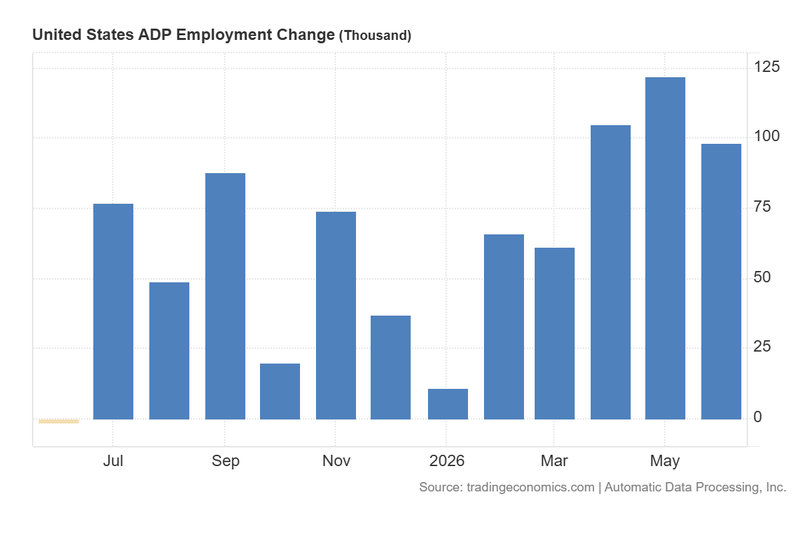
Figure 1. US ADP Employment Change (2025–2026). Source: Data from Automatic Data Processing Inc.; figure obtained from Trading Economics.
Japan consumer confidence improves, but remains below market expectations
According to data from the Cabinet Office of Japan, consumer confidence improved from 33.6 points in May to 33.8 points in June. Nevertheless, the reading remained below analysts’ forecast of 34.0 points. An analysis by Trading Economics indicates that there was an improvement across almost all major categories, including overall livelihood, employment prospects, and willingness to buy durable goods, although the income growth indicator remained unchanged. However, despite the implied improvement, current levels remain considerably below the February reading, when the indicator reached 39.7 points.
