
 Help
US GDP surprises higher; ECB holds rates as Amazon misses estimates
The US economy expanded by 3.4% in Q3 2026, exceeding expectations despite accelerating PCE inflation. Concurrently, the ECB maintained refinancing rate at 2.65%, while Amazon reported disappointing quarterly earnings.

ECB held refinancing rate steady at 2.65% to balance economic growth against inflationary risks, waiting for more data.
US Q3 2026 GDP accelerated by 3.4%, exceeding estimates and reinforcing expectations of a Fed interest rate hike.
US Core PCE inflation advanced to 3.1%, highlighting resilient consumer spending amidst geopolitical risks.
Amazon quarterly results missed revenue and EPS forecasts, resulting in a 7% share drop in post-market trading amidst heavy AI capital expenditure.
Date: 30 October 2026 (GMT+3)
ECB decides to hold benchmark interest rate steady, as expected by analysts
The European Central Bank (ECB) decided to keep its benchmark interest rates unchanged, in line with analysts' expectations, maintaining the main refinancing rate at 2.65% and the deposit facility rate at 2.50%. In a unanimous decision, the ECB cited risks to economic growth should inflation remain elevated and trade fragmentation adversely affect value chains across European countries.
ECB President Christine Lagarde highlighted underlying economic resilience, noting positive momentum across the services sector, manufacturing, and exports—areas that have delivered strong results amidst surging demand for artificial intelligence (AI). Additionally, President Lagarde cited robust government expenditure on infrastructure and defence as key drivers supporting positive economic growth.
However, President Lagarde cautioned that energy costs are exerting upward pressure on inflation, thereby weighing on consumer and business confidence as higher fuel prices—notably for natural gas and diesel—adversely affect household and corporate budgets. Furthermore, she highlighted next factors: geopolitical risks (which could exacerbate energy costs if ongoing tensions persist in the Middle East and Eastern Europe), fiscal vulnerabilities (particularly in France), and bond market headwinds (as elevated long-term yields linked to mortgage rates damp housing demand).
Finally, the ECB reaffirmed its commitment to returning inflation to its 2.0% target over the medium term through a data-dependent, meeting-by-meeting approach. Although the central bank refrained from issuing explicit forward guidance regarding interest rates, it stated that further data are required to determine whether current conditions—which might otherwise have justified a rate hike—will be confirmed, adding that, should this occur, the 'sense of direction is quite clear'.
Against this backdrop, market participants will remain closely focused on upcoming economic releases to gauge the likelihood of an interest rate hike at the ECB's December meeting.
US GDP growth beats expectations as PCE inflation accelerates in line with forecasts
According to data released by the US Bureau of Economic Analysis (BEA), real gross domestic product (GDP) expanded at an annualised rate of 3.4% in the third quarter of 2026 according to its advance estimate, surpassing analysts' expectations of 3.2%. This marks the strongest quarterly growth rate since Q3 2025, when GDP expanded by 3.9%.
The BEA report highlighted that the principal contributors to growth were private investment (+3.3%), consumer spending (+2.5%), and government expenditure (+0.9%). These expansionary drivers stood in contrast to trade dynamics, where net exports exerted a negative drag on growth (with exports falling by 0.7% and imports declining by 2.6%).
Additionally, the BEA reported that the headline Personal Consumption Expenditures (PCE) Price Index accelerated from 3.4% in August to 3.6% in September, while Core PCE inflation—which excludes volatile food and energy components—rose from 3.0% to 3.1%. Both readings aligned precisely with market forecasts.
These figures demonstrate that domestic consumption and business investment remain robust despite ongoing geopolitical tensions in the Middle East and persistent inflationary pressures. While the underlying economic data highlights economic resilience, it also reinforces market expectations that the Federal Reserve will implement an interest rate hike at its December meeting, driven by accelerating economic activity and rising inflation.
According to the CME FedWatch Tool, the market-implied probability indicates a 75% likelihood that the US central bank will raise its benchmark interest rate by 25 basis points.
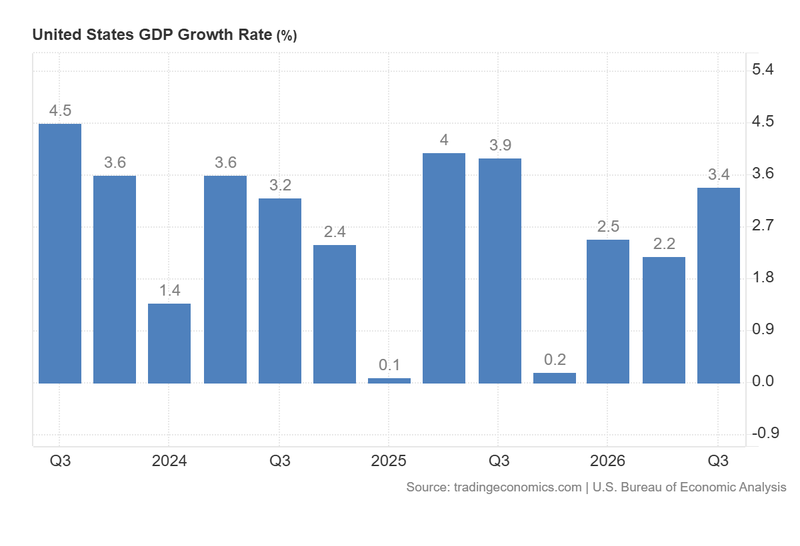
Figure 1. US GDP Growth Rate (2023–2026). Source: Data from the US Bureau of Economic Analysis; chart retrieved via Trading Economics.
Amazon falls short of analysts' estimates in quarterly earnings report; shares decline post-market
Amazon.com Inc. released its third-quarter earnings report, missing market expectations for both net revenue and earnings per share (EPS).
The technology giant reported revenue of $201.94 billion, falling slightly short of the $202.22 billion consensus estimate. EPS stood at $1.89, missing the market consensus forecast of $1.97. These results reflect a year-on-year revenue increase of 12%, alongside a 3% annual decline in EPS.
Notably, the company reported operating income of $28.1 billion, delivering an operating margin of 13.9%—the highest in its history. Furthermore, Amazon Web Services (AWS) recorded a 39.3% increase in net sales, marking its fastest growth pace in roughly five years. AWS revenues reached $46 billion, accounting for 22.75% of total company revenue, continuing a multi-year upward trajectory in segment contribution.
However, the firm recorded a negative free cash flow (an outflow) of $22.21 billion, driven by substantial capital expenditure on property, equipment, and net acquisitions. This contrasts sharply with the positive free cash flow of $9.01 billion reported in Q3 2025. The company noted that a significant portion of this capital expenditure is being allocated towards artificial intelligence infrastructure and projects.
These extensive capital commitments appear to be weighing on investor sentiment, as external debt financing was required to fund investment outflows during the quarter. Nevertheless, Amazon's leverage metrics remain in line with industry benchmarks; according to data published by Investing.com, the company's total debt-to-capital ratio stands at 45.62%, a figure below the industry average of 51.92%. Nonetheless, market participants are subjecting AI-related capital allocation to heightened scrutiny, raising questions over the long-term return profile and cash-flow sustainability of these expenditures.
Following the announcement, Amazon shares fell by approximately 7% in post-market trading.
