
 Help
Help US import inflation surges as industrial production nears four-year peak
US import inflation surged to 8.1% year-on-year in September, driven by tariffs, elevated fuel costs, and robust demand for artificial intelligence technology, fuelling market expectations of a more restrictive monetary policy stance by the Federal Reserve. Concurrently, resilient industrial production reached a multi-year peak.

September US import prices accelerated by 1.1% month-on-month and 8.1% year-on-year, touching a high last seen in July 2022.
Escalating import costs were primarily spurred by tariffs, fuel prices, and capital goods such as semiconductors.
US industrial production grew by 0.7% in September, achieving its strongest annual performance since 2022.
Intensifying inflationary pressures dragged equity benchmarks lower amidst expectations of further Federal Reserve interest rate hikes.
Date: 16 October 2026
US import prices accelerate beyond expectations to highest level since July 2022
According to data released by the US Bureau of Labor Statistics (BLS), import prices accelerated by 1.1% month-on-month in September, surpassing the market consensus forecast of 0.8% and marking the steepest monthly rise since May 2026. Consequently, year-on-year import price inflation accelerated from 6.7% to 8.1%, reaching a peak not observed since July 2022. Notably, as reported by Trading Economics, the BLS indicated that higher costs were primarily driven by tariffs and fuel prices.
Additionally, as cited by Reuters, capital goods prices advanced by 0.9%, propelled by higher costs for computers, peripherals, and semiconductors amidst robust demand for artificial intelligence (AI) hardware. Economists note that this persistent capital demand is exerting further upward pressure on broader US inflation.
This underlying surge in import prices aligns with the sharp accelerations observed in consumer and producer price measures published by the BLS earlier in the week. Nevertheless, market expectations regarding upcoming Federal Reserve policy decisions remained steady. Data from the CME FedWatch Tool indicates that the market-implied probability of the Fed holding rates unchanged at its October meeting rose to 82.8%, up from a previous 72%. Conversely, for the December meeting, financial markets reflect a 75% likelihood of a 25-basis-point interest rate hike.
Simultaneously, the Brent crude futures contract (BRN) approached the $110.00 per barrel mark amidst persistent geopolitical tensions in the Middle East.
Against this backdrop, major US equity benchmarks dropped in tandem, weighed down by expectations that the Federal Reserve will adopt a more restrictive monetary policy stance as inflationary pressures persist. The S&P 500 index declined by 1.09% to 7,659 points, the Dow Jones Industrial Average fell by 0.34% to 52,007, and the tech-heavy Nasdaq 100 index depreciated sharply by 2.50% to 29,187 points.
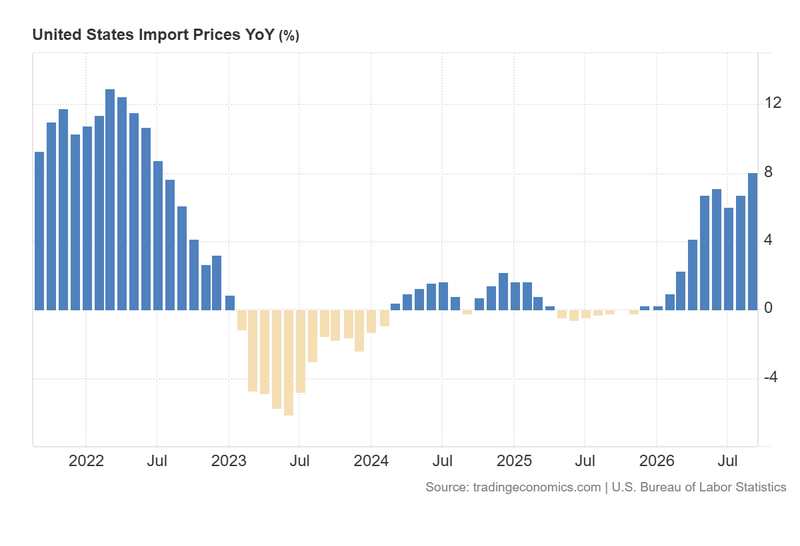
Figure 1. US Import Prices YoY (2021–2026). Source: Data from the US Bureau of Labor Statistics; figure retrieved from Trading Economics.
US industrial production accelerates towards four-year high
Data published by the Federal Reserve showed that US industrial production grew by 0.7% month-on-month in September, exceeding the market consensus forecast of 0.4%. This represents the strongest monthly expansion since April 2026, underscoring the ongoing resilience of US industrial output. Consequently, year-on-year industrial production growth accelerated from 1.6% to 2.2%, marking its highest level since September 2022.
This solid performance was predominantly anchored by robust manufacturing within the tech and AI sectors. According to a Reuters report, the output of semiconductors and electronic components jumped by 28.4% over the past quarter, reflecting substantial capital investment in the artificial intelligence supply chain over recent months.
