
 Help
US indices retreat on earnings disappointments; EU GDP exceeds expectations
US stocks fell following disappointing Amazon and Intel quarterly results and mounting doubts over artificial intelligence (AI) spending, whilst resilient European Union third-quarter GDP growth surpassed forecasts, underpinned by robust investment and government expenditure.

Amazon missed third-quarter revenue and earnings per share (EPS) estimates, whilst elevated AI capital expenditure (CapEx) resulted in negative free cash flow.
Intel tumbled 28.58% despite beating earnings estimates, weighed down by weak forward guidance, PC market softness, and disruptions at its plant in Israel.
Heightened concerns over heavy technology CapEx alongside earnings disappointments dragged the Nasdaq 100 index down by 3.46%.
EU third-quarter GDP expanded by 0.4%, beating the consensus estimate of 0.2%, led by Ireland's 5.5% AI-driven expansion.
Date: 31 October 2026 (GMT+3)
US stock indices drop as Amazon and Intel earnings reports disappoint market expectations and fuel AI CapEx concerns
Equity benchmarks dropped in tandem amidst rising concerns over the sustainability of capital expenditure (CapEx) on artificial intelligence (AI) by major technology firms. Furthermore, market participants reacted negatively to the latest quarterly earnings reports from Amazon and Intel.
On the one hand, Amazon.com, Inc. (AMZN) fell short of market expectations in both total revenue and earnings per share (EPS). The e-commerce giant reported revenue of $201.94 billion, missing the market consensus forecast of $202.22 billion. Meanwhile, the firm posted EPS of $1.89, below the $1.97 estimate. These results reflect a year-on-year (YoY) revenue increase of 12%, alongside a 3% annual decline in EPS. At the market close, Amazon's shares had fallen 1.41% to $240.35.
The underlying weakness in Amazon’s share price can be attributed to its lower-than-expected third-quarter results and negative free cash flow, driven by substantial capital outlays that exceeded operational cash flow. Moreover, the firm has now recorded three consecutive quarters of negative free cash flow, raising doubts regarding the sustainability of its CapEx, which is heavily directed towards AI infrastructure and related projects.
On the other hand, Intel Corporation (INTC) posted revenue of $16.51 billion, slightly missing the $16.56 billion consensus forecast. In turn, the semiconductor giant reported earnings per share of $0.52, topping the market consensus estimate of $0.41. These figures represent YoY revenue growth of 21% and a 126% annual surge in EPS. However, despite solid top- and bottom-line growth, Intel’s shares plunged 28.58% to $65.76.
The sharp drop in Intel’s shares was primarily driven by weaker-than-expected guidance following a plant shutdown in Israel and persistent softness in the PC market, as cited by CNBC.
Consequently, US stock benchmarks declined across the board, with the Nasdaq index facing intense pressure due to sharp pullbacks in mega-cap technology companies, where CapEx remains significantly elevated while return on investment remains modest. The S&P 500 index dropped 1.82% to 7,580 points, the Dow Jones Industrial Average fell 1.09% to 51,775, and the Nasdaq 100 plunged 3.46% to 28,384 points.
European Union GDP growth rate accelerates beyond forecasts
According to preliminary data released by Eurostat, the European Union's gross domestic product (GDP) grew by 0.4% quarter-on-quarter in Q3 2026, exceeding analyst forecasts of 0.2% growth. Consequently, the YoY GDP growth rate accelerated from 1.2% to 1.3%, surpassing the consensus estimate of 1.1%. This marks the strongest expansion since Q2 2025, demonstrating ongoing resilience within the Eurozone economy.
Eurostat's report highlighted that Ireland recorded the highest growth rate (+5.5%), propelled by strong AI-related investment, as cited by Trading Economics. Furthermore, Spain (+0.6%), the Netherlands (+0.6%), and Germany (+0.2%) demonstrated underlying economic growth, whereas the French economy contracted (-0.1%). Meanwhile, GDP growth in Italy remained flat. Overall, Eurozone economic activity was supported by robust expenditure on AI alongside public investment in infrastructure and defence.
Following the Eurostat release, the euro depreciated 0.16% against the US dollar, with the EUR/USD currency pair closing at $1.1157. This market reaction was largely attributed to rising crude oil prices, which are increasing pressure on the Federal Reserve to maintain a more restrictive monetary policy stance ahead of its upcoming decision. At market close, Brent crude futures (BRN) rose 2.37% to $113.43 per barrel, while West Texas Intermediate futures (CL) advanced 2.80% to $104.12 per barrel.
According to the CME FedWatch Tool, market-implied probabilities continue to signal a high likelihood (72%) that the US central bank will raise its benchmark interest rate by 25 basis points at its December meeting.
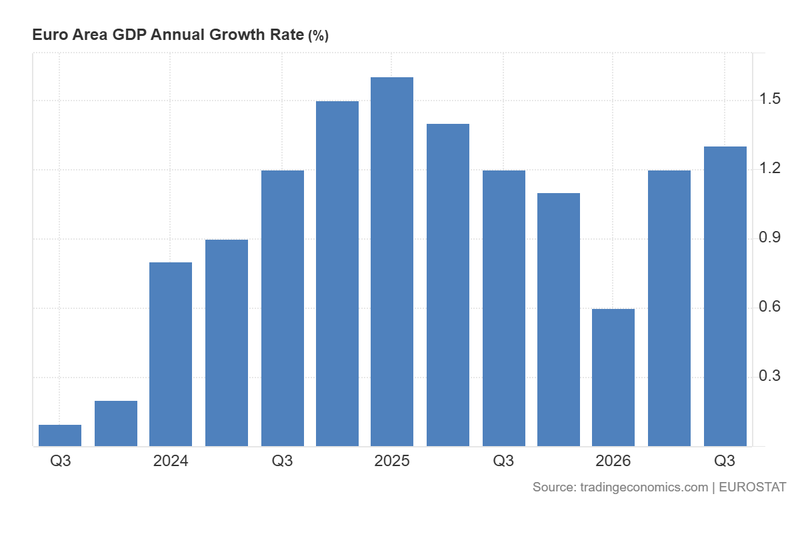
Figure 1. Euro Area GDP Growth Rate YoY (2023–2026). Source: Data from Eurostat; figure retrieved via Trading Economics.
