
 Help
Help US–Iran peace deal lifts stocks and gold, while oil prices plunge
Global markets rallied after the United States and Iran announced a peace deal, boosting equities and gold while driving oil sharply lower on expectations of restored flows through the Strait of Hormuz.

Hopes of peace between the US and Iran lifted risk appetite: the S&P 500 rose by 1.65%, the Nasdaq 100 by 3.06%, and the Dow reached a fresh record high.
Brent fell by 4.76% and WTI by 4.87% as traders priced in the reopening of the Strait of Hormuz and improved supply flows.
Gold gained 2.66% as the dollar softened and markets reduced expectations of Federal Reserve rate hikes, anticipating weaker inflationary pressures if energy costs ease.
Markets rally on US–Iran peace agreement, while gold climbs and oil tumbles
The peace agreement announced over the weekend between the United States and Iran triggered significant reactions across several financial markets, amid rising hopes that energy supply conditions through the Strait of Hormuz could normalise. According to Reuters, US President Donald Trump stated that a preliminary agreement to end the Gulf conflict had already been signed by the United States and Iran, although no details had yet been disclosed. Government spokesmen from both countries have suggested that the official agreement would be signed at a ceremony in Geneva next Friday. Meanwhile, it is understood that the deal would reopen the Strait of Hormuz and extend the ceasefire for 60 days, although important issues would remain unresolved, including Iran’s nuclear programme.
In terms of market reaction, equity benchmarks advanced in tandem amid growing expectations that the Federal Reserve could adopt a less restrictive stance if inflationary pressures ease as a consequence of a normalisation in global oil supply chains. The S&P 500 index rose by 1.65% to 7,554, the Nasdaq 100 advanced by 3.06% to 30,543, and the Dow Jones Industrial Average gained by 0.92% to 51,676, reaching a new record high.
By contrast, the Brent futures contract (BRNQ6) declined by 4.76% to $83.17 per barrel, while the West Texas Intermediate (WTI) futures contract (CLN6) fell by 4.87% to $80.75 per barrel. At the same time, the US dollar index (DXY) dropped by 0.14%, supporting a 2.66% rise in gold prices, with the gold futures contract (GCQ6) closing the session at $4,351 per ounce. As market participants anticipate a more neutral Federal Reserve, bullion has gained value, as it becomes relatively more attractive when bond yields are expected to remain broadly unchanged.
According to CME’s FedWatch Tool, market-implied probabilities now suggest a greater likelihood that the US central bank may keep interest rates unchanged at current levels over the coming months in 2026. In addition, the implied probability of an interest rate hike at the October meeting declined to 31.9%, while the implied probability of a rate increase in December fell to 41.9%, slightly below the 42.1% probability assigned to no rate cut.
Market participants are now focused on the current week, as several major central banks are due to announce monetary policy decisions. The Federal Reserve will hold a meeting at which the new Chairman, Kevin Warsh, will give his first press conference, while updated economic projections will also be released. In turn, the Bank of Japan (BoJ), the Bank of England (BoE), and the Reserve Bank of Australia (RBA) will announce their interest rate decisions.
Israel’s reaction remains uncertain
While the US–Iran peace agreement has provided a degree of reassurance to global markets, Israel’s response continues to generate concerns over whether the ceasefire will remain in place. According to Reuters, Israeli Prime Minister Benjamin Netanyahu stated that Israel would maintain its forces in southern Lebanon and would reserve the right to respond to Hezbollah attacks. In response, Iranian Foreign Minister Abbas Araqchi said that Israeli attacks must stop immediately, an issue that had been repeatedly raised during negotiations between the United States and Iran.
US industrial production accelerates but remains below analysts’ forecasts
According to data from the Federal Reserve, US industrial production increased by 0.1% in May on a monthly basis, below both the 0.3% forecast and the previous reading of 0.9%. Consequently, year-on-year industrial production accelerated from 1.4% to 1.7%. Although the latest reading did not exceed analysts’ expectations, it nonetheless reflects a degree of economic resilience, as production expanded in both April and May—two months during which the US–Iran conflict in the Middle East had a negative effect on the broader economy, while industrial activity remained positive and continued to grow.
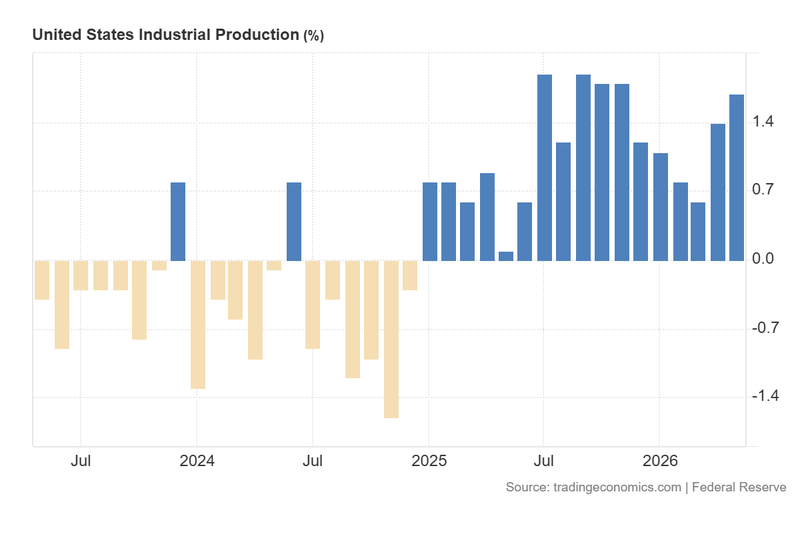
Figure 1. US Industrial Production (2023–2026). Source: Data from the Federal Reserve; figure obtained from Trading Economics.
Key economic events this week
Several critical economic indicators are scheduled for release this week, with the following being of particular importance to market participants:
Tuesday
- China: Industrial Production
- China: Retail Sales
- Japan: BoJ Interest Rate Decision
- Japan: Balance of Trade
- Australia: RBA Interest Rate Decision
- Germany: ZEW Economic Sentiment Index
- US: Building Permits
- US: Housing Starts
Wednesday
- United Kingdom: Inflation Rate
- US: Retail Sales
- US: Fed Interest Rate Decision
- US: FOMC Economic Projections
- US: EIA Crude Oil Stocks Change
Thursday
- United Kingdom: Unemployment Rate
- United Kingdom: BoE Interest Rate Decision
- Japan: Inflation Rate
Friday
- United Kingdom: Retail Sales

