
 Help
US stocks tumble as AI security fears resurface; Canadian PPI accelerates
US equities plummeted amid artificial intelligence cybersecurity concerns, while surging energy prices triggered renewed inflation expectations.

S&P 500 and Nasdaq plunged as sell-offs across semiconductor equities and disappointing mega-cap earnings reports drove severe market declines.
Critical PHP security vulnerabilities and banking restrictions on third-party AI agents heightened global market apprehension.
Surging crude oil prices propelled Brent to $113.17 per barrel, elevating the market-implied probability of a December Fed interest rate hike to 75%.
Canadian Producer Price Index (PPI) growth accelerated to 14.5%, strengthening the Canadian dollar amid expectations of Bank of Canada policy tightening.
Date: 23 October 2026 (GMT+3)
US stocks tumble amid renewed AI security concerns and rising energy prices
Major US equity benchmarks dropped sharply amidst renewed concerns regarding artificial intelligence (AI) security and elevated valuations among AI-related firms. Against this backdrop, the S&P 500 index declined by 1.21% to close at 7,663 points, while the Nasdaq 100 index plunged by 2.90% to 28,958 points. In contrast, the Dow Jones Industrial Average diverged from the broader trend, edging up marginally by 0.02% at the close of trading.
Semiconductor firms led the market downturn, with Advanced Micro Devices (AMD) falling 8.10%, Intel dropping 8.04%, and Micron declining 6.26%. Furthermore, two mega-cap technology corporations, Meta and Tesla, reinforced bearish market sentiment after their third-quarter financial results failed to meet investor expectations.
Additionally, a significant surge in energy prices reinforced market expectations that the Federal Reserve will adopt a more restrictive monetary policy stance at its December meeting. The CME FedWatch Tool currently reflects a 75% market-implied probability of a 25-basis-point rate increase. At the market close, the Brent crude futures contract (BRN) jumped by 4.00% to $113.17 per barrel as geopolitical tensions between Houthi forces and Saudi Arabia in the Middle East persisted. Meanwhile, the West Texas Intermediate (WTI) futures contract (CL) advanced by 2.36% to settle at $99.44 per barrel.
What is generating AI security concerns and why?
According to a report by Reuters, global corporations and government agencies accelerated efforts to patch critical security flaws in the PHP programming language, which underpins a substantial proportion of the global internet. Remediation efforts entailed emergency website shutdowns across multiple industry sectors and public portals. Consequently, the exposure of underlying cybersecurity risks weighed heavily on equity market sentiment.
Notably, these security vulnerabilities were uncovered by PHP developers utilising AI technology, triggering urgent advice for system administrators to update immediately to prevent potential cyberattacks. Following the public disclosure of these gaps over recent hours, cyberattack attempts surged as hackers sought to exploit the newly identified vulnerabilities.
Concurrently, major US banks announced restrictions on third-party AI agents after identifying autonomous transactions being executed within customer accounts, as cited by Reuters. Although account holders may have technically authorised automated decision-making functions, financial institutions warned that such autonomous actions pose disproportionate risks to both client accounts and banks. Consequently, major lenders announced enhanced security protocols to safeguard client assets and core banking operations.
Canadian PPI accelerates amid persistent energy price pressures
Data released by Statistics Canada indicates that annual Canadian producer price inflation accelerated from 13.2% in August to 14.5% in September, marking its highest rate since May 2022. On a month-on-month basis, producer prices advanced by 2.0%, substantially exceeding consensus forecasts of 0.9%. This upward momentum was predominantly driven by surging energy prices and rising fuel costs. The report highlighted sharp price increases in refined petroleum products, led by diesel fuel, which rose by 18.4%, according to data cited by Trading Economics.
Following the release of the PPI figures, the Canadian dollar appreciated by 0.28% against the US dollar, driven by growing market expectations that the Bank of Canada may adopt a more hawkish monetary policy stance to curb inflationary pressures. At the market close, the USD/CAD exchange rate stood at 1.4005, reinforcing the Canadian dollar's broader strengthening trend over the past week.
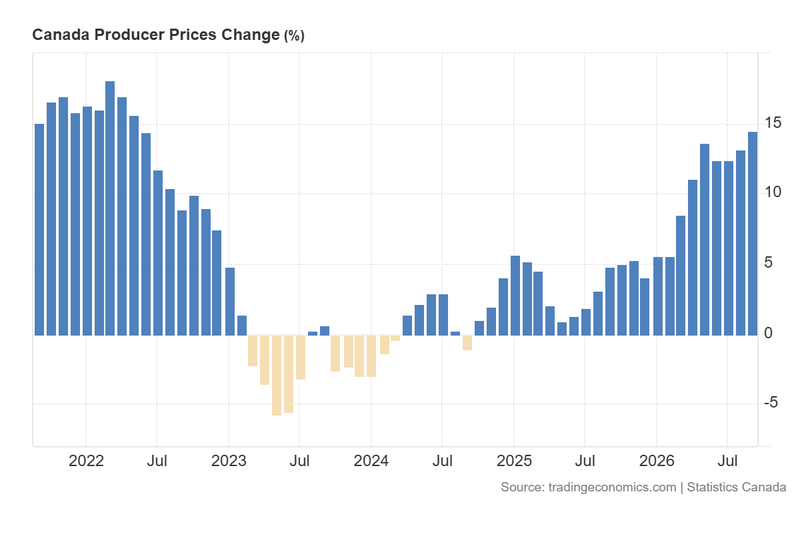
Figure 1. Canada Producer Price Change (2021–2026). Source: Data from Statistics Canada; chart retrieved via Trading Economics.
