
 Help
Help Wall Street gains on solid SpaceX IPO debut; Michigan consumer sentiment improves
US stocks rose as SpaceX’s strong IPO debut and signs of a possible US-Iran ceasefire improved risk sentiment. The S&P 500, Nasdaq 100, and Dow advanced, while consumer sentiment beat forecasts.

Wall Street gained on stronger risk appetite: S&P 500 +0.50%, Nasdaq 100 +0.64%, and Dow +0.69%. In turn, SpaceX rose 7.26% on its IPO debut, closing at $160.95.
Hopes for a US-Iran ceasefire lifted sentiment, though no formal deal was signed and key issues remain unresolved.
Michigan consumer sentiment rose to 48.9 in June, while one-year inflation expectations eased from 4.8% to 4.6%.
US equities edge higher on solid SpaceX IPO debut
US equity benchmarks advanced in parallel, driven by the highly anticipated public debut of SpaceX and growing market expectations of a potential US-Iran ceasefire agreement. By the session close, the S&P 500 index had risen by 0.50% to 7,431 points, the Nasdaq 100 advanced by 0.64% to 29,635 points, and the Dow Jones Industrial Average appreciated by 0.69% to settle at 51,207 points.
Space Exploration Technologies Corp. (SpaceX) saw its shares climb 7.26% on its trading debut, marking the largest initial public offering (IPO) in Wall Street history. Opening at $150, the equity established an intraday high of $176 before closing the session at $160.95 per share. According to data from Finviz, this closing price implies a market capitalisation of approximately $2.1 trillion, instantly positioning the aerospace manufacturer among the most highly valued enterprises in the US equity market.
Despite the company's significant growth expectations and robust business strategy, analysts are advising caution. Securities and Exchange Commission (SEC) filings reveal that SpaceX concluded the 2025 fiscal year with a net loss of $4.94 billion. Consequently, the session's trading activity indicates that market participants are currently prioritising technological innovation and future expansion over near-term fundamental metrics.
Simultaneously, risk appetite was supported by geopolitical developments. Reuters reported that both the US and Iran have signalled that a potential agreement to conclude hostilities is nearing completion. However, Iranian Foreign Minister Abbas Araqchi noted that a formal memorandum of understanding has not yet been executed, indicating that the terms remain subject to negotiation. While a definitive ceasefire framework could be unveiled over the weekend, market focus is trained on the core architecture of the deal; sources suggest that nuclear discussions may be excluded from the current agenda, despite having been a primary prerequisite for the US when the conflict commenced on 28 February.
Michigan consumer sentiment improves above market expectations
On the macroeconomic front, data released by the University of Michigan revealed that its consumer sentiment index rose from 44.8 points in May to 48.9 points in June, comfortably eclipsing the consensus forecast of 46.0 points. The University’s preliminary report indicated that this rebound in consumer confidence was primarily driven by an early-month moderation in retail gasoline prices, which directly alleviated short-term household budgetary pressures. Assessments of personal financial positions and broader business conditions similarly recorded upward revisions.
Nevertheless, US households remain visibly concerned by persistent inflationary pressures, largely because the geopolitical standoff in the Middle East has not yet been formally resolved. One-year inflation expectations moderated slightly from 4.8% to 4.6% this month, though the figure remains historically elevated. In tandem, long-run five-year inflation expectations retreated from 3.9% in May to 3.4% in June.
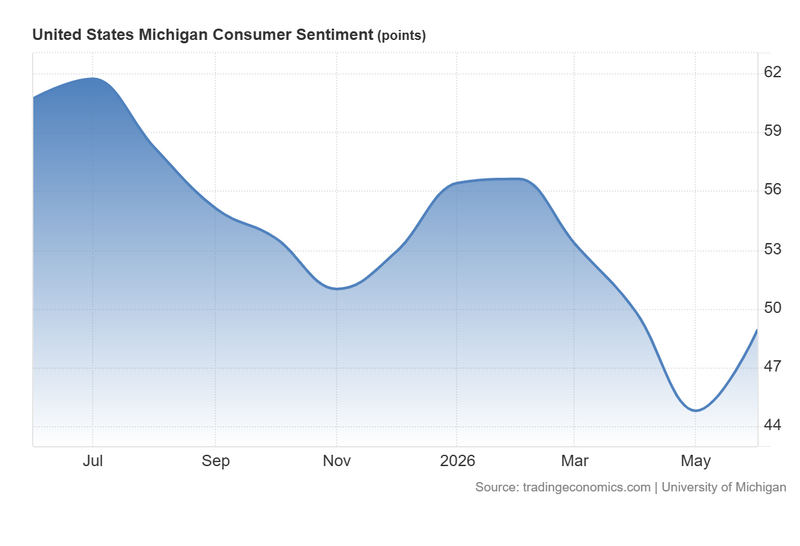
Figure 1. US Michigan Consumer Sentiment (2025–2026). Source: Data from the University of Michigan; Figure obtained from Trading Economics.

