Help
Big tech earnings: can Microsoft, Alphabet and Amazon justify AI spending?
Meta showed that strong revenue is no longer enough to protect AI stock when the cost of generating that growth keeps rising. Microsoft, Alphabet and Amazon now face the same test.

Nasdaq selloff showed that beating earnings expectations is no longer sufficient.
Alphabet, Microsoft and Amazon must connect capital spending with cloud growth, margins and cash flow.
Forward guidance will matter more than another backward-looking earnings beat.
Strong chip demand could benefit suppliers while increasing pressure on the companies financing the expansion.
The selloff changed what investors want from earnings
The Nasdaq fell after Meta’s results revived concerns about the cost of the AI expansion. Meta exceeded analysts’ expectations, but its shares still fell 7% after heavy infrastructure spending contributed to the company’s first cash outflow in more than a decade.
Investors had spent much of the AI cycle rewarding companies for increasing capacity. They are now asking how quickly that capacity will generate revenue and whether the eventual return will compensate for the cash being committed today.
The selloff was concentrated in the part of the US market most exposed to that question. The Dow finished almost unchanged, while the technology-heavy Nasdaq absorbed the pressure.
That distinction makes this week’s US earnings a direct test for the index
Microsoft, Alphabet and Amazon now must show that the spending concern exposed by Meta does not apply across the largest technology companies.
That is why the next three reports matter more than their individual share prices. Microsoft, Alphabet and Amazon are among Nasdaq’s largest companies and sit at the centre of the AI spending cycle. If they repeat Meta’s pattern of strong operating growth but even faster investment, the market may treat other earnings beat as evidence of the same problem rather than a reason to buy the dip.
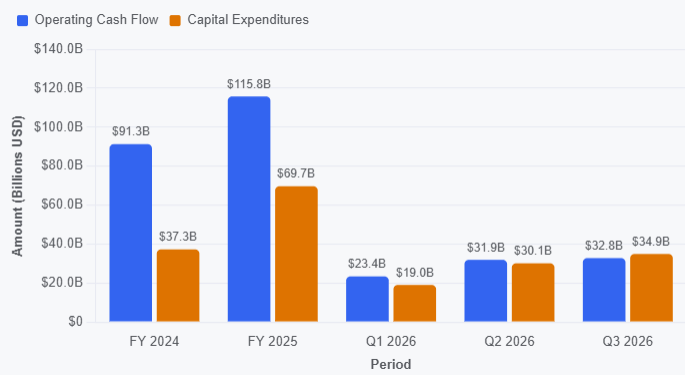
Source: ChatGPT – Authors idea
Big Tech must show what those chips are producing
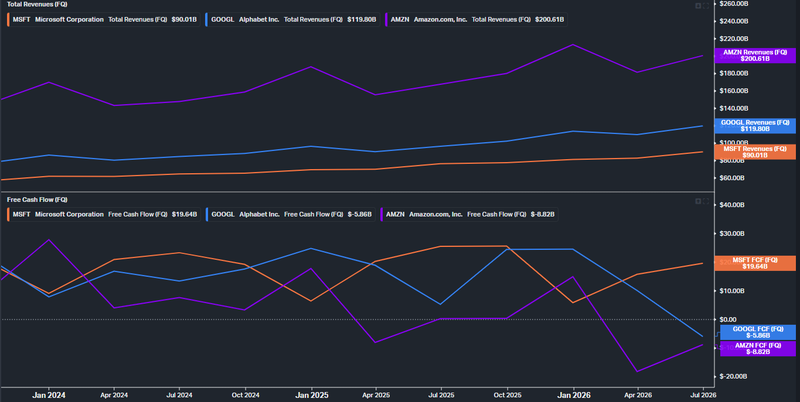
Alphabet and Microsoft report after Wednesday’s US close, followed by Amazon on Thursday, expectations for Microsoft to report approximately $90.64 billion of revenue for its fiscal first quarter of 2027 and Alphabet to report $127.86 billion for the third quarter of 2026. Wall Street’s consensus for Amazon’s third-quarter revenue is approximately $202.2 billion.
The more consequential numbers will sit below those headlines
Alphabet’s cloud revenue grew 82% in the previous quarter, yet the company recorded negative free cash flow and raised its 2026 capital-spending forecast to between $195 billion and $205 billion.
Microsoft’s Azure business grew 43%, supported by improving enterprise AI adoption, while quarterly capital expenditure reached $41 billion. Amazon reported 37% AWS growth but raised its annual investment plans as free cash flow came under pressure.
Source: Koyfin
Investors must distinguish expansion from efficiency
That makes the composition of growth as important as its speed. Revenue generated from scarce computing capacity may look strong while margins narrow because depreciation, energy and financing costs are rising underneath it. A company can therefore beat the topline forecast and still be disappointed if each new dollar of growth requires a larger amount of capital than the one before it.
Spending discipline would provide some relief, but even that signal is complicated. A lower capital-expenditure forecast could improve free cash flow and reassure investors that management is protecting returns. It could also suggest that demand is no longer strong enough to justify the expansion previously promised. The market will have to decide whether restraint reflects greater efficiency or weaker confidence.
Interest rates can amplify the earnings reaction
The Federal Reserve announces its decision on the same day that Microsoft and Alphabet report. A hold is widely expected, but the market will be watching whether Kevin Warsh leaves the door open to a December rate hike.
If that possibility remains firmly on the table, short-term Treasury yields could rise, tightening financial conditions and putting renewed pressure on technology valuations.
That could bring investors back to the same concerns that drove last week’s selloff, particularly if higher borrowing costs coincide with rising AI spending and uncertain returns. Strong earnings may struggle to offset a more hawkish rate outlook.
What would restore confidence in the AI trade
The clearest positive outcome would combine accelerating cloud revenue, stable margins, stronger free cash flow and evidence that AI products are creating demand beyond the companies’ own infrastructure spending. That would show that the investment cycle is beginning to finance itself through commercial returns.
Strong revenue accompanied by another sharp increase in capital expenditure would be less reassuring. It would confirm that AI demand remains firm while leaving the market unsure how much of the resulting value will reach shareholders.
The greatest risk would be weaker cloud guidance alongside sustained or higher spending
That combination would suggest that costs are becoming harder to slow just as revenue momentum begins to soften, potentially extending the Nasdaq correction even if the reported quarter beats expectations.
This week is therefore less about whether Microsoft, Alphabet and Amazon can beat the current numbers. It is about whether their guidance can make the next round of AI spending look more valuable than the last.