
 Help
Help 
Can AI spending keep driving the market?
AI has become the driving force behind the biggest gains in global equity markets. Over the past two years, investors have rewarded technology companies with trillions of dollars in additional market value on the expectation that AI will reshape industries ranging from cloud computing to enterprise software. But as investment continues to accelerate, the market is beginning to ask a different question It is whether those investments are generating enough revenue to justify the pace of spending.

One of the strongest arguments supporting today's AI rally is that much of the spending remains within the same technology ecosystem.
Microsoft reported revenue of $90 billion while Azure cloud revenue accelerated 43%.
Higher interest rates increase the cost of capital and can reduce the value investors place on future earnings.
AI is creating its own economic cycle
One reason investors remain optimistic is that much of today's AI investment is funding the same ecosystem that generates it.
The world's largest technology companies are using cash generated from mature businesses such as cloud services, enterprise software, advertising and consumer devices to finance another wave of investment in data centres, AI chips and computing infrastructure. That spending then creates revenue for semiconductor manufacturers, cloud providers and software companies, many of which reinvest their own profits into expanding AI capacity.
The result is an industry that is increasingly financing its own growth. Rather than depending entirely on outside demand or easy access to capital, much of the money flowing into artificial intelligence remains inside the technology sector, reinforcing investment across multiple parts of the supply chain. That helps explain why AI spending has remained resilient despite higher interest rates and a more challenging economic backdrop.
The latest earnings suggest companies are starting to see the returns
Recent earnings offered some of the clearest evidence yet that the industry's massive investment is beginning to translate into business growth.
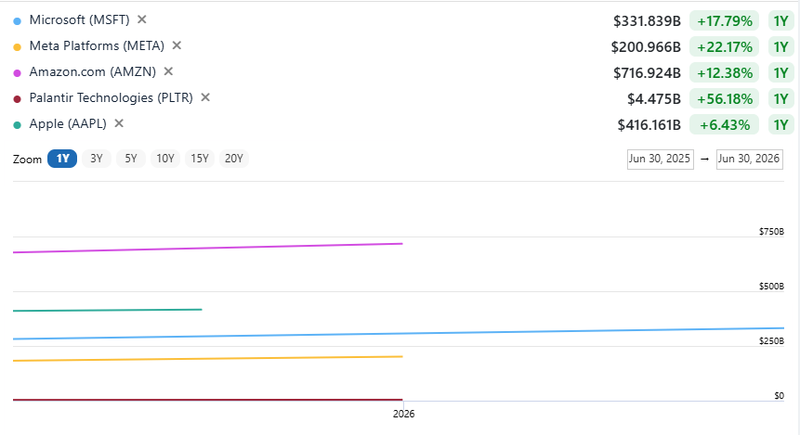
Microsoft reported quarterly revenue of $90 billion, while Azure expanded 43%, its strongest growth in several years. Management also projected another acceleration this quarter, indicating that demand for cloud computing continues to outpace available capacity.
Amazon crossed $200 billion in quarterly revenue for the first time, supported by continued strength in AWS as businesses increased spending on cloud infrastructure needed to run AI applications.
Apple delivered nearly $30 billion in quarterly profit while continuing to increase investment in artificial intelligence across its hardware and software ecosystem, signaling that it sees AI as a long-term driver of future products rather than a short-term feature.
Meta and Palantir show that AI demand extends beyond the cloud
The story was not limited to cloud providers. Meta continued to generate strong revenue growth while investing heavily in AI infrastructure, reinforcing its strategy of using artificial intelligence to strengthen advertising, recommendations and user engagement across its platforms.
Palantir demonstrated the software side of the equation. Revenue jumped 93%, while profits exceeded $1 billion as more businesses adopted its AI platform to automate decision-making and operational workflows. Each company benefits from AI in a different way. Microsoft and Amazon are selling computing power that makes AI possible. Meta is using technology to improve its core advertising business. Palantir is turning AI directly into enterprise software revenue.
Source: Finance chart
Investors are paying closer attention to operational signals
Strong earnings have improved confidence, but they have not removed concerns about valuations. Technology companies are still spending extraordinary amounts on infrastructure, and investors want evidence that demand will continue to grow once this initial wave of investment passes.
That is why attention is increasingly shifting toward operational indicators rather than headline announcements. Enterprise software retention rates show whether companies continue expanding AI adoption after their first deployments. Cloud infrastructure order backlogs provide insight into future demand for computing capacity.
Hardware replacement cycles reveal whether consumers are willing to upgrade devices because of new AI capabilities, while corporate technology budgets indicate whether businesses continue prioritizing artificial intelligence despite broader economic uncertainty.
The market is asking a different question
Not long ago, investors were focused on one issue: whether technology companies were spending too much on artificial intelligence.
The latest earnings suggest the market is becoming more interested in what those investments are producing. Companies are beginning to show that AI is generating stronger cloud demand, attracting enterprise customers and creating new sources of recurring revenue rather than simply increasing capital expenditure.
That is no longer the centre of the debate
That does not mean every company investing heavily in AI will succeed, nor does it remove the questions surrounding valuations. Expectations remain high, and investors will continue looking for evidence that revenue growth can keep pace with infrastructure spending.
For now, however, the conversation has clearly shifted. The challenge is no longer explaining why companies are investing so aggressively in artificial intelligence. It proves that those investments can continue generating the growth needed to support one of the market's most expensive and closely watched sectors.


