
 Help
Help Intel's 10% CPU price hike could be the start of a bigger semiconductor shift
Intel's plan to raise PC processor prices by roughly 10% in October has changed the conversation. For years, chipmakers competed by cutting prices whenever demand softened. Now they are doing the opposite, and the market is treating that as evidence that supply has become valuable enough to protect margins instead of sacrificing them for market share.
Intel plans a 10% PC CPU price increase in October.
Intel has processed more than one million High-NA EUV wafers.
High-volume High-NA production still sits ahead of TSMC and Samsung.
The break above the descending trendline from the 140 peak is the first sign that sellers are losing their grip.
Intel is betting that margins matter more than market share
Intel is making this move from a much stronger position than it was a year ago. Quarterly revenue climbed from $13.58 billion to $16.13 billion, while the company's net loss narrowed dramatically from $2.75 billion to $684 million. That gives management more room to protect profitability instead of chasing volume in a PC market that has stabilized but is no longer driving the industry's next growth cycle.
The timing is not accidental
Enterprise demand has stopped deteriorating, while AI infrastructure continues pulling far more capital than traditional computing. Intel is testing whether customers will accept higher prices rather than expecting manufacturers to compete through discounts.
The supply chain is making that decision easier
Memory costs remain elevated, advanced packaging is still constrained, and AI demand continues absorbing premium manufacturing capacity. When supply becomes more valuable than spare capacity, protecting margins becomes easier than fighting for market share.
That is why other chip stocks moved with Intel. Investors treated the price increase as a signal that the industry is entering a different phase, one where pricing power is becoming just as important as shipment growth.
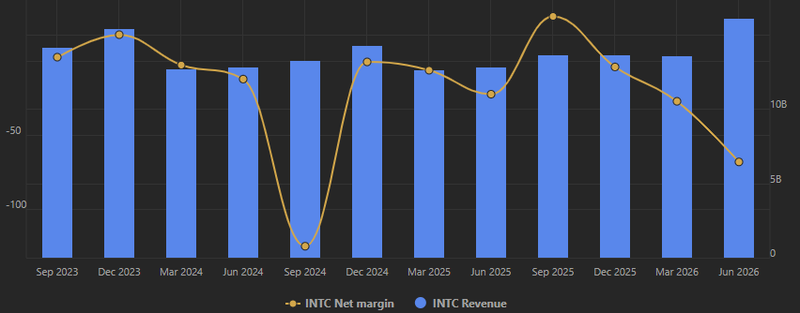
Source: Fullratio
The bigger story sits inside Intel's factories
The more important announcement came from manufacturing. Intel has now processed more than one million High-NA EUV wafers, becoming the first company to reach high-volume production at that scale with ASML's newest lithography platform.
That milestone matters because High-NA EUV changes how the smallest chip features are produced. Instead of relying on increasingly complex multi-patterning, the newer tools allow more advanced layers to be printed with greater precision, improving throughput on some of the industry's most demanding manufacturing steps.
The lead becomes more noticeable when compared with the rest of the industry
TSMC does not expect meaningful High-NA deployment until around 2030, while Samsung's broader production plans arrive later in the decade. Intel is already building commercial products with the technology today.
That does not automatically make Intel the manufacturing leader overnight. It does mean the company has reached commercial experience with a production tool its biggest rivals have yet to deploy at comparable scale.
The next competition may be about manufacturing, not just AI chips For much of the AI boom, investors focused on whoever designed the fastest accelerator.
The next race looks different
Broadcom is expanding custom AI chips, Nvidia continues dominating accelerators, and Intel is trying to turn manufacturing itself into a competitive advantage. The High-NA milestone gives Intel something that is difficult to build quickly: real production experience with a technology expected to define future process generations.
That is why semiconductor stocks outperformed while other technology sectors struggled. The market is beginning to price two different stories at once. One is AI demand. The other is the growing value of companies that control how the next generation of chips gets built.
Technical outlook
Intel is starting to look different after months of trading on the defensive. The break above the descending trendline from the 140 peak is the first sign that sellers are losing their grip, while the rising long-term trendline underneath shows buyers have been stepping in earlier on every pullback.
The next test is already clear
Price is pushing into the 107.10 area, where the recovery has to prove it can keep going. Getting through that level would leave the recent breakout looking much more convincing, especially after the steady build-up of higher lows that has been developing beneath the surface.
Scenarios Ahead
104-105 area has become the first place where buyers need to show they are still in control. If that zone holds, another push through 107.10 becomes much easier to build on, with the next resistance levels coming back into view as momentum expands beyond the initial breakout.
Losing 104 changes the conversation
A move back below 104 would raise the first warning that the breakout is losing strength. If price also slips beneath the rising trendline, attention shifts back toward 90, where buyers previously slowed the decline. A deeper break would leave 69.47 back on the chart as the level that separates the current recovery from a return to the broader downtrend.
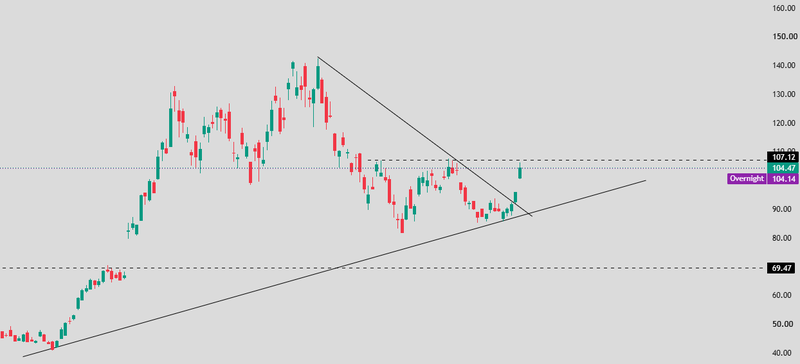
Source: Trading view


