
 Help
Help IonQ acquires Elisity to strengthen cybersecurity capabilities; shares decline
IonQ has agreed to acquire cybersecurity firm Elisity in an all-stock transaction valued at up to $1.3 billion. Despite the strategic reinforcement of its quantum security capabilities, IonQ’s share price declined amid investor concerns regarding cash-flow consolidation.

IonQ has entered into a definitive agreement to acquire Zero Trust provider Elisity in an all-stock transaction valued at up to $1.3 billion.
The transaction combines Zero Trust architecture with quantum security technologies to address emerging risks in artificial intelligence and encryption.
Despite strong existing liquidity, market participants appear to view the implied cost of the Elisity acquisition as a potential operational risk, placing downward pressure on IonQ shares.
Date: 13 October 2026
Why are IonQ shares falling after the Elisity acquisition announcement?
IonQ Inc. announced that it has entered into a definitive agreement to acquire Elisity Inc. through an all-stock transaction valued at up to $1.3 billion, including up to $150 million in performance-based earnouts—as cited by CNBC.
Elisity is a cybersecurity firm specialising in Zero Trust security solutions for users, devices, workloads, AI agents, and other non-human identities. Against this backdrop, IonQ aims to expand its cybersecurity portfolio through the acquisition, combining Elisity’s Zero Trust platform with its own quantum security technologies to mitigate current threats involving large language models (LLMs) and prepare for emerging quantum-related cybersecurity risks.
IonQ is a technology company specialising in quantum computing, providing access to quantum systems via cloud platforms, alongside quantum networking and related technologies and services. Consequently, robust cybersecurity is essential for safeguarding the company's internal systems, proprietary information, and customer data. This imperative is particularly pronounced given the escalating cybersecurity challenges tied to advances in artificial intelligence and the prospective threat of quantum computing to conventional encryption protocols.
However, although the announcement points to potential service enhancements and long-term revenue growth, IonQ’s shares fell by 9.07% to $36.27. This market reaction may reflect investor concerns regarding the substantial cash-flow commitments required to consolidate the acquisition. Mergers and acquisitions frequently entail a temporary contraction in available liquidity, even though the broader strategic benefits typically manifest over the longer term through enhanced operational cash flows.
By the Q2 2026, IonQ held $2.12 billion in cash and short-term investments. With the transaction expected to close in the fourth quarter of 2026, the underlying market reaction underscores investor caution regarding the required acquisition costs relative to available liquidity. In this context, it remains possible that the necessary cash flows will be supported through financing activities.
Technical analysis of IonQ’s share price
From a technical perspective, IonQ has undergone a consolidation phase over the past year. The following points highlight key developments in its price action performance:
- Trend Context: Over the long term, IonQ’s shares remain in a broader consolidation phase, with price action oscillating within a descending triangle pattern. Over the last four months, however, the equity has experienced a downward trajectory, currently trading beneath its 50-day, 100-day, and 200-day Simple Moving Averages (SMAs), reinforcing a short-term bearish bias.
- Resistance Levels: In the event of a bullish price recovery, initial major resistance stands at $43—a level that converges with the 200-day SMA. A decisive close above this threshold would enhance the likelihood of testing higher valuation levels, notably the $50 and $62 zones—this latest coinciding with the upper boundary of the descending trendline.
- Support Levels: Should the current bearish momentum persist, primary technical support lies at $30. A downside breach of this level would expose the next critical support area at $26. A failure to hold these support zones would heighten the probability of a more pronounced market correction.
- Momentum Indicators: Both the Moving Average Convergence Divergence (MACD) and the Relative Strength Index (RSI) display downward trajectories, signalling that short-term bearish pressure could continue. However, with the RSI approaching oversold territory, suggesting caution regarding to the sustainability of the ongoing selling pressure.
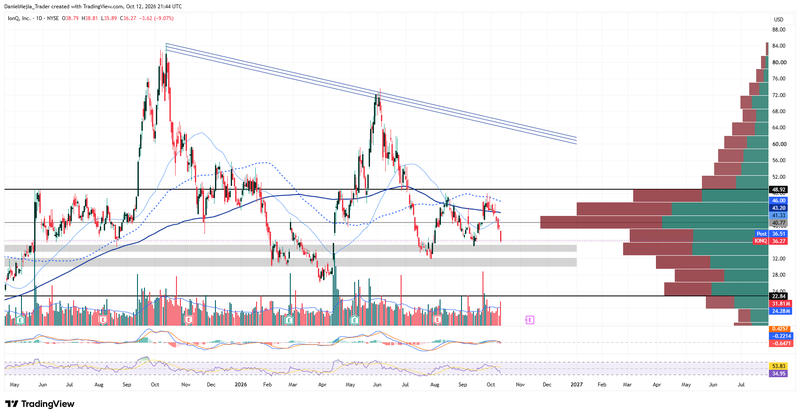
Figure 1. IonQ Share Price Performance (2025–2026). Source: Data from the New York Stock Exchange (NYSE) data; author's analysis conducted via TradingView.


