
 Help
Help 
Is Nvidia losing its AI leadership? why the next phase of AI may not favour Nvidia
Nvidia has become synonymous with the artificial intelligence boom. Its graphics processing units (GPUs) powered the race to build large language models (LLMs), turning the company into the dominant supplier of AI infrastructure and one of the world's most valuable businesses.
Nvidia remains the dominant provider of AI chips for training large language models.
AI investment is shifting from building models to deploying them on a scale.
Capital is spreading across the semiconductor supply chain as investors look for the next AI winners.
The AI market is entering a new phase
The first wave of AI investment had a clear objective: build bigger and more capable language models. Training those models required enormous computing power, and Nvidia's GPUs quickly became the industry's standard. Its CUDA software ecosystem, mature developer tools and performance advantage made it difficult for competitors to gain meaningful market share.
Investment cycle is beginning to mature
The largest technology companies have already committed hundreds of billions of dollars to AI infrastructure. The priority is no longer simply training increasingly powerful models, but finding ways to deploy them across search engines, productivity software, customer service, cloud computing and enterprise applications.
Nvidia’s stock performance reflects this transition. Shares are up roughly 12% in 2026, broadly tracking the gains in the wider S&P 500, as the company’s previously explosive growth rate begins to normalize. While demand for AI infrastructure remains strong, investors are increasingly focused on whether future growth can justify already elevated expectations and how quickly AI spending can translate into sustainable revenue growth.
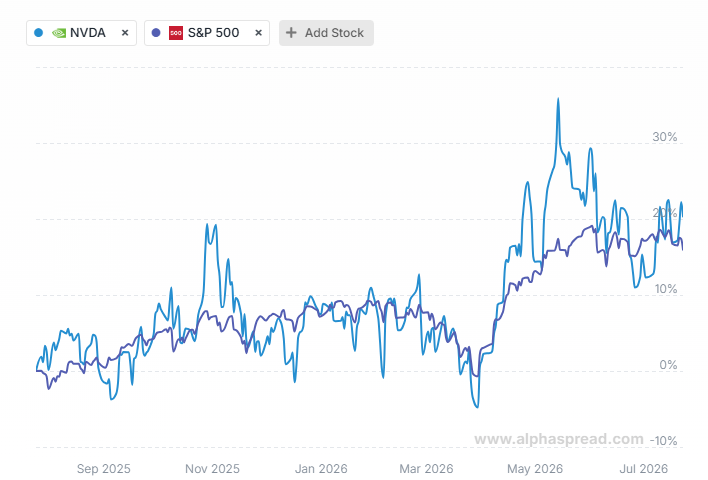
Source: Alphaspread
Nvidia's biggest customers are becoming its biggest challengers
Nvidia still occupies a unique position in the AI ecosystem, but its success has also created a strong incentive for customers to diversify.
The world's largest cloud providers are spending tens of billions of dollars each year on AI infrastructure. Reducing even a small portion of those costs can translate into significant savings over time.
Rather than relying exclusively on Nvidia, companies are increasingly investing in their own processors. Meta Platforms is expanding development of custom AI chips for internal workloads. Google continues to improve its Tensor Processing Units (TPUs), which already power many of its AI services and are increasingly available through Google Cloud.
Amazon is following a similar strategy with its Trainium and Inferentia chips, giving customers alternatives for AI training and inference. These initiatives are unlikely to replace Nvidia overnight. Instead, they highlight a market that is becoming more competitive as customers seek greater control over costs, supply chains and long-term infrastructure.
A broader market creates new opportunities
Unlike the first phase of AI, where success depended largely on supplying training hardware, the next stage is likely to reward a wider range of technologies, including inference accelerators, high-bandwidth memory and networking infrastructure.
AMD is one example
The company has steadily expanded its AI accelerator portfolio and strengthened relationships with major cloud providers. It does not need to overtake Nvidia to become a larger beneficiary of AI investment. If inference spending grows faster than training over the coming years, AMD could capture a meaningful share of that expanding market while growing from a much smaller revenue base.
Market performance has already reflected this shift in expectations. AMD has significantly outperformed Nvidia in 2026, with shares gaining roughly 131.49% compared with Nvidia’s approximately 8.88% increase. While Nvidia remains the dominant supplier of AI infrastructure, investors are increasingly looking beyond the current market leader and reassessing which semiconductor companies could benefit most as AI spending expands beyond model training and into inference, deployment and enterprise applications.
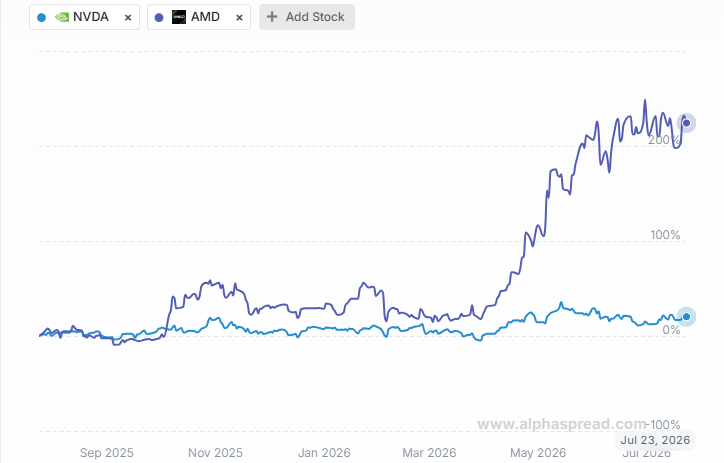
Source: Alpha spread
Capital is already moving across the AI supply chain
During the early stages of the AI rally, Nvidia became the primary way to gain exposure to artificial intelligence. More recently, capital has started flowing into companies supplying other parts of the AI ecosystem.
Memory manufacturers such as Micron Technology and SK Hynix have attracted growing attention as demand for high-bandwidth memory accelerates. Networking companies, chip designers and infrastructure suppliers are also benefiting as AI data centres become larger and more complex.
That doesn't mean that Nvidia's leadership is ending
Nvidia remains the benchmark for AI infrastructure, and its technological leadership in model training appears secure for the foreseeable future.
What may change is where the next wave of investment generates the strongest returns. As AI adoption shifts from building foundation models to deploying them across the global economy, demand is likely to become more diversified. Inference computing, custom silicon, memory and networking are all expected to capture a growing share of future AI spending.
It means the AI investment story is becoming bigger than Nvidia alone. For investors, the next chapter of artificial intelligence may not be defined by one dominant winner, but by a broader group of semiconductor companies benefiting from an industry entering a new stage of growth.


