
 Help
Help Micron stock forecast: AI demand, China competition and key levels
Micron’s recent share-price weakness raises a question that goes beyond competition from China. The memory market is becoming more profitable as AI infrastructure drives demand for advanced memory, but those margins also create an incentive for new competitors to expand capacity.
If AI-related demand remains strong, Micron may be able to absorb competitive pressure.
CXMT does not need to overtake Micron in HBM to influence sentiment or challenge pricing in other memory categories.
A sustained move above $1,035.50 would strengthen the bullish case and bring the $1,080–$1,100.
China’s capacity ambitions are the bigger concern
CXMT’s development of a “4F square” cell architecture for server memory has raised concerns about its ability to increase memory density and compete more aggressively with established manufacturers. Elon Musk has also highlighted China’s capacity to scale production once it masters a technology.
The risk for Micron is not necessarily that CXMT immediately matches its most advanced products. It is that additional Chinese capacity could eventually increase supply in conventional memory, putting pressure on prices and reducing the exceptional profitability manufacturers currently enjoy.
When demand outpaces supply, pricing and margins can rise sharply
When manufacturers expand capacity faster than demand grows, the same economics can reverse. CXMT does not need to overtake Micron in HBM to influence sentiment or challenge pricing in other memory categories.
For now, the scale of that threat remains uncertain. Commercial production, manufacturing yields, customer qualifications and access to international markets will determine how quickly CXMT can translate its technology into meaningful competition.
AI demand has changed Micron’s earnings profile
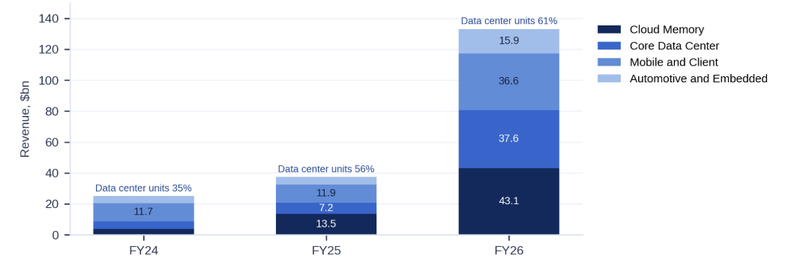
Micron is entering this competitive phase with a business increasingly tied to cloud infrastructure and data centres. Those activities accounted for 61% of revenue in 2026, compared with 35% in fiscal 2024.
That shift makes the company more exposed to AI infrastructure spending, but it also creates a more important question for investors: how durable is the current pricing environment? Strong demand for server memory and HBM can support profitability, yet the returns depend on customers continuing to invest and supply remain disciplined.
If AI-related demand remains strong, Micron may be able to absorb competitive pressure in conventional memory while maintaining a valuable position in advanced products. If capacity expands faster than demand, however, lower prices could affect earnings even before competitors match its most sophisticated technology.
Source: Micron
Margins show strength, but cash generation matters too
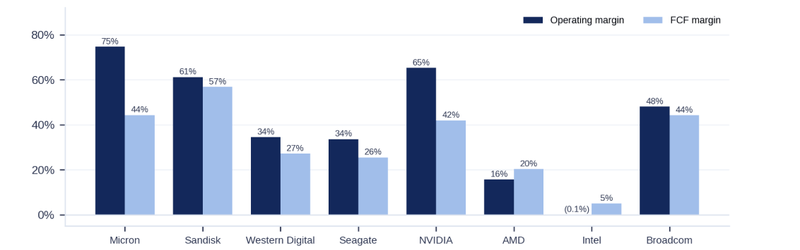
The supplied margin comparison puts Micron ahead of NVIDIA, SanDisk and Broadcom operating margin, at 75% versus 65%, 61% and 48%, respectively. That points to strong operating profitability, although Micron’s margins are particularly sensitive to memory pricing and the industry cycle.
SanDisk leads the comparison in free-cash-flow margin at 57%, followed by Broadcom and Micron at 44%, and NVIDIA at 42%. These figures suggest that operating profitability and cash generation do not necessarily produce the same ranking. Capital expenditure, working capital and business models can create differences between reported operating income and the cash left after investment.
Source: Micron
Technical outlook
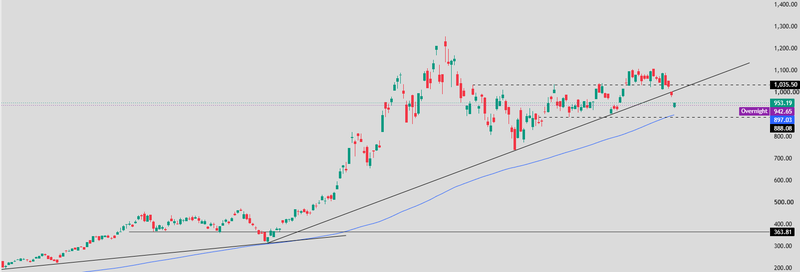
The broader trend remains positive, but the rally has lost momentum since reaching its highs. Repeated failures to hold gains near $1,100 have established a resistance zone where sellers continue to emerge.
The recent break below the rising trendline points to weakening short-term momentum. Buyers have lost some control, although the moving average near $900.83 remains intact. The $888.08–$900.83 area is now the key test. A hold here would leave room for the pullback to stabilize, while a clear break below it would increase the risk of a deeper correction.
Scenarios ahead
Holding the $888–$901 support zone and reclaiming the broken trendline would improve the outlook for a recovery toward $1,000–$1,035.50. A sustained move above $1,035.50 would strengthen the bullish case and bring the $1,080–$1,100 resistance zone back into focus. Clearing that ceiling would open the way for another attempt at the previous highs.
The outlook will weaken further if price remains below the broken trendline and sellers push it decisively beyond $888.08. That would expose $850, followed by the $800 area. A failure to reclaim $900–$901 after such a breakdown would add weight to the bearish case.
For now, the longer-term advance remains intact, but the trendline break has shifted the near-term balance in favour of caution. The $888–$901 zone will help determine whether buyers can contain the pullback or whether selling pressure is gaining traction. A recovery above $1,035.50 would provide a clearer signal that bullish momentum is returning.
Source: Trading view


