
 Help
Help 
Microsoft adds record $450 billion in one day as Azure growth accelerates
Microsoft added roughly $450 billion to its market value in a single trading session, the largest one-day increase ever recorded by a public company, after faster Azure growth, stronger earnings and unchanged AI investment plans reignited investor confidence.
Microsoft shares surged 16%, their biggest one-day gain since October 2008.
The company added around $450 billion in market value, setting a new stock-market record.
Azure revenue grew 43%, its fastest pace since early 2022.
Microsoft expects Azure growth to accelerate to about 45% in the current quarter.
Microsoft sets a new market record
Microsoft delivered one of the most dramatic single-day moves in stock-market history after stronger-than-expected cloud growth triggered a 16% surge in its shares.
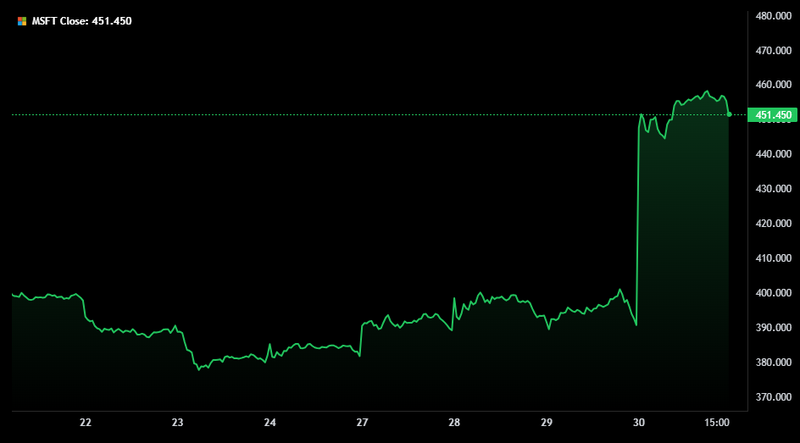
The rally added approximately $450 billion to Microsoft’s market capitalization in one session, surpassing the previous record of roughly $440 billion set by Nvidia.
The stock rose to about $451.10, marking Microsoft’s strongest daily gain since October 2008.
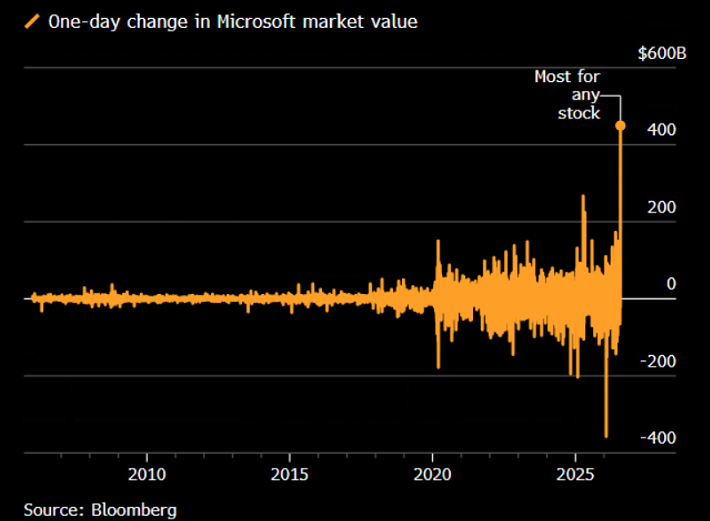
Source: Bloomberg
The size of the increase is difficult to put into perspective. Microsoft added more value in one trading day than the entire market capitalization of roughly 96% of companies in the S&P 500.
The increase was also larger than the combined market value of the 41 smallest members of the index.
Azure growth drives the rally
The main catalyst was Microsoft’s cloud business.
Azure revenue rose 43% during the fiscal fourth quarter, accelerating to its fastest growth rate since early 2022 and beating expectations for roughly 40%.
The company also disclosed that Azure generated more than $100 billion in annual revenue for the first time during the fiscal year ending in June.
More importantly, management expects growth to accelerate further.
Microsoft is forecasting Azure growth of approximately 45% in the current quarter, suggesting that demand for cloud computing and AI infrastructure remains exceptionally strong.
Demand is still exceeding available capacity, reinforcing the view that Microsoft’s challenge is currently building enough infrastructure rather than finding customers.
AI demand is becoming visible in revenue
The results offered investors something they have been demanding from major technology companies: clearer evidence that enormous AI spending is translating into revenue growth.
Microsoft was one of the earliest companies to commit aggressively to generative AI through its partnership with OpenAI.
Since then, the company has expanded AI products across Azure, Microsoft 365, software development and enterprise applications.
The latest numbers suggest those investments are beginning to produce more visible commercial results.
Microsoft now has more than 30 million paying users for Microsoft 365 Copilot, up from about 20 million only three months earlier.
A 50% increase in paid users over one quarter provides an important indication that businesses are becoming more willing to pay directly for AI tools rather than merely experimenting with them.
Revenue and profit beat expectations
Microsoft’s overall financial performance was also stronger than expected.
Quarterly revenue increased 18% to $90 billion, compared with market expectations of approximately $87.7 billion.
Profit reached $4.81 per share, well above the consensus estimate of $4.25.
The result included a roughly 33-cent-per-share contribution from the rising value of Microsoft’s investment in Anthropic.
Even excluding that boost, the underlying business remained strong.
Cloud growth, enterprise software demand and AI adoption all helped reinforce the view that Microsoft remains one of the strongest earnings stories among the largest US technology companies.
Investors welcome discipline on AI spending
Capital expenditure has become one of the biggest concerns surrounding the artificial-intelligence boom.
Microsoft spent approximately $41 billion on capital projects during the quarter, up 70% from a year earlier. Analysts had expected around $42 billion.
The company is building data centers, purchasing advanced semiconductors and expanding power and computing capacity required to run increasingly complex AI models.
But management reassured investors that its 2026 investment expectations have not increased.
Microsoft now expects reported capital spending to land near $175 billion this year, compared with an earlier estimate of roughly $190 billion.
Part of the reduction comes from an accounting adjustment involving the expected useful life of data centers and office buildings, rather than an actual retreat from infrastructure investment.
Outside that accounting change, Microsoft said its underlying investment plans remain unchanged.
That distinction helped calm investors who had become increasingly concerned that AI spending across the technology sector was expanding faster than revenue.
Microsoft stands apart from AI spending concerns
The market reaction also highlights a growing divide between technology companies.
Alphabet recently increased its capital-spending outlook, while Meta raised the lower end of its expected investment range.
Both companies saw their shares come under pressure as investors questioned whether the additional spending would generate sufficient returns.
Microsoft faced the same concern heading into earnings.
The difference was that Microsoft combined heavy investment with an acceleration in Azure growth and stronger evidence of AI monetization.
That gave investors more confidence that its capital expenditures are generating demand rather than simply creating future capacity.
The market appears increasingly willing to reward AI spending when revenue is accelerating alongside it.
Demand still exceeds capacity
Perhaps the most important comment from Microsoft’s results was that cloud demand continues to exceed available supply.
That signals that infrastructure constraints are still limiting growth.
For a company already spending tens of billions of dollars each quarter on data centers, this suggests the underlying market for cloud and AI computing remains stronger than Microsoft can currently serve.
It also helps explain why the company has been reluctant to slow infrastructure investment despite concerns over capital intensity.
If new capacity can be filled quickly, the return on those investments may be considerably stronger than investors feared.
The next challenge will be maintaining that relationship as spending climbs toward levels rarely seen in corporate history.
Copilot adoption strengthens the AI thesis
The acceleration in Microsoft 365 Copilot subscriptions is another important part of the story.
Paid users increased from roughly 20 million to more than 30 million in only three months.
Copilot is sold as an additional subscription on top of Microsoft’s existing Office products, allowing the company to monetize AI through a customer base it already controls.
That distribution advantage could become one of Microsoft’s most important competitive strengths.
Instead of needing to build an entirely new customer base for AI, Microsoft can integrate the technology into software already used by hundreds of millions of workers and businesses.
If adoption continues increasing, Copilot could become a major source of recurring AI revenue.
Wall Street raises expectations
The earnings report has also encouraged analysts to raise their valuation assumptions.
Goldman Sachs increased its 12-month Microsoft price target to $640 from $610 while maintaining a positive view on the stock.
The upgrade reflects stronger Azure growth, improving sentiment around Copilot and greater confidence that Microsoft can generate returns from its AI investments.
The central question for investors is shifting.
Earlier in the AI cycle, markets focused primarily on how much Microsoft would spend.
The debate is increasingly about how much revenue and profit that spending can generate.
The $450 billion move puts Microsoft’s scale in perspective
Microsoft’s record one-day increase also illustrates just how concentrated global equity markets have become.
The roughly $450 billion added to Microsoft’s valuation in one session exceeds the total stock-market capitalization of several countries, including South Africa, Turkey, Finland and Vietnam.
A single earnings report from one US technology company therefore created more equity value in a day than entire national stock markets contain.
That level of scale means earnings from companies such as Microsoft can materially influence major US indexes and global investor sentiment.
It also raises concentration risk.
When a small group of technology companies represents such a large share of index value, their earnings and AI investment decisions can increasingly determine the direction of the broader market.


