
 Help
Why is 28,871 a critical support level for the Nasdaq 100?
Nasdaq’s latest retreat exposes a weakness in the AI investment story that strong chip sales alone cannot resolve. Investors are asking whether the infrastructure behind AI can generate sufficient returns to justify the debt required to build it, particularly as inflation threatens to keep financing costs elevated.
September CPI rose 3.7% year on year and 0.6% month on month.
Cash-rich technology giants can fund substantial investment internally.
This week’s results from Meta and Tesla will offer another test of investor confidence.
Nasdaq 100 is trading around 29,527 after a sharp reversal from the 31,000-resistance zone.
Core Weave exposes the cost of the AI boom
The recent sell-off has made the bond market an important indicator of stress within the AI trade. Core Weave shares lost roughly 25% over five sessions, while yields on its bonds climbed above 15%. The move reflects growing concern about the company’s capacity to finance its expansion and generate sufficient returns from its infrastructure investments.
The issue is not that AI demand has disappeared
It is that building the capacity to serve that demand requires enormous upfront investment. Core Weave reported $35.6 billion in debt at the end of June and spent $14.9 billion on investment activities during the first half of 2026, primarily on infrastructure. The question is how quickly those investments can generate cash to cover operating expenses, debt service and further expansion.
This distinction matters for the Nasdaq because the financing pressure is unlikely to affect every company equally. Cash-rich technology giants can fund much of their spending internally, while infrastructure providers that depend more heavily on borrowing face a higher hurdle as credit costs rise. If developers’ slow construction or become more selective about capacity, the consequences could eventually reach chipmakers and cloud providers.
Inflation raises the hurdle for AI investment
The inflation backdrop makes that calculation more difficult. US CPI increased 3.7% annually in September and Producer prices climbed 1.3% during September and 6.3% over the year. Although energy contributed substantially to the monthly pressure, services prices also rose, complicating the path back towards price stability.
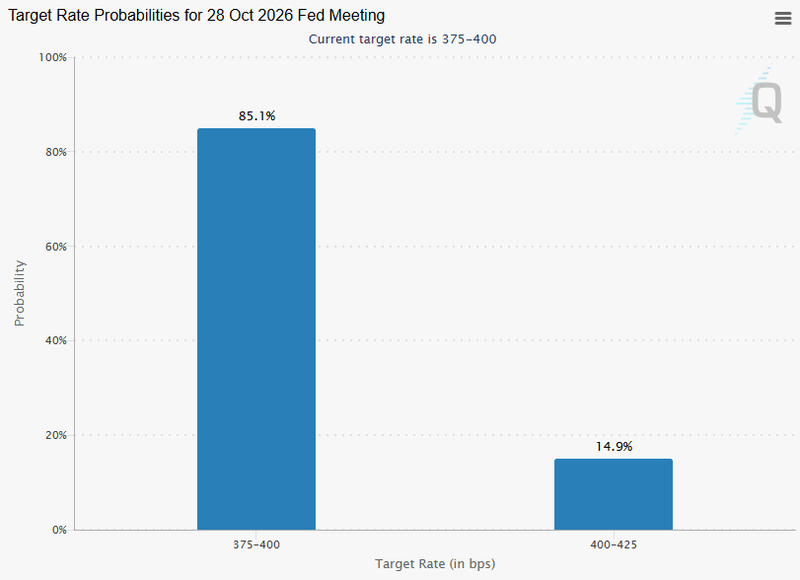
Markets are largely expecting the fed to hold rates in October, while pricing approximately an 89% probability of a quarter-point increase in December, investors are confronting the possibility that financing costs will remain restrictive for longer.
Higher rates affect technology valuations through two channels. They increase the cost of borrowing for capital-intensive projects, and they reduce the present value of earnings expected further into the future. Companies can continue growing rapidly and still see their shares fall if the capital required to produce that growth becomes more expensive than investors anticipated.
Source: CME Group
Earnings must justify the spending
This week’s results from Meta and Tesla arrive at a sensitive point for the technology sector. Investors need evidence that AI investment is translating into stronger revenue, margins and productivity, rather than simply producing larger capital expenditure budgets. Meta’s spending plans will help reveal how aggressively major platforms intend to expand infrastructure, while Tesla’s results will offer a separate test of expectations surrounding its AI, robotics and autonomous-driving ambitions.
The reaction may depend as much on future spending guidance as on quarterly earnings. If companies signal that investment will continue accelerating without clearer evidence of returns, investors may demand a greater risk premium. Conversely, credible evidence of monetization could help restore confidence that the AI buildout can support its own cost.
Technical outlook
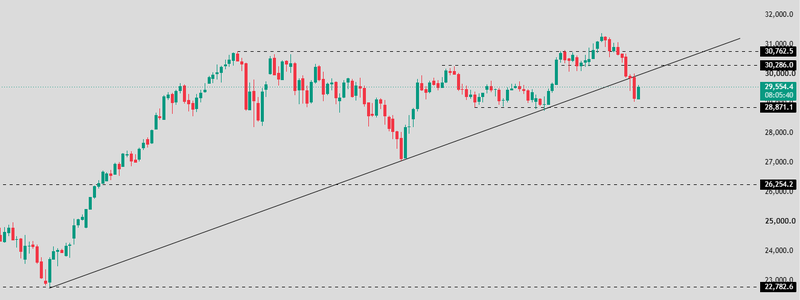
Nasdaq 100 is trading around 29,527 after a sharp reversal from the 31,000–31,200 resistance zone. The pullback has weakened the bullish structure, with the index breaking below the rising trendline that supported its advance from the 22,800 area.
The failure to sustain the breakout above 30,762 has shifted the near-term balance in favour of sellers. Prices have now fallen below 30,286, leaving the index attempting to recover from beneath a level that previously supported the advance. The broader uptrend has not been entirely erased, but buyers need to reclaim lost ground before the latest decline can be treated as a temporary correction.
The immediate focus is 28,871. Holding above this support would leave room for stabilization, while a decisive break lower would increase the risk that the sell-off develops into a deeper reversal.
Scenario ahead
If Nasdaq 100 holds above 28,871 and reclaims 30,286, the recent breakdown could lose momentum, opening the way towards 30,762. A sustained break above that resistance would strengthen the recovery and bring 31,000–31,200 back into focus.
However, if the rebound fails below 30,286 and the index breaks decisively beneath 28,871, selling pressure will gain confirmation. The next downside levels would be around 28,200, followed by the broader support zone near 26,254.
Source: Trading view


