Help
Nasdaq jumps after Nvidia's board reinstates Jensen Huang as CEO
Nasdaq futures surged by 6.65% after Nvidia reinstated Jensen Huang as CEO following presidential support, sparking a broad technology rally despite intensifying congressional scrutiny over AI chip exports.
Nvidia reinstated Huang as CEO after investigations have not found definitive proof.
Nvidia's shares jumped 31%, lifting Nasdaq futures by 6.65% and boosting major technology peers.
US President Donald Trump publicly supported Huang's reinstatement by Nvidia's board.
US lawmakers criticised the Huang reinstatement decision.
Date: 24 November 2026 (GMT+3)
Is Nvidia's CEO reinstatement a turning point for the technology sector?
The Nasdaq futures contract rose by 6.65% to 26,797 points after Nvidia's board decided to reinstate Jensen Huang as CEO. The announcement was positively received by market participants, as investors viewed Huang's return as a key factor in restoring confidence in Nvidia's leadership and the broader artificial intelligence (AI) industry, given his prominent role in the semiconductor sector.
Huang had resigned as CEO of Nvidia in early November following a scandal involving extramarital affairs that raised serious concerns regarding potential breaches of corporate confidentiality and US national security.
At the time, market participants reacted negatively to his departure, sending Nvidia's shares lower as concerns regarding potential issues within the US semiconductor industry weighed on equity markets, particularly the technology sector. Crucially, following days of significant volatility, the underlying investigations revealed no definitive evidence regarding the accusations against Huang, enabling him to reclaim his position and leadership.
Notably, US President Donald Trump stated that he had spoken with Nvidia's board, remarking that "Huang did nothing wrong", as quoted by CNBC. This suggests that the US President exerted political pressure regarding Huang's reinstatement. Additionally, Trump wrote in a social media post that Nvidia's board had made the right decision in reinstating him.
Against this backdrop, Nvidia's shares surged by 31%, reclaiming the $165 price level—a rally representing a rebound of approximately $1 trillion in market capitalisation. Additionally, prominent technology peers recorded substantial gains, most notably Micron, which jumped by 19%; Dell, which rose by 20%; Tesla, which advanced by 11%; and Advanced Micro Devices (AMD), which appreciated by approximately 7%.
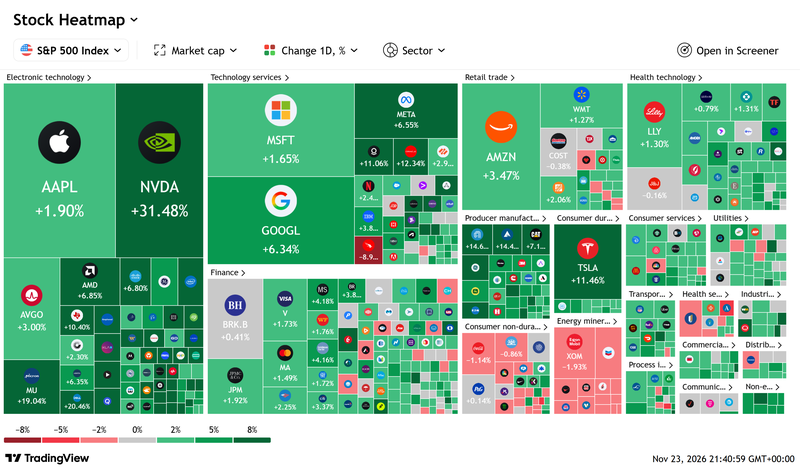
Figure 1. Nasdaq 100 Index Heatmap (23 November 2026). Source: Figure retrieved from TradingView.
However, both Republican and Democratic US lawmakers criticised Nvidia's decision, arguing that Congress should tighten restrictions on China's access to advanced AI chips, as reported by Reuters. In this context, Democratic US Senator Elizabeth Warren—who is set to lead the Banking Committee starting in January—characterised the decision as "reckless" and added that Nvidia's board must provide answers to Congress regarding export control compliance.
These developments suggest that regulatory and political pressures surrounding the semiconductor giant remain significant, as congressional scrutiny intensifies and investigations into potential export-control violations and national security implications continue.
According to Republican Senator Tim Scott, Chairman of the Senate Banking Committee, Huang will testify at a public hearing before the committee on 3 December, as cited by Reuters. The hearing will focus on the oversight of US export controls on advanced semiconductors. In this context, Congress is seeking to strengthen export-control legislation to restrict China's access to advanced AI chips and safeguard the United States' technological leadership in artificial intelligence.
Technical analysis of the Nasdaq futures contract
From a technical perspective, the Nasdaq has lost its prevailing bullish structure in the short term. A detailed examination of price action reveals several notable dynamics in underlying momentum:
- Trend Context: Over an extended horizon, the Nasdaq contract has lost its bullish structure of higher highs and higher lows, trading below its 50-day, 100-day, and 200-day Simple Moving Averages (SMAs). This market structure indicates that bearish momentum is dominating in the short term amid heightened scrutiny of AI-related firms and rising expectations of a more restrictive Federal Reserve stance. Notably, the index is exhibiting a double-top pattern—a technical structure commonly associated with trend reversals.
- Momentum Indicators: The Moving Average Convergence Divergence (MACD) indicator reflects a downward trajectory, though its histogram exhibits a bullish divergence, suggesting that bearish pressure may be subsiding. Meanwhile, the Relative Strength Index (RSI) has rebounded out of oversold territory, signalling a potential short-term price recovery. Nevertheless, it is worth noting that fundamental factors remain the predominant drivers of price action.
- Resistance Levels: Should the index regain bullish momentum, initial key resistance lies at 27,300 points (the double-top neckline), followed by secondary resistance at 28,200 points—a level that converges with the 200-day SMA.
- Support Levels: Should short-term selling pressure intensify, the next primary structural floor sits at 26,300 points (a structural support), followed by the 25,000 mark—a psychological barrier that converges with the Volume Profile's Point of Control (POC).
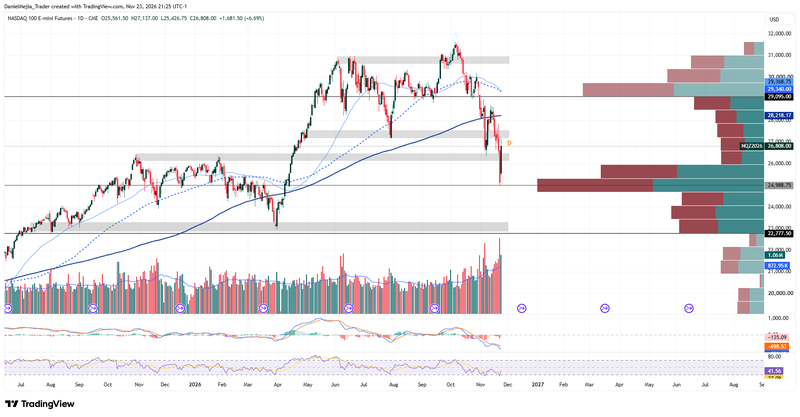
Figure 2. Nasdaq Futures Contract (2025–2026). Source: Data from the CME Exchange; author's analysis via TradingView.