
 Help
Help Nasdaq outperforms the US market as AI bets intensify
Nasdaq has gained around 22% this year, outpacing the S&P 500 at 14.1% and the Dow Jones at 7.5%. The gap reflects the dominance of technology companies in the AI boom, but it also leaves the index increasingly dependent on a small group of stocks delivering on high expectations.

Microsoft, Alphabet, Meta, and Nvidia are expected to spend around $700 billion on capital expenditure in 2026.
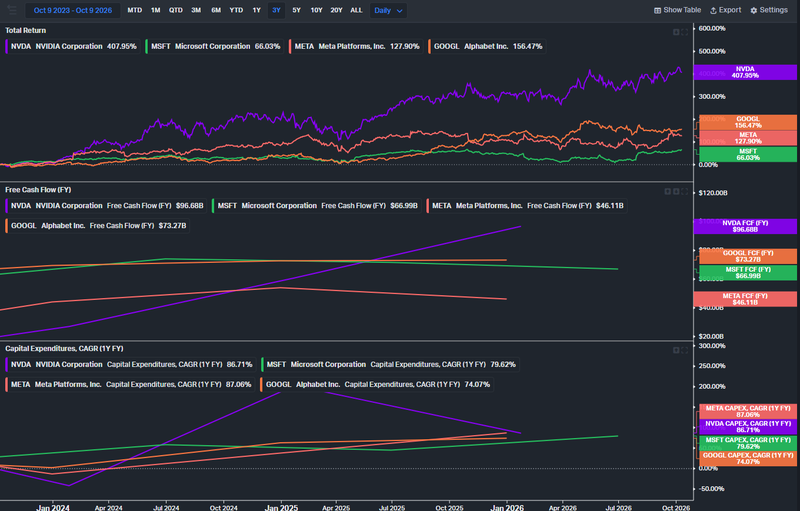
Over the three years to October 2026, NVIDIA gained 407.95%, compared with 156.47% for Alphabet, 127.90% for Meta and 66.03% for Microsoft.
Data centres, chips and power infrastructure require large commitments before the revenue arrives.
Four companies, four different bets on AI
The money going into AI is extraordinary. Microsoft, Alphabet, Meta, and Nvidia are expected to spend around $700 billion on capital expenditure in 2026, that is nearly six times their combined spending in 2022. Chipmakers and cloud providers are already benefiting from the buildout. The harder question is what happens if the companies paying for that infrastructure take longer to earn the money back.
The gap between the largest technology stocks is already telling
Over the three years to October 2026, NVIDIA gained 407.95%, compared with 156.47% for Alphabet, 127.90% for Meta and 66.03% for Microsoft. They are all central to the AI trade, but investors are not valuing their prospects in the same way.
NVIDIA has captured the most direct benefit from the rush to build computing capacity. Its reported fiscal year free cash flow of $96.68 billion shows how profitable that demand has been. The risk is that expectations have risen alongside the share price. Hyperscalers can continue spending heavily and still become more selective if the returns from their AI services fall short.
Alphabet has a different advantage
Its $73.27 billion in reported free cash flow gives it considerable room to finance AI development from an established advertising business. But AI also creates a challenge for Google Search. Alphabet needs to expand its AI and cloud businesses without weakening the economics of the business that funds them.
Meta's shares have risen 127.90%, helped by advertising performance and AI-driven improvements in targeting. Its reported capital-expenditure growth of 87.06%, however, shows how quickly the cost of expansion is rising. Investors will want to see those investments translate into better advertising returns and stronger earnings, rather than simply a larger infrastructure bill.
Microsoft's 66.03% gain looks modest by comparison, despite reported free cash flow of $66.99 billion. Its cloud business and enterprise AI products give it a strong position, but the market appears to want clearer evidence that demand for AI services can justify the cost of supplying them. A strong balance sheet helps. It does not settle the question of returns.
Source: Koyfin
Bond yields change the stakes
Nasdaq Composite has risen approximately 103% on a price basis between October 2023 and October 2026. NVIDIA has been one of the rally's biggest winners, while the different performances of Alphabet, Meta and Microsoft show that investors are already distinguishing between the companies.
That distinction matters more when bond yields are high. Much of the value assigned to growth stocks rests on profits expected years from now. Higher yields reduce what investors are willing to pay for those future earnings. If profit forecasts are also cut, the share price can come under pressure from both directions.
Spending itself creates another vulnerability
Data centres, chips and power infrastructure require large commitments before the revenue arrives. If AI adoption delivers the expected returns, those investments can support years of growth. If customers spend less than anticipated, companies are left carrying the cost of capacity that may take longer to pay for itself.
A pullback would not stop with the biggest technology stocks. Semiconductor suppliers, data-centre operators and other businesses tied to the buildout would feel the effect. With AI investment now contributing to broader economic activity, a sustained slowdown could reach beyond the technology sector.
The next move depends on earnings
The AI boom is not necessarily nearing its end. The largest technology companies still generate substantial cash, and demand for computing remains a powerful business opportunity. But spending announcements alone may not be enough to keep their shares rising at the same pace.
NVIDIA needs demand for chips to remain strong; Alphabet must protect its search business while growing AI revenue. Meta must show that its investment improves advertising economics, while Microsoft needs to demonstrate that enterprise AI can generate returns that justify its infrastructure costs.
Those are different tests, and the market may reward the companies that pass them at different times. If earnings and cash generation keep up with spending, Nasdaq can remain ahead of the broader market. If they do not, its concentration in a handful of expensive technology stocks could turn into a weakness.
The market has already been priced in a great deal of AI's promise. The next leg of the rally will depend on how much of that promise shows up in the results.


