Help
Nasdaq plunges as semiconductor stocks lead broad market selloff
Following Democratic midterm gains, fears of increased regulation on AI data centres and semiconductor developments, combined with hawkish Federal Reserve interest rate projections, triggered a sharp 6.36% drop in Nasdaq futures.
Democratic control of Congress raised concerns over strict AI and chip industry regulation.
Public scrutiny grew over AI data centres' excessive water and energy resource demands.
Democratic leaders have proposed data centre moratoria to protect local community resources.
Expectations of restrictive monetary policy and rate hikes added market pressure.
Date: 6 November 2026 (GMT+3)
Why are semiconductor firms leading a broader selloff in the Nasdaq?
The Nasdaq futures contract (NQ) plunged by 6.36% to 26,747 points, led by semiconductor firms as market participants expressed growing concern over potential regulatory tightening on artificial intelligence (AI) under a Democratic Congress. Notably, the VIX index—a key volatility benchmark linked to S&P 500 performance—surged by 69.70% to 28.17 points, reflecting heightened investor uncertainty across US stock markets.
After Democrats secured majorities in both chambers of Congress in the midterm elections, market participants grew concerned that lawmakers could introduce stricter regulations governing AI development, particularly targeting the semiconductor industry and data centres. This issue has come under increasing scrutiny as the heavy water and energy consumption of AI data centres places additional strain on local resources, potentially intensifying competition between technology infrastructure and the essential needs of surrounding communities.
In this context, Senator Bernie Sanders wrote in a post on X: "National data centre moratorium now... Americans don't want Big Tech oligarchs wrecking the environment, gutting jobs and threatening humanity's future." Furthermore, Democratic Representatives Yassamin Ansari and Greg Casar stated on X that pausing AI development must be a top priority for the Democratic majority in the House of Representatives, as reported by CNBC.
Additionally, Democratic Governors took strong stances against data centre expansion in their victory speeches. Pennsylvania Governor Josh Shapiro stated that Big Tech companies should not dictate residents' futures, arguing that local communities must retain final decision-making power. Meanwhile, Democratic Texas Governor-elect Gina Hinojosa announced during her campaign that she would issue a moratorium on all data centre approvals until state legislation is passed to protect Texans, as cited by CNBC. Crucially, Texas is a key state where numerous data centre projects are currently planned or underway, generating significant doubts surrounding the future of upcoming AI-related developments.
Finally, US equity markets faced further headwinds from ongoing expectations that the Federal Reserve will adopt a more restrictive monetary policy stance in upcoming meetings. Against this backdrop, Federal Reserve Bank of Cleveland President Beth Hammack stated that monetary policy will need to move to a restrictive stance to return inflation to the central bank's 2.0% target, as reported by Reuters. Meanwhile, Richmond Fed President Thomas Barkin described current inflation as "too high", suggesting that a hawkish policy stance remains appropriate. According to the CME FedWatch Tool, market-implied probabilities still indicate a 64% likelihood of an interest rate hike by the US central bank at its December meeting.
Consequently, the Nasdaq futures contract registered the sharpest contraction across equity markets as semiconductor stocks led the selloff. Among the most pronounced declines were Nvidia, down 9.26%; Broadcom, dropping 10.43%; Tesla, falling 10.77%; Micron, depreciating 17.46%; and Advanced Micro Devices, plunging 17.26%.
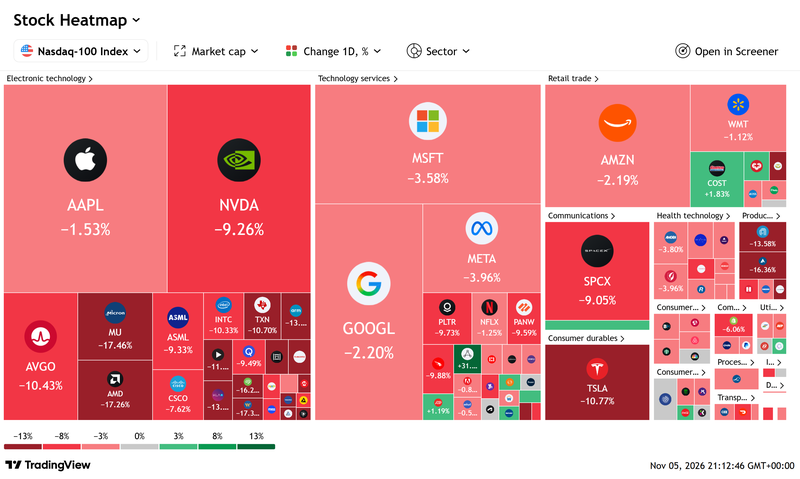
Figure 1. Nasdaq 100 Index Heatmap (5 November 2026). Source: Figure retrieved from TradingView.
Technical analysis of the Nasdaq futures contract
From a technical perspective, the Nasdaq contract retains its broader long-term bullish structure. However, a detailed examination of price action reveals notable shifts in underlying momentum:
- Trend Context: Over an extended horizon, the Nasdaq has exhibited a classic ascending structure defined by a succession of higher highs and higher lows. Nevertheless, a period of acute short-term selling pressure has driven the index below its 50-day, 100-day, and 200-day Simple Moving Averages (SMAs), signalling a potential momentum shift. Furthermore, current bearish price action has breached a prominent support level, potentially indicating a double-top pattern completion—a classic technical reversal signal.
- Momentum Indicators: The Moving Average Convergence Divergence (MACD) indicator reflects a downward trajectory accompanied by a contracting histogram, signalling that short-term selling pressure may persist. However, the Relative Strength Index (RSI) has entered oversold territory, suggesting caution regarding the immediate sustainability of the bearish momentum.
- Resistance Levels: Should the index regain bullish momentum, the initial key resistance level lies at 27,300 points (the double-top neckline), followed by secondary resistance at 28,119 points—a level that converges with the 200-day SMA.
- Support Levels: If short-term selling pressure intensifies, the next primary structural floor sits at 26,300 points, followed by the 25,000 mark—a psychological and technical zone that coincides with the Volume Profile's Point of Control (POC).
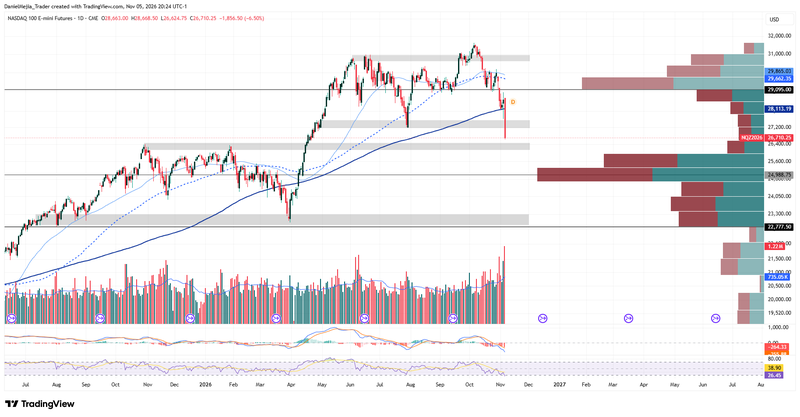
Figure 2. Nasdaq Futures Contract (2025–2026). Source: Data from the CME Exchange; author's analysis conducted via TradingView.