Help
Nvidia beats earnings forecasts, but higher yields are still holding back Nasdaq
Nvidia's earnings addressed at least one question the selloff in Nasdaq has raised. Heavy spending by the biggest cloud players on AI infrastructure is paying off, and Nvidia is capitalizing on it faster than expected.
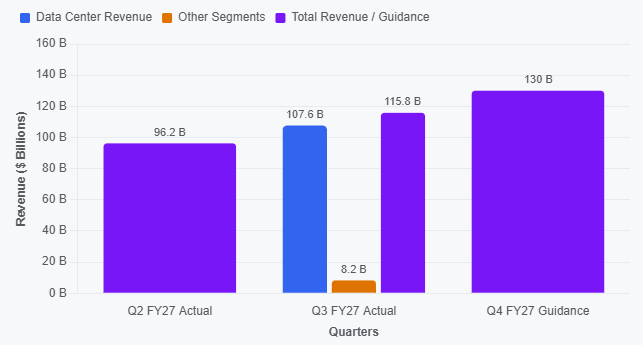
Nvidia’s quarterly revenue more than doubled to $115.8 billion, beating estimates of roughly $109 billion.
Anthropic’s IPO will test how much investors are willing to pay for AI growth in a higher-rate market.
The most supportive outcome for Nasdaq would be softer core inflation while spending holds up.
If Nasdaq remains below 28.000, selling pressure could continue toward 26,254.
Rubin gives Nvidia room to grow while cloud budgets are under scrutiny
Data center sales more than doubled and accounted for about 93% of the quarter’s revenues. First shipments of Nvidia’s Vera Rubin systems and continued growth of its Blackwell Ultra systems contributed to the increase.
Nvidia’s product transitions have benefitted from overlap, if customers are waiting to purchase the latest systems, the previous systems have benefitted from continued demand.
Nvidia expects revenues to grow 70%-75% next year. Management sees continuing tight budgets for data center spending and cautions that revenues may grow in line with those budgets.
Nvidia sells systems. Cloud providers then must keep those systems busy enough to justify the cost. Their ability to do that will determine the next round of purchases.
Source: Google
Nasdaq is looking beyond December
A quarter-point hike in December is largely priced in. Waller’s willingness to consider 50 basis points changes what investors have to account for after that meeting.
Even if the Fed raises rates by 25 basis points in December, another firm core inflation reading could bring a half-point move back into the discussion at a later meeting.
For equities, that means there’s now a greater risk the Fed tightens faster in 2027 and takes rates higher than investors had expected.
The timing makes that risk harder to absorb
Housing is already showing the effects of earlier hikes, if households start cutting spending while core inflation stays firm, the Fed could feel compelled to tighten into a slowdown. That would hit equities from both sides.
Analysts could cut earnings forecasts as demand weakens, while elevated Treasury yields leave investors willing to pay less for each dollar of those earnings.
Nasdaq is especially exposed because so much of its valuation depends on profits expected years from now. Rate-sensitive businesses could feel the impact sooner as financing costs rise and sales slow.
Nvidia’s results were enough to lift futures, but the broader selloff will be harder to reverse if markets keep pushing back the date of a Fed pause.
The most supportive outcome for equities would be softer core inflation while spending holds up. That would give the Fed room to pause before weaker demand starts showing up in earnings.
Anthropic’s IPO tests the other side of AI spending
Anthropic is expected to price its IPO on November 18, ahead of its planned November 19 Nasdaq listing, where it will trade under ANT.
Anthropic set an IPO range of $70- $78 per share, giving it a fully diluted valuation of approximately $1.4 trillion at the top of the range.
Nvidia is also among the companies taking part in the simultaneous $26 billion private placement. An above-range price would show that investors are willing to fund one of the largest buyers of AI computing power, despite the recent selloff.
The first couple of sessions will show whether public-market buyers are willing to pay a premium once the shares begin trading.
If Anthropic cannot maintain its offer price, the sector could see a more discerning market, where investors are willing to back companies that are currently funded by AI spending, but are unwilling to back companies that make that spending possible.
Technical outlook
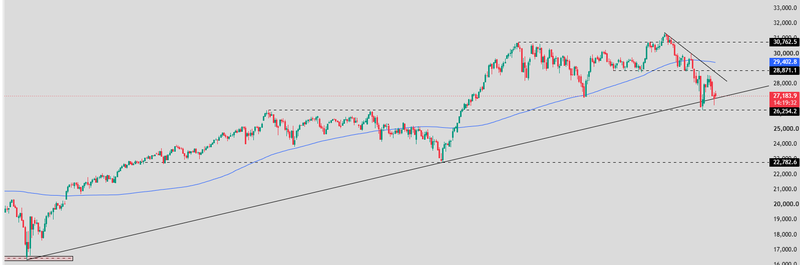
The Nasdaq is trading near 27,290 after extending its decline from the 31,000 regions. The index has broken below its moving average at 29,403 and the previous support at 28,871, reinforcing the recent shift toward lower highs and lower lows.
The latest selloff has brought prices back toward the long-term ascending trendline, which has supported the broader upward trend since the 17,000 regions. Although buyers have attempted to defend this area, the recovery remains limited, with the index struggling to regain momentum above 28,000.
The 26,254 level remains the most important support. A sustained break below it would weaken the broader bullish structure and increase the risk of a deeper correction toward 25,000, followed by 22,783.
Source: Trading view
Scenario ahead
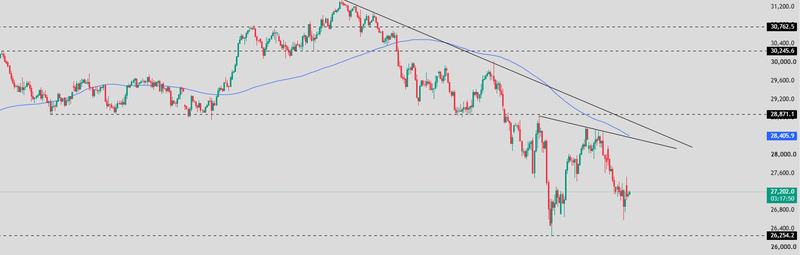
If Nasdaq remains below 28.000, selling pressure could continue toward 26,254. A sustained break below this support would increase the risk of further losses toward 25,500.
However, holding above 26,254 could encourage a technical rebound toward 28,000. However, a sustained break above 28,871 would be needed to improve the outlook and open the way toward 30,245.
Source: Trading view