
 Help
Help 
Nasdaq slides as AI spending doubts meet fed uncertainty
The Nasdaq has slipped into a deeper correction, falling nearly 11% from its recent highs as investors begin reassessing the two forces that have driven much of the market's rally over the past two years: the AI investment boom and expectations for Federal Reserve policy.
The Nasdaq has fallen around 11% as investors reduce exposure to high-growth technology stocks.
Semiconductor shares have come under pressure amid concerns over AI spending, rising infrastructure costs and increasing competition from China.
Fed left markets with little clarity on the path of interest rates, adding another layer of uncertainty.
AI optimism meets reality
The AI story itself hasn't changed. Businesses continue to invest aggressively in artificial intelligence, and demand for advanced computing power remains exceptionally strong. What has changed is how investors are evaluating those investments.
Building AI infrastructure has become increasingly expensive. Developing large language models requires enormous spending on advanced chips, networking equipment, power generation and data centers, with investments running into tens of billions of dollars across the industry's largest companies.
That spending has so far been rewarded because markets believed future revenue growth would comfortably justify today's costs.
Investors are becoming less certain
Rather than asking whether AI will transform the global economy, the market has started asking when those investments will begin producing returns that match the scale of capital being deployed. As valuations have climbed, that question has become increasingly difficult to ignore.
Chipmakers bear the brunt
That shift in thinking has been reflected most clearly across semiconductor shares. SOX has fallen by as much as 6% over several sessions, underperforming the broader technology sector as investors reassess earnings expectations for companies supplying AI infrastructure.
The concern extends well beyond chipmakers themselves
Companies such as Meta Platforms and Amazon remain among the world's largest buyers of AI hardware. If those firms begin slowing the pace of capital expenditure, the impact would quickly spread across the supply chain, affecting semiconductor manufacturers, networking companies, memory producers and equipment suppliers alike.
That is why weakness in semiconductor stocks often signals something larger than company-specific concerns. It reflects changing expectations for investment across the entire AI ecosystem.
Competition is adding another layer of uncertainty. Chinese semiconductor manufacturers continue investing heavily despite export restrictions, raising longer-term questions about pricing power and market share as domestic alternatives gradually improve.
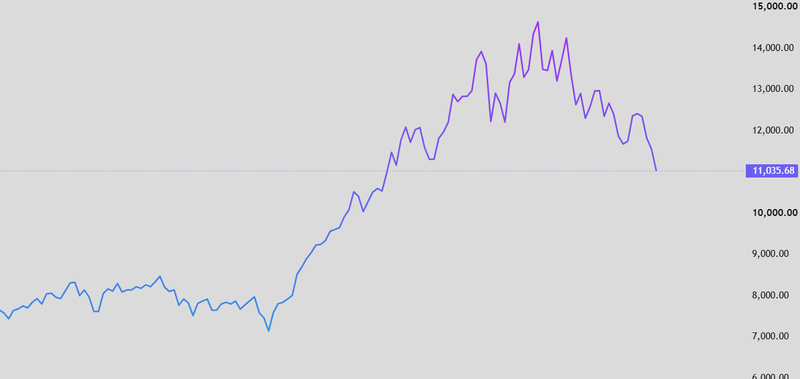
Source: Trading view
Investors question the AI funding cycle
Another debate is beginning to emerge across the technology sector. Much of today's AI ecosystem depends on the industry's largest companies continuing to spend aggressively. Cloud providers purchase advanced chips. Chip manufacturers expand production. Infrastructure companies build additional capacity.
Software developers launch increasingly complex AI services. As long as every participant continues investing, the cycle largely supports itself.
The risk is what happens if one part of that chain begins slowing
Should companies such as Meta or Amazon decide that investment has reached an appropriate level, expectations for future chip demand would likely be revised lower almost immediately. Revenue forecasts across much of the semiconductor industry would then come under pressure, forcing investors to reassess valuations that currently assume years of exceptional growth. The market is not pricing in a collapse in AI demand. It is beginning to price in a slower pace of expansion.
The Fed adds another source of uncertainty
At the same time, monetary policy has become less supportive. Markets entered the latest Federal Reserve meeting hoping for greater clarity on the direction of interest rates. Instead, policymakers largely maintained their data-dependent approach, offering few signals about whether the next move will be a rate cut, another hike or an extended pause.
For technology investors, that uncertainty matters
Growth stocks derive much of their value from earnings expected years into the future, making them particularly sensitive to changes in discount rates. Without greater confidence that borrowing costs will begin falling, investors become less willing to justify the premium valuations that have characterized much of the AI rally. The result has been a broader reduction in risk appetite rather than panic selling.
History suggests complacency can unwind quickly
History shows that periods of exceptionally low volatility can sometimes mask growing risks beneath the surface. In both 2015 and early 2018, markets appeared remarkably calm even as positioning became increasingly concentrated. When sentiment eventually shifted, volatility returned far more aggressively than many investors expected.
A similar pattern emerged in early 2020. Equity markets remained resilient while measures of tail risk quietly moved higher, only for volatility to surge once COVID-19 disrupted the global economy.
The current environment is different, and history rarely repeats itself in exactly the same way. Still, those episodes serve as a reminder that markets built around a single dominant investment theme can become vulnerable when investors begin questioning the assumptions behind that narrative.
Today, AI occupies a similar position within equity markets. The long-term opportunity remains widely accepted, but confidence in the pace of investment is no longer unquestioned.
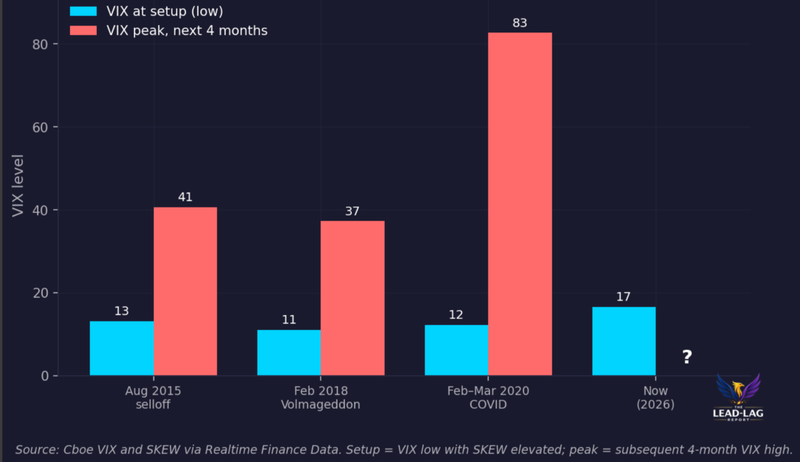
Source: Leadlag


